
What Is the Pipe Wall Thickness Calculator?
This tool estimates the minimum wall thickness a pipe needs to safely contain a given internal pressure. It uses Barlow formula, a widely used relationship in piping, pipeline, and pressure vessel engineering that links internal pressure, outside diameter, and the material allowable stress.
How to Use It
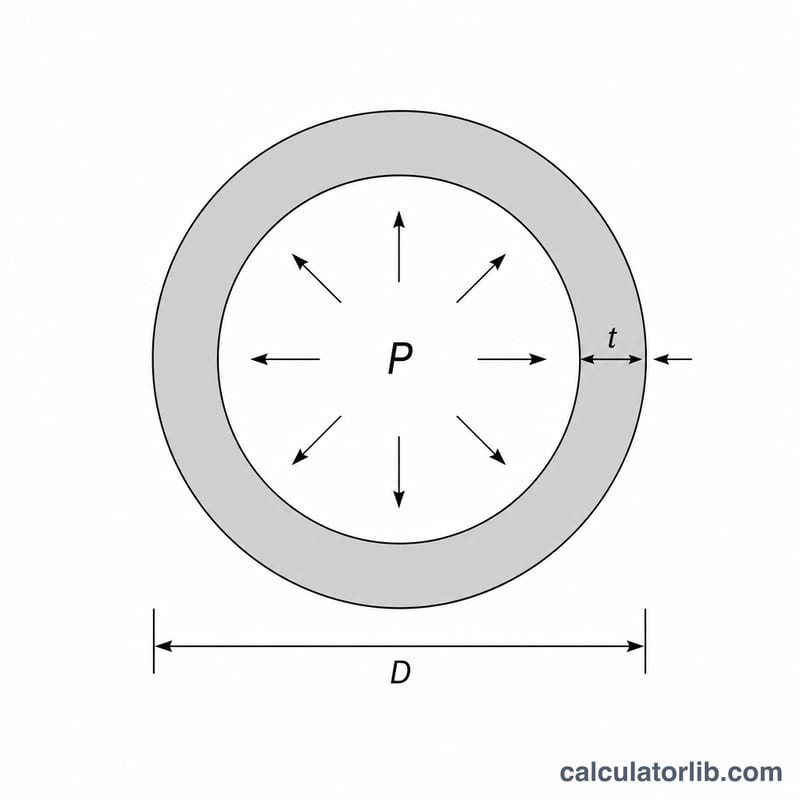
Enter the internal pressure P in psi, the pipe outside diameter D in inches, and the allowable (or yield) stress S of the pipe material in psi. The calculator returns the minimum wall thickness in both inches and millimetres. For a real design you should add a corrosion allowance, mill tolerance, and an appropriate safety/design factor to this minimum value.
The Formula Explained
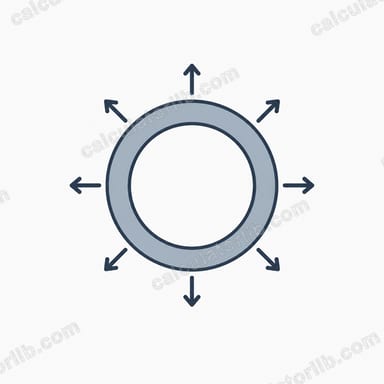
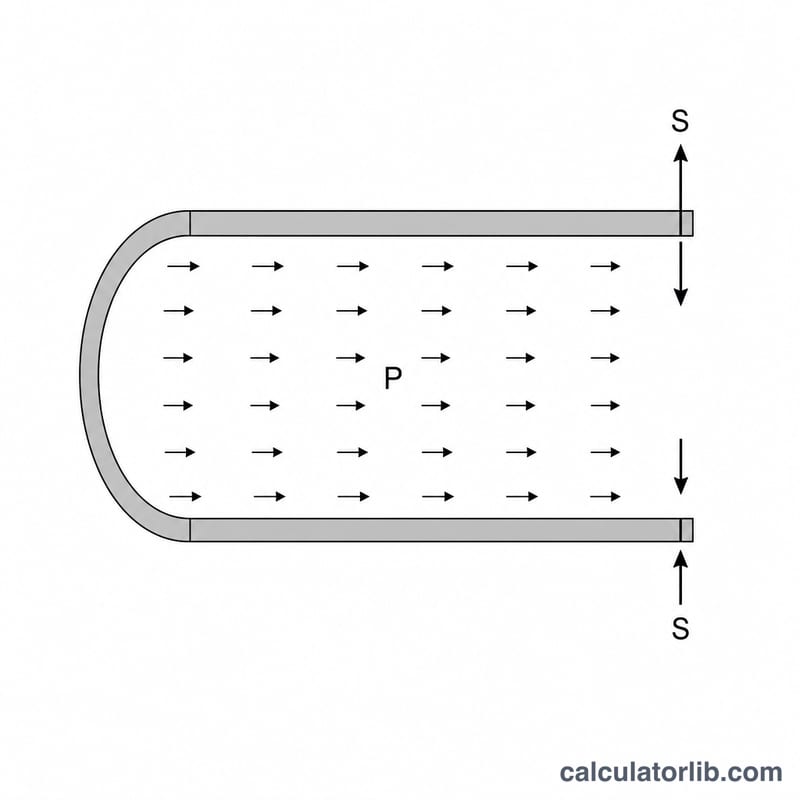
Barlow formula is $$t = \frac{P D}{2 S}$$ It comes from a simple hoop-stress balance on a thin-walled cylinder: the pressure pushing outward on a slice of pipe is resisted by the tension in the wall. Because it uses the outside diameter, Barlow formula is slightly conservative, which is why it is popular for quick checks. Rearranged, the maximum allowable pressure for a known thickness is $$P = \frac{2 S t}{D}$$
Worked Example
Suppose \(P = 1000\) psi, \(D = 10\) in, and \(S = 20000\) psi. Then $$t = \frac{1000 \times 10}{2 \times 20000} = \frac{10000}{40000} = 0.25 \text{ in}$$ which is \(0.25 \times 25.4 = 6.35\) mm. So the bare minimum wall thickness is a quarter inch before any allowances.
FAQ
Does this include a safety factor? No. The allowable stress S you enter should already incorporate your code-based design factor. The result is a theoretical minimum.
Inside or outside diameter? Barlow formula uses the outside diameter, which makes it slightly conservative.
What value should I use for S? Use the allowable stress from your governing code (for example a fraction of the material yield or ultimate strength) rather than the raw yield value.