
What Is Hoop Stress?
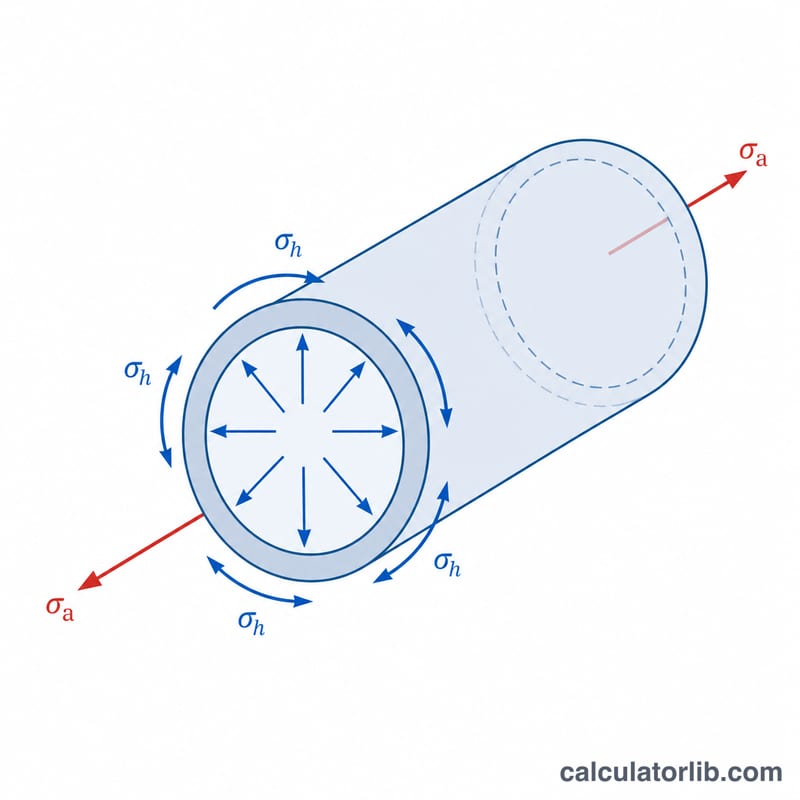
Hoop stress (also called circumferential stress) is the tensile stress that acts around the circumference of a cylindrical pressure vessel or pipe wall when it is pressurized internally. For thin-walled pipes — where the wall thickness is small compared with the diameter (roughly \(D/t > 20\)) — the stress is assumed uniform through the wall and is given by the simple relationship \(\sigma = PD / 2t\). This calculator returns both the hoop stress and the axial (longitudinal) stress, which for a closed cylinder is exactly half the hoop value.
How to Use It
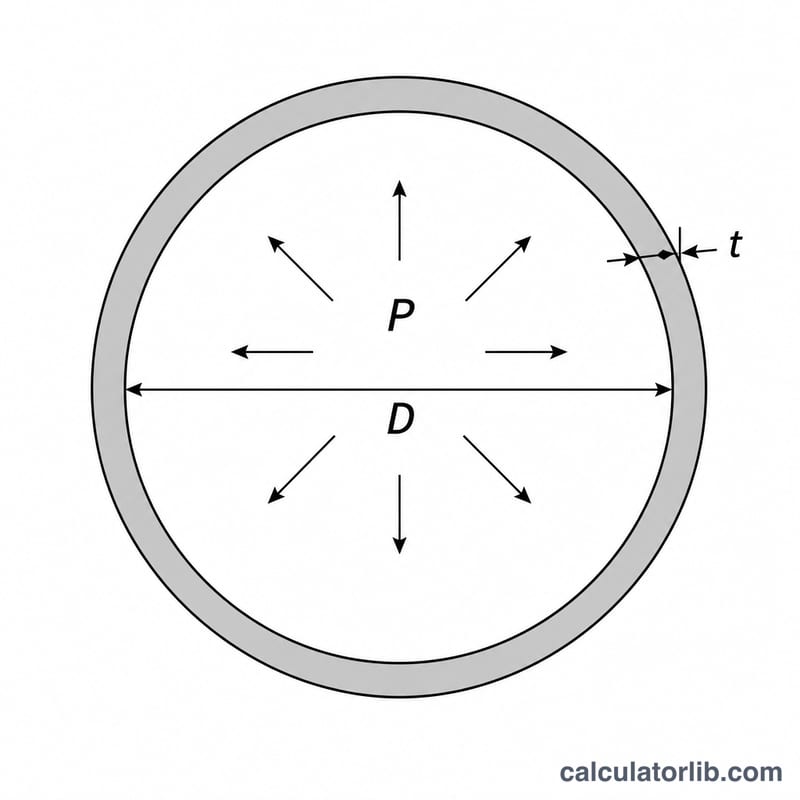
Enter the internal gauge pressure P, the inner diameter D, and the wall thickness t. Keep your units consistent: if you use pressure in MPa (N/mm²) with diameter and thickness in millimetres, the resulting stress is in MPa. The calculator then divides P·D by 2t for hoop stress and by 4t for axial stress.
The Formula Explained
The thin-wall hoop formula comes from a force balance on a half-section of the pipe: the pressure acting on the projected area (P·D per unit length) must be resisted by the wall material on the two cut edges (2·t·σ). Solving gives $$\sigma_h = \frac{\text{Pressure }P \cdot \text{Diameter }D}{2 \cdot \text{Thickness }t}$$ The axial stress comes from the pressure on the end caps \(\left(P \cdot \pi D^2/4\right)\) resisted by the annular wall area \(\left(\pi D \cdot t\right)\), giving $$\sigma_a = \frac{\text{Pressure }P \cdot \text{Diameter }D}{4 \cdot \text{Thickness }t}$$
Worked Example
A pipe carries P = 5 MPa with an inner diameter D = 500 mm and wall thickness t = 10 mm. $$\text{Hoop stress} = \frac{5 \times 500}{2 \times 10} = \frac{2500}{20} = 125 \text{ MPa}$$ $$\text{Axial stress} = \frac{5 \times 500}{4 \times 10} = 62.5 \text{ MPa}$$ Both are well below the yield strength of typical structural steel (~250 MPa), so the design has a comfortable margin before adding a safety factor.
FAQ
When is the thin-wall assumption valid? Generally when the diameter-to-thickness ratio is greater than about 20. For thicker walls use the Lamé (thick-wall) equations instead.
Should I use inner, mean or outer diameter? The classic formula uses inner diameter, but using mean diameter gives a slightly more accurate result for moderately thick walls.
Why is hoop stress twice the axial stress? Because the geometry resists axial load over a larger effective wall area than it resists the circumferential bursting load — leading to the 2:1 ratio that explains why pressurized pipes tend to split lengthwise.