
What is the Pipe Flow Calculator?
This calculator finds the volumetric flow rate of a fluid moving through a round pipe. Given the pipe's inner diameter and the average flow velocity, it returns how much volume passes a cross-section each second, expressed in cubic metres per second (m³/s), litres per second (L/s) and cubic metres per hour (m³/h). It is a universal physics tool that applies to water, oil, air and any incompressible fluid in any country.
How to use it
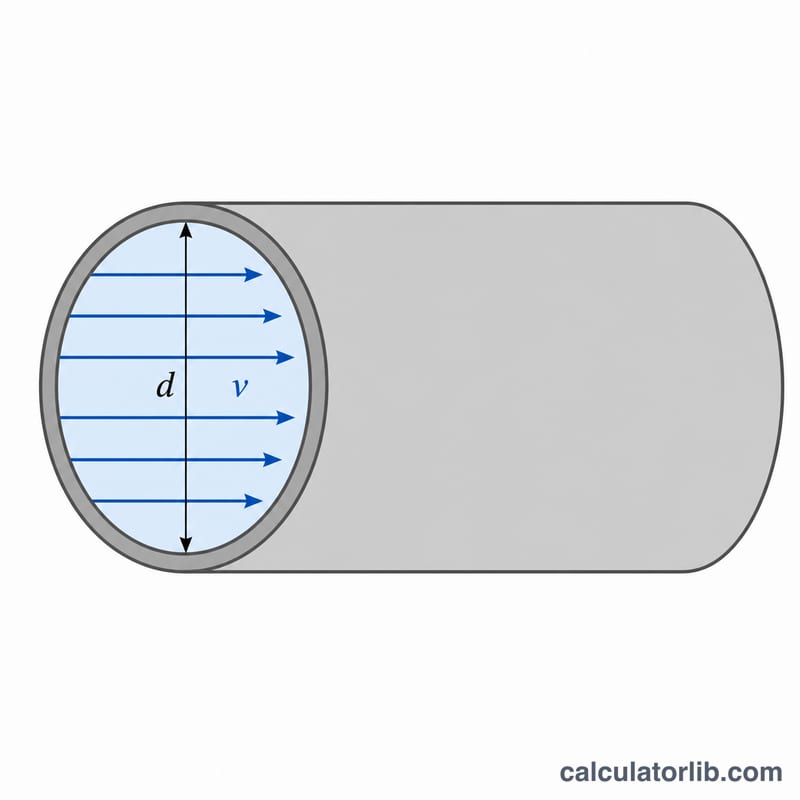
Enter the pipe's inner diameter in metres (not the nominal or outer size) and the average flow velocity in metres per second. The calculator computes the circular cross-sectional area, multiplies it by the velocity, and converts the result to several common units.
The formula explained
The flow rate is the product of the cross-sectional area and the average velocity:
$$Q = A \times v$$ where $$A = \frac{\pi}{4} \times d^{2}$$
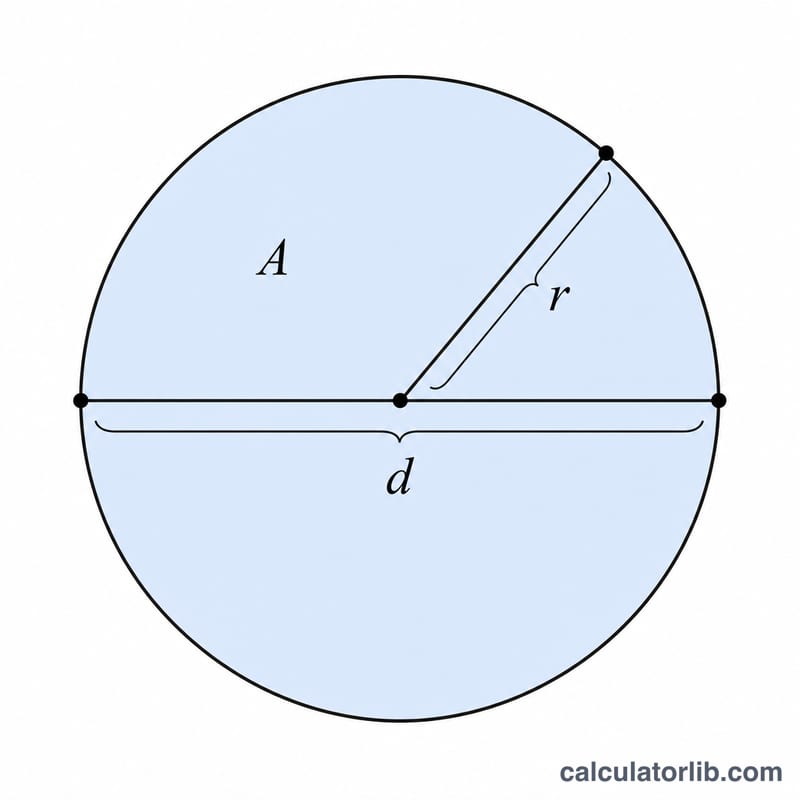
Here \(Q\) is the volumetric flow rate (m³/s), \(A\) is the pipe's internal area (m²), \(d\) is the inner diameter (m), and \(v\) is the average velocity (m/s). The \(\frac{\pi}{4} \cdot d^{2}\) term is simply the area of a circle written using the diameter instead of the radius.
Worked example
Suppose a pipe has an inner diameter of 0.1 m and the fluid flows at 2 m/s. The area is $$A = \frac{\pi}{4} \times 0.1^{2} = 0.0078539816 \text{ m}^{2}$$ The flow rate is $$Q = 0.0078539816 \times 2 = 0.0157079633 \text{ m}^{3}/\text{s}$$ which equals about 15.71 L/s or 56.55 m³/h.
FAQ
Should I use inner or outer diameter? Always use the inner (bore) diameter — that is the space the fluid actually flows through.
Does this account for friction or pressure drop? No. This is a continuity-based flow rate (\(Q = A \cdot v\)). It does not model head loss; use the Hazen-Williams or Darcy-Weisbach equations for that.
How do I convert to gallons or other units? 1 m³/s equals 1000 L/s; multiply L/s by 0.2642 for US gallons per second, or by 15.85 for US gallons per minute.