
What it is
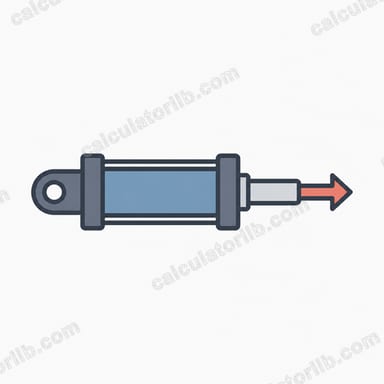
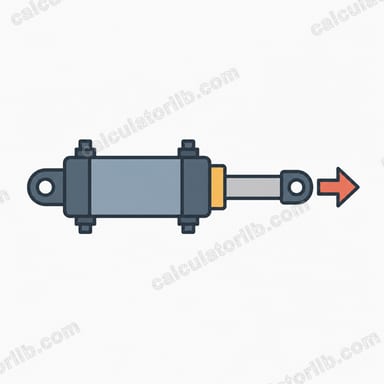
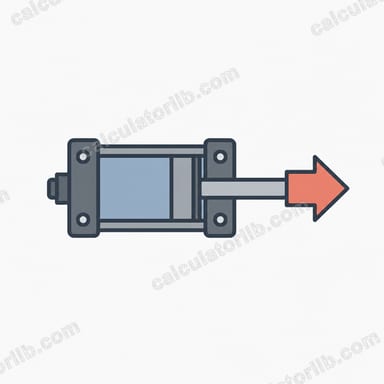
A pneumatic cylinder force calculator works out the theoretical force an air cylinder can deliver from the supplied air pressure and the cylinder bore diameter. The same physics applies everywhere, so this tool is universal — pick whatever pressure unit (bar, psi or kPa) your gauge shows.
How to use it
Enter the air pressure and choose its unit, then enter the cylinder bore diameter in millimetres. For the retract (pull) force, also enter the piston rod diameter — the rod takes up part of the piston face, reducing the effective area on the rod side. Leave rod at 0 to ignore pull force.
The formula explained
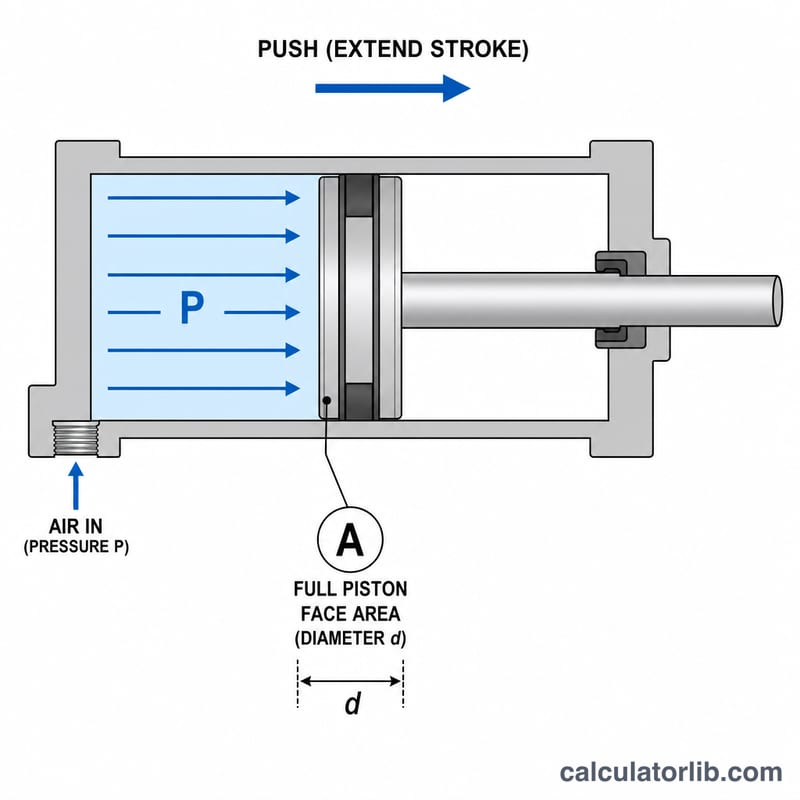
Force equals pressure times area: \(F = P \times A\). The piston face is a circle, so its area is \(A = \frac{\pi}{4} \cdot d^{2}\). On extension the full bore area is used. On retraction the rod's cross-section is subtracted, giving the annular area \(A = \frac{\pi}{4}(d^{2} - d_{r}^{2})\). Convert pressure to pascals (1 bar = 100,000 Pa, 1 psi ≈ 6894.76 Pa, 1 kPa = 1000 Pa) and area to square metres, and the result is in newtons.
$$F_{push} = P \cdot \frac{\pi}{4}\,D^{2} \qquad F_{pull} = P \cdot \frac{\pi}{4}\left(D^{2} - d^{2}\right)$$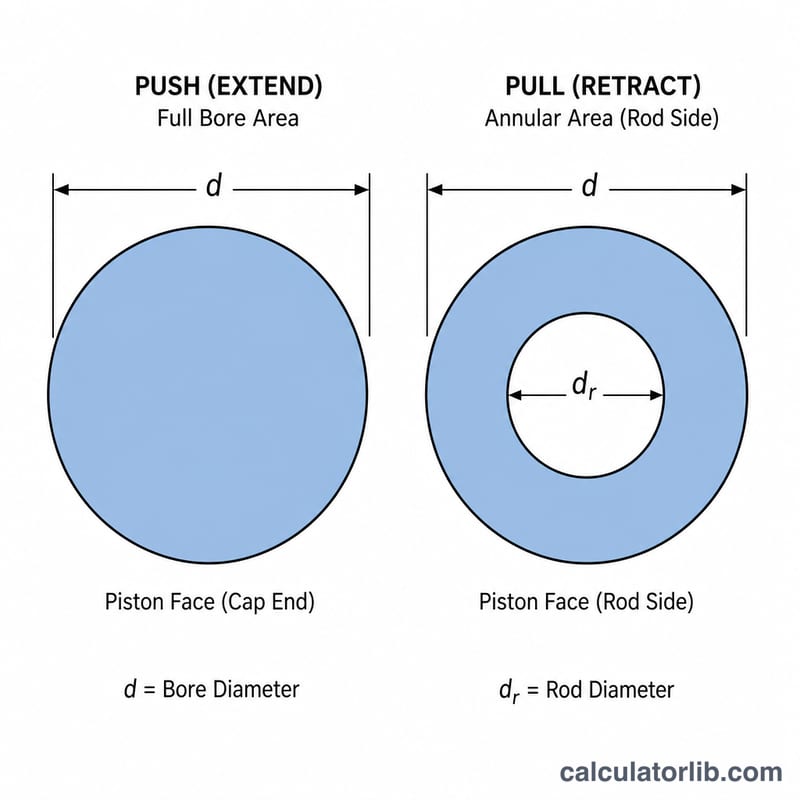
Worked example
A cylinder with a 50.8 mm bore at 100 psi:
$$P = 100 \times 6894.757 = 689{,}475.7\ \text{Pa}$$$$A = \frac{\pi}{4}(0.0508)^{2} = 0.0020268\ \text{m}^{2}$$$$F = 689{,}475.7 \times 0.0020268 \approx 1397.45\ \text{N}$$A larger 2.5× bore equivalent area scales the force proportionally.
FAQ
Is this the real working force? No — it is the theoretical static force. Real output is lower due to seal friction (typically 3–10% loss) and any back-pressure on the exhaust side.
Why is pull force lower than push force? The piston rod occupies part of the piston area on the rod side, so less area is exposed to pressure during retraction.
Which unit should I use? Use whatever your regulator gauge reads; the calculator converts internally to pascals.