
What Is the Prandtl Number?
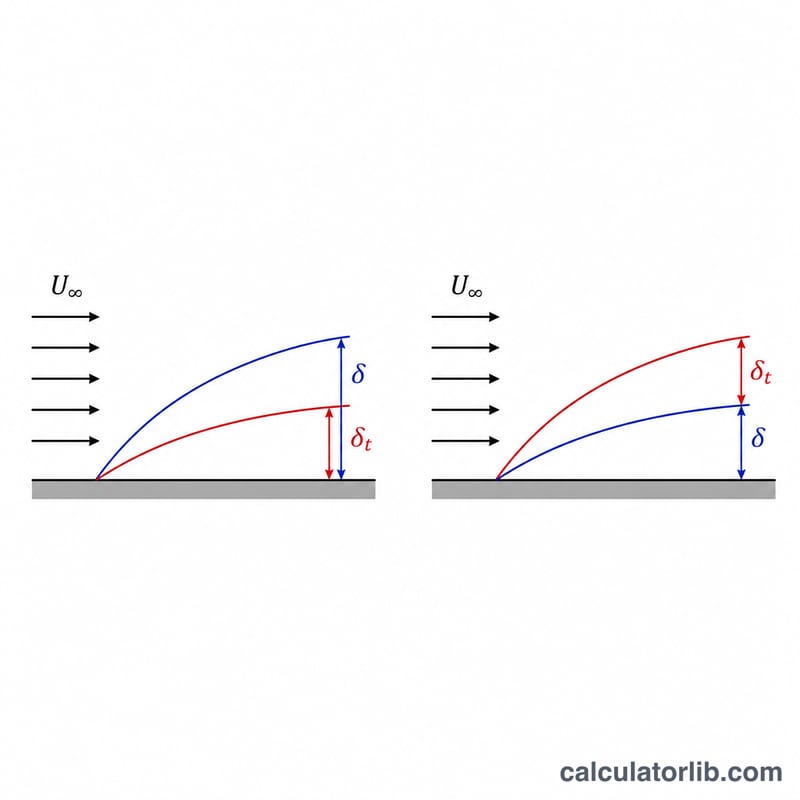
The Prandtl number (Pr) is a dimensionless quantity in fluid mechanics and heat transfer that represents the ratio of momentum diffusivity (kinematic viscosity) to thermal diffusivity. It characterizes how heat and momentum diffuse relative to each other within a fluid. A low Prandtl number (e.g. liquid metals ≈ 0.01) means heat diffuses much faster than momentum, while a high Prandtl number (e.g. oils > 100) means momentum diffuses faster than heat. For air it is roughly 0.7 and for water near 7.
How to Use This Calculator
Enter the fluid's specific heat capacity at constant pressure (cp, in J/kg·K), its dynamic viscosity (μ, in Pa·s), and its thermal conductivity (k, in W/m·K). The calculator instantly returns the dimensionless Prandtl number. Make sure all inputs use consistent SI units so the result is properly dimensionless.
The Formula Explained
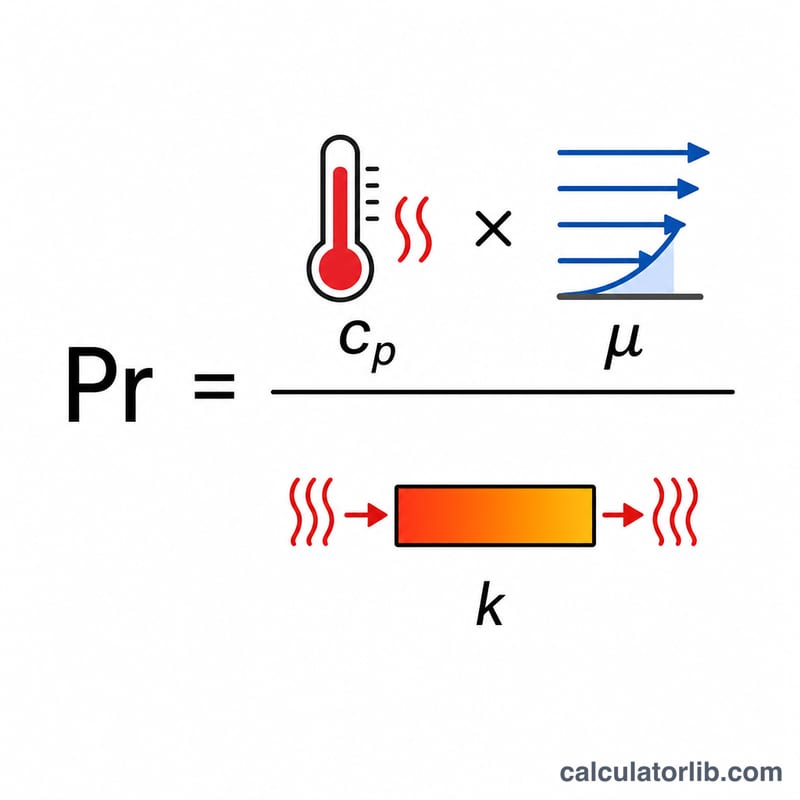
The Prandtl number is defined as $$\text{Pr} = \frac{c_p \cdot \mu}{k}$$ Here \(c_p \cdot \mu\) captures how momentum is transported (and stored as thermal energy capacity), while \(k\) captures how readily heat conducts through the fluid. Because the units of \(c_p \cdot \mu\) (J/kg·K × Pa·s = W·s/(m·K) per unit... ) divide cleanly by those of \(k\), the result carries no units.
Worked Example
For air at about 25 °C: \(c_p = 1005\ {\text{J/kg}\cdot\text{K}}\), \(\mu = 1.825 \times 10^{-5}\ {\text{Pa}\cdot\text{s}}\), \(k = 0.0257\ {\text{W/m}\cdot\text{K}}\). Then $$\text{Pr} = \frac{1005 \times 0.00001825}{0.0257} = \frac{0.0183413}{0.0257} \approx 0.7136$$ This matches the well-known value of ~0.71 for air.
FAQ
Is the Prandtl number temperature dependent? Yes — cp, μ, and k all vary with temperature, so Pr changes accordingly. Always use property values at your operating temperature.
Why is the Prandtl number important? It links velocity and thermal boundary layers and appears in correlations for the Nusselt number, governing convective heat transfer.
What is a typical range? Liquid metals ~0.004–0.03, gases ~0.7–1.0, water ~1.7–13, and viscous oils can exceed 1000.