
What Is the Resultant Force Calculator?
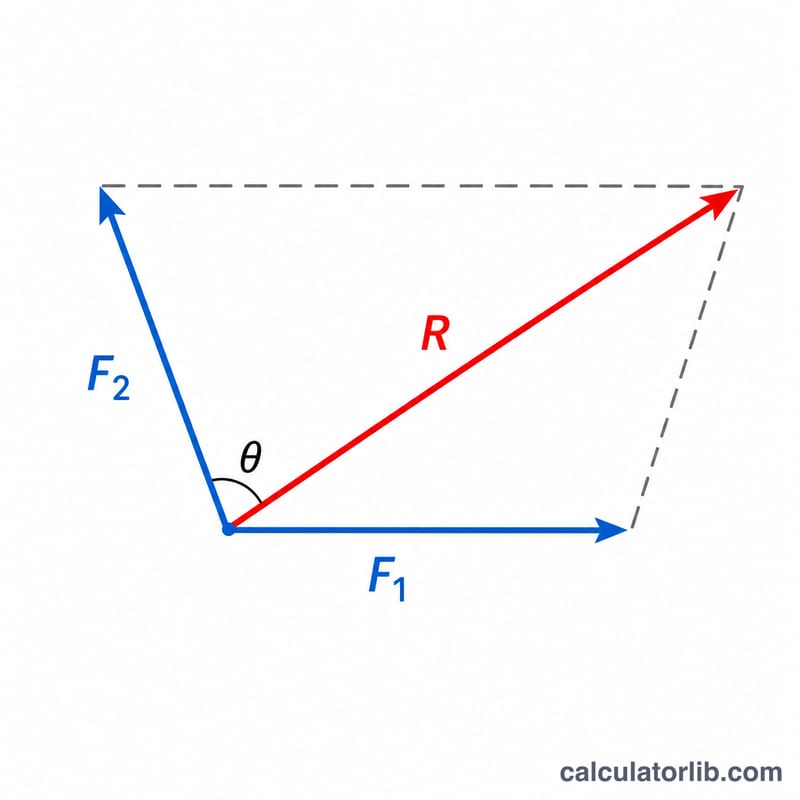
When two forces act on the same point at an angle to each other, they can be replaced by a single equivalent force called the resultant. This calculator uses the parallelogram law of vector addition to find both the magnitude and direction of that resultant force from two input forces and the angle between them. It applies universally in physics and engineering — no country-specific rules.
How to Use It
Enter the magnitude of Force 1 and Force 2 in newtons, then enter the angle between them in degrees (0° means they point the same way, 180° means they oppose). The calculator returns the resultant magnitude in newtons and its direction measured from Force 1.
The Formula Explained
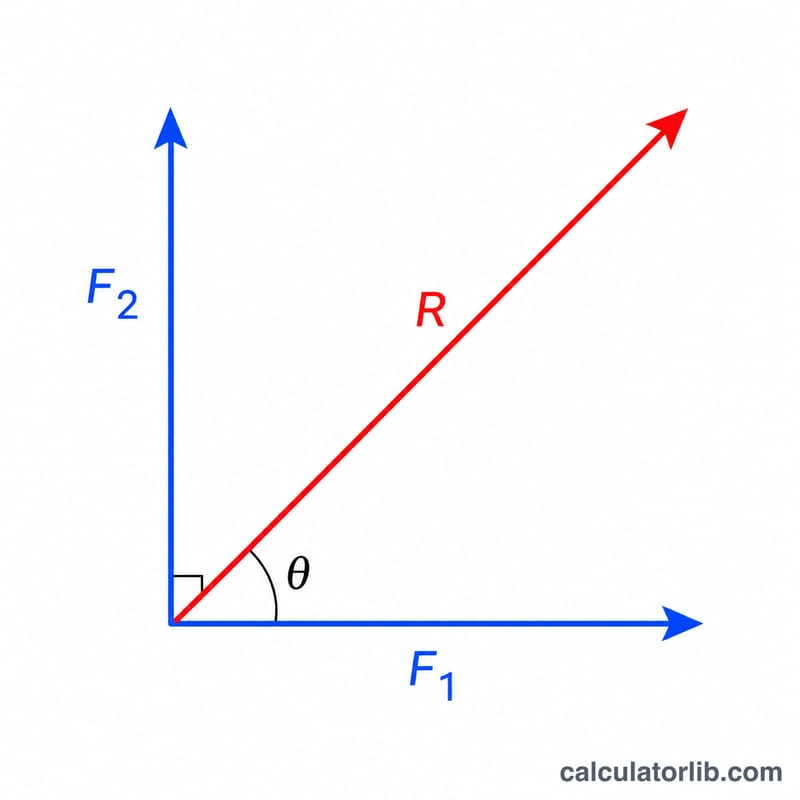
The magnitude is given by $$R = \sqrt{\text{F}_1^{2} + \text{F}_2^{2} + 2\,\text{F}_1\,\text{F}_2\cos\theta}$$, which follows from the law of cosines applied to the parallelogram of forces. The direction relative to Force 1 is $$\varphi = \tan^{-1}\!\left(\frac{\text{F}_2\sin\theta}{\text{F}_1 + \text{F}_2\cos\theta}\right)$$. When \(\theta = 90^\circ\), \(\cos\theta = 0\) and the formula simplifies to the familiar Pythagorean form \(R = \sqrt{\text{F}_1^{2} + \text{F}_2^{2}}\).
Worked Example
Suppose \(\text{F}_1 = 30\,\text{N}\) and \(\text{F}_2 = 40\,\text{N}\) act at \(90^\circ\). Then $$R = \sqrt{900 + 1600 + 0} = \sqrt{2500} = 50\,\text{N}.$$ The direction is \(\tan^{-1}\!\left(\frac{40\cdot 1}{30 + 0}\right) = \tan^{-1}(1.333) \approx 53.13^\circ\) from Force 1.
FAQ
What if the angle is 0°? The forces add directly: \(R = \text{F}_1 + \text{F}_2\) and the direction is \(0^\circ\).
What about 180°? The forces subtract: \(R = |\text{F}_1 - \text{F}_2|\), acting along the larger force.
Can I use other units? Yes — the formula is unit-independent. Use any consistent force unit and the resultant will be in that same unit.