
What This Calculator Does
This tool computes the sum of an arithmetic series (also called an arithmetic progression) when you already know how many terms there are, the value of the first term, and the value of the last term. Instead of adding every term by hand, you supply three numbers and get the total instantly.
How to Use It
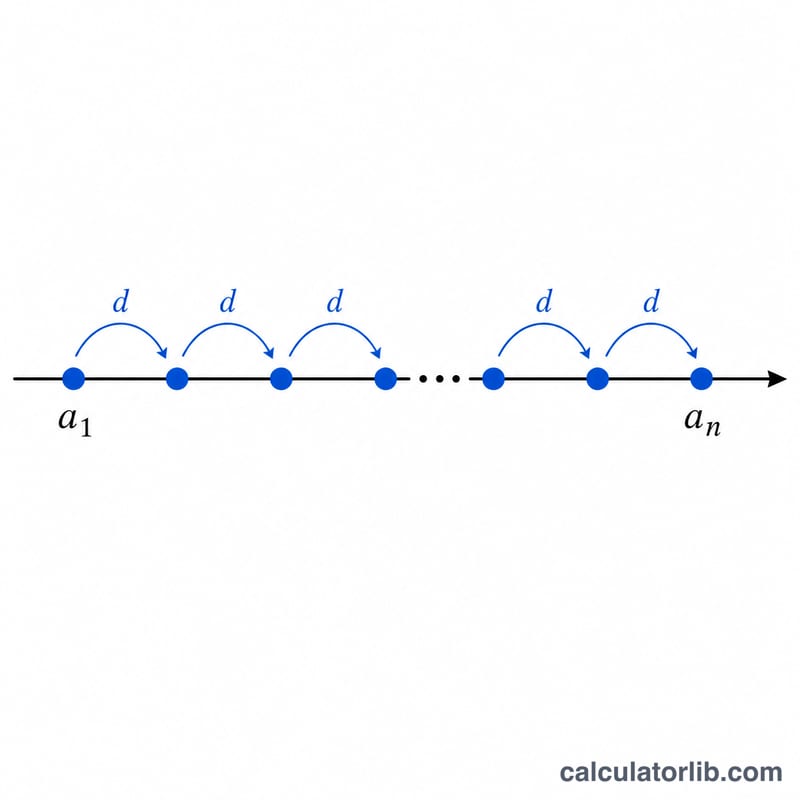
Enter the number of terms n, the first term a₁, and the last term aₙ. Click calculate to see the sum. The result table also shows the average term, which is simply the midpoint of the first and last values — a handy intuition for why the formula works.
The Formula Explained
The sum is given by:
$$S_n = \frac{n(a_1 + a_n)}{2}$$
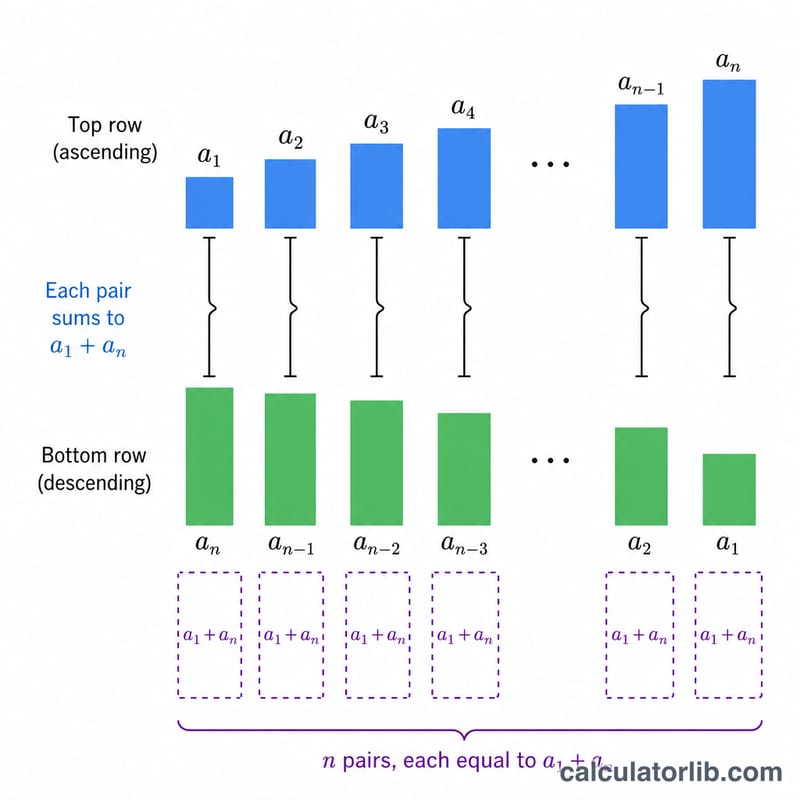
The idea, attributed to a young Carl Friedrich Gauss, is that pairing the first and last terms, the second and second-to-last, and so on, each pair sums to the same value \((a_1 + a_n)\). There are \(n/2\) such pairs, giving \(n(a_1 + a_n)/2\). Because every term is evenly spaced, the average of all terms equals the average of just the endpoints, and the sum is that average multiplied by the count of terms.
Worked Example
Consider the series 1, 3, 5, 7, ..., 19. Here \(n = 10\), \(a_1 = 1\), and \(a_n = 19\). The sum is:
$$S = \frac{10 \times (1 + 19)}{2} = \frac{10 \times 20}{2} = 10 \times 10 = 100$$
Adding the ten odd numbers directly (1+3+5+7+9+11+13+15+17+19) also gives 100, confirming the formula.
Definitions & Glossary
- Arithmetic series / arithmetic progression
- The sum of the terms of an arithmetic sequence — a list of numbers in which each term differs from the previous one by a fixed amount. The sequence itself (1, 4, 7, 10, …) is the progression; the added total (1 + 4 + 7 + 10) is the series.
- n — number of terms
- How many terms are being added together. It must be a positive whole number; in \(S_n = \frac{n}{2}(a_1 + a_n)\), it scales the sum.
- a₁ — first term
- The starting value of the sequence, the term where the addition begins.
- aₙ — last term
- The final term being included in the sum (the \(n\)th term). Together with \(a_1\), it sets the range of values added.
- d — common difference
- The constant amount added to move from one term to the next, \(d = a_{k+1} - a_k\). It can be found from the endpoints as \(d = \frac{a_n - a_1}{n - 1}\). A positive \(d\) gives an increasing sequence; a negative \(d\) a decreasing one.
- Average term
- The mean of all the terms, equal to \(\frac{a_1 + a_n}{2}\) (also \(\frac{S_n}{n}\)). Because the terms are evenly spaced, the average is simply the midpoint of the first and last terms, which is why \(S_n = n \times \text{(average term)}\).
FAQ
Do the terms have to be integers? No. The formula works for any arithmetic sequence, including decimals and negatives, as long as the spacing between consecutive terms is constant.
What if I do not know the last term? If you know the common difference \(d\) instead, compute \(a_n = a_1 + (n - 1)d\) first, then use this calculator — or use the equivalent form \(S_n = \frac{n}{2}\left[2a_1 + (n - 1)d\right]\).
Can n be a decimal? In a true sequence \(n\) is a positive whole number (the count of terms). The calculator will still evaluate the arithmetic, but use a whole number for meaningful results.