

What this calculator does
The Sum of Special Series (Σ) Calculator evaluates the sum of the first n terms of a chosen "special" sequence using its exact closed-form summation formula. Instead of adding terms one by one, it applies a known identity, so the answer is exact and instant even for large n. This is a pure-mathematics tool that works identically anywhere — no units, no jurisdiction.
The seven series
You can pick any of these term expressions summed from k = 1 to n:
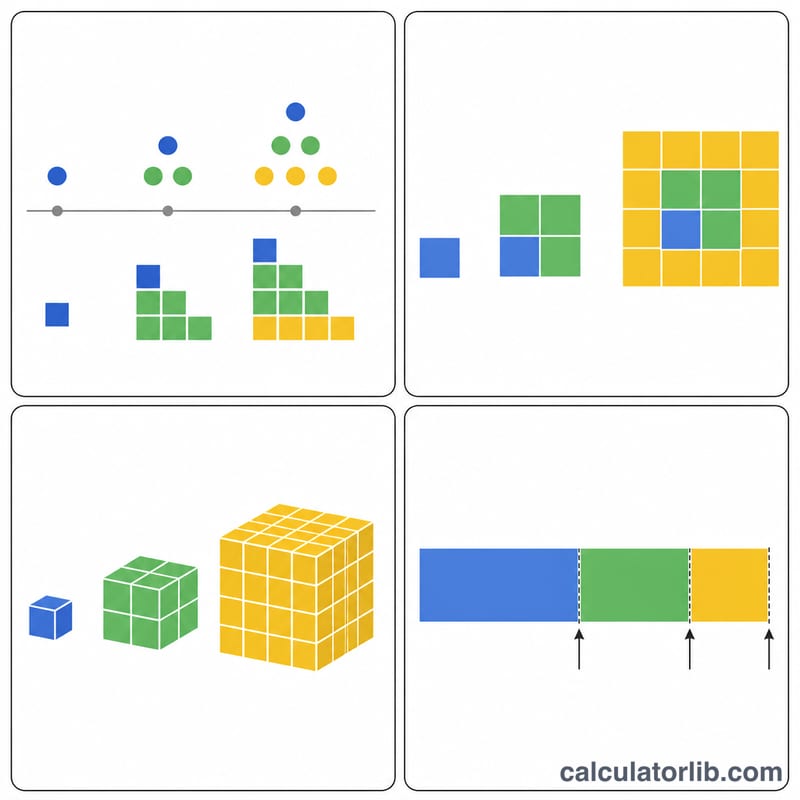
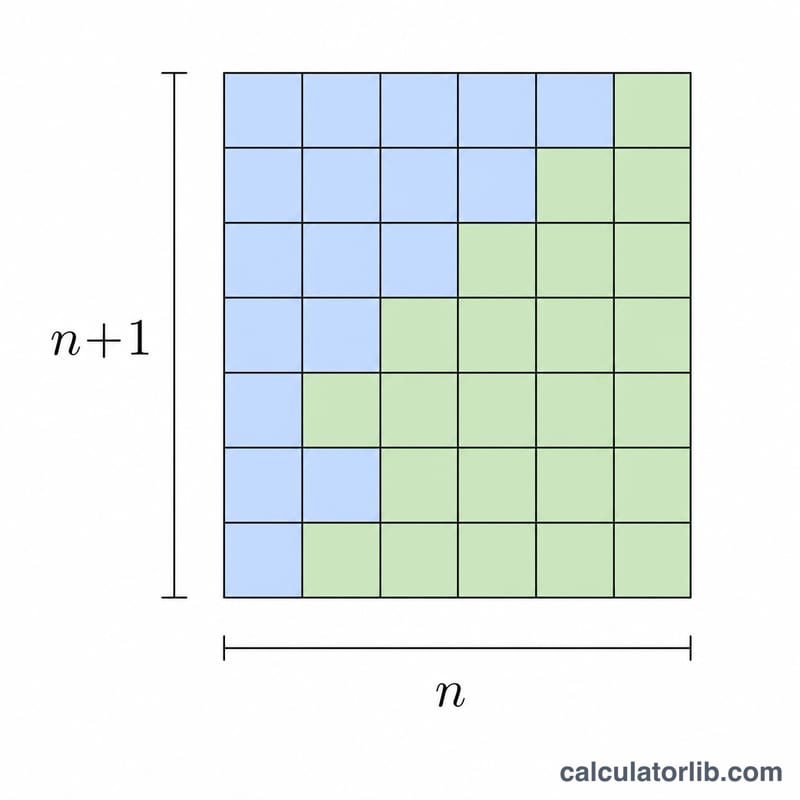
\(\sum_{k=1}^{n} k = \frac{n(n+1)}{2}\); \(\sum_{k=1}^{n} k^2 = \frac{n(n+1)(2n+1)}{6}\); \(\sum_{k=1}^{n} k^3 = \frac{n^2(n+1)^2}{4}\); \(\sum_{k=1}^{n} k(k+1) = \frac{n(n+1)(n+2)}{3}\); \(\sum_{k=1}^{n} \frac{1}{k(k+1)} = \frac{n}{n+1}\); \(\sum_{k=1}^{n} k(k+1)(k+2) = \frac{n(n+1)(n+2)(n+3)}{4}\); and \(\sum_{k=1}^{n} \frac{1}{k(k+1)(k+2)} = \frac{n(n+3)}{4(n+1)(n+2)}\).
The first, second, third, fourth and sixth give whole-number results; the fifth and seventh are telescoping series whose sums lie strictly between 0 and 1.
How to use it
Select a series from the dropdown, enter the number of terms n (a positive integer: 1, 2, 3 …), choose how many significant figures to display, and read off the sum. The precision selector is purely cosmetic — the underlying closed forms are mathematically exact.
Worked example
Choose Σ k³ with n = 9. The formula gives $$9^2 \times 10^2 / 4 = 81 \times 100 / 4 = 8100 / 4 = 2025.$$ This matches the classic identity \(1^3 + 2^3 + \cdots + 9^3 = 2025\).
FAQ
Why use a formula instead of adding? Closed forms are O(1) — instant and exact regardless of how large n is, with no rounding from long addition.
What if n is not a positive integer? The summation index k runs over positive integers, so n is coerced to the nearest integer of at least 1.
Why are options 5 and 7 less than 1? They are telescoping series whose partial sums approach 1 (for \(\frac{1}{k(k+1)}\)) or \(\frac{1}{4}\) (for \(\frac{1}{k(k+1)(k+2)}\)) but never reach the limit for finite n.