
What this calculator does
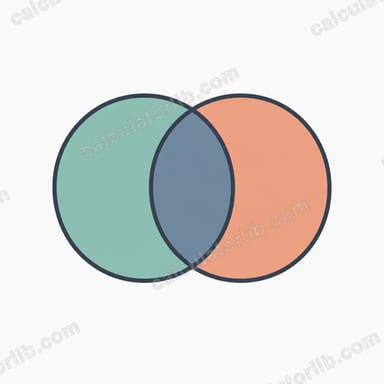
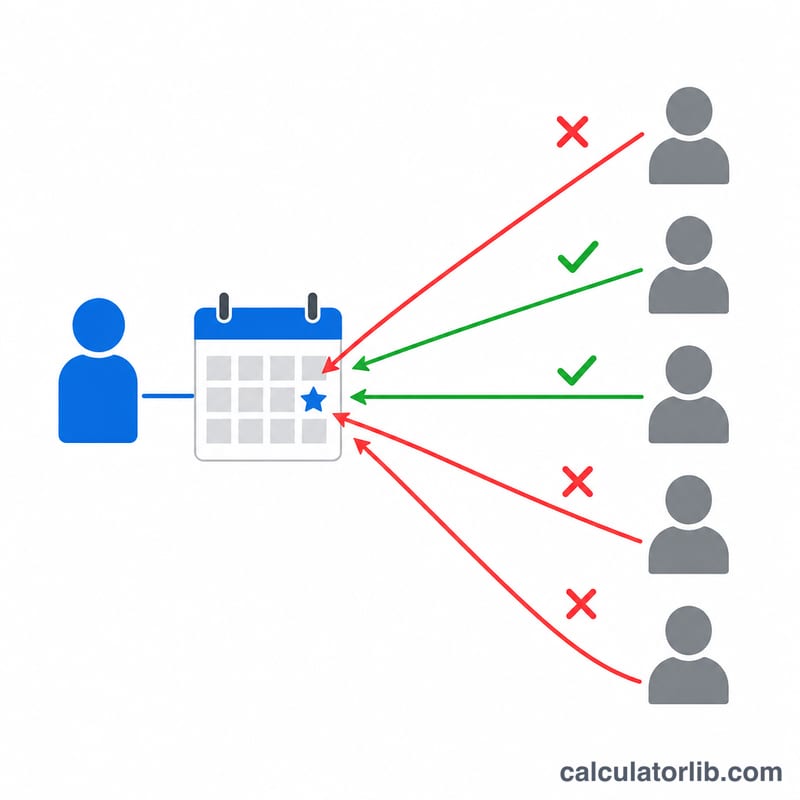
This tool answers a specific question: in a group of n people that includes you, what is the probability that at least one of the other people has the same birthday as you? This is the "matches my birthday" version of the birthday problem. It is deliberately different from the famous birthday paradox, which asks whether any two people in a room share a birthday. That classic version reaches 50% at just 23 people, but matching one specific (your) birthday is much harder and needs about 254 people to cross 50%.
How to use it
Enter the group size including yourself. The calculator counts the other n − 1 people, treats the year as 365 equally likely days (leap-year Feb 29 is ignored), and computes the chance that at least one of them lands on your exact birthday.
The formula explained
Each other person has a \(\frac{364}{365}\) chance of not sharing your birthday. Assuming independence, the chance that none of the n − 1 others matches is \(\left(\frac{364}{365}\right)^{n-1}\). Therefore the chance that at least one matches is:
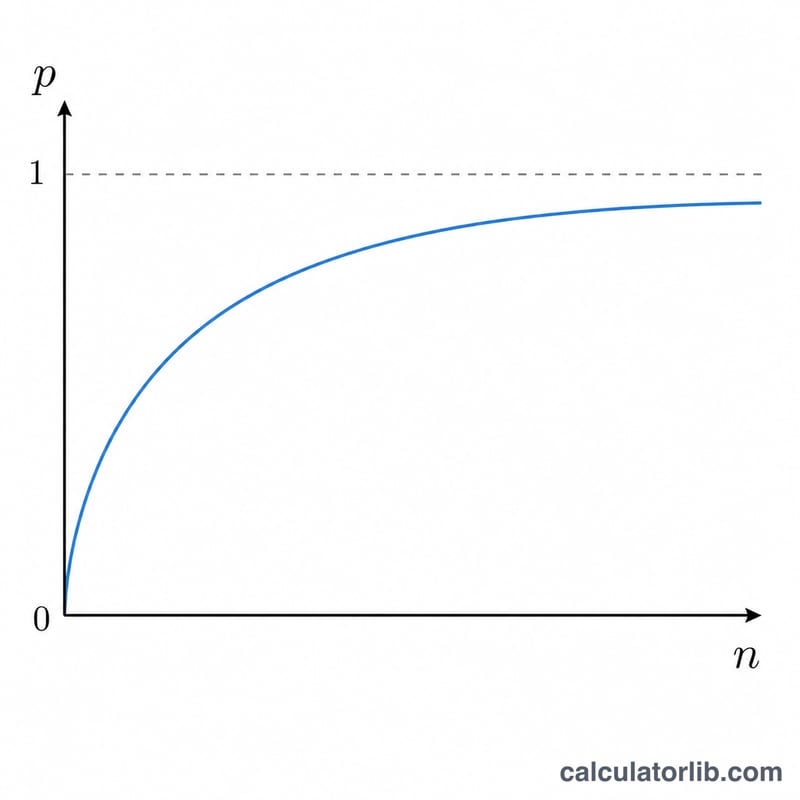
$$p(n) = 1 - \left(\frac{364}{365}\right)^{n-1}$$ expressed as a percentage by multiplying by 100. The exponent is n − 1 because you never compare yourself with yourself — only the other people can match your fixed date.
Worked example
For a group of 30 people, there are 29 others. \(\left(\frac{364}{365}\right)^{29} = 0.92352\), so $$p = 1 - 0.92352 = 0.07648 = \text{about } 7.65\%$$ So in a room of 30 (including you), there is roughly a 7.65% chance that someone else shares your exact birthday.
FAQ
Why isn't this 50% at 23 people? Because 23 is the answer to a different question — whether any pair matches. Matching your specific date is far rarer; you need roughly 254 people to reach 50%.
Can it ever reach 100%? Not exactly — the probability approaches 100% asymptotically. You would need around 42,220 people for the displayed value to round to 100%.
What about leap years? Feb 29 is ignored; the model uses exactly 365 equally likely days for simplicity.