
What this calculator does
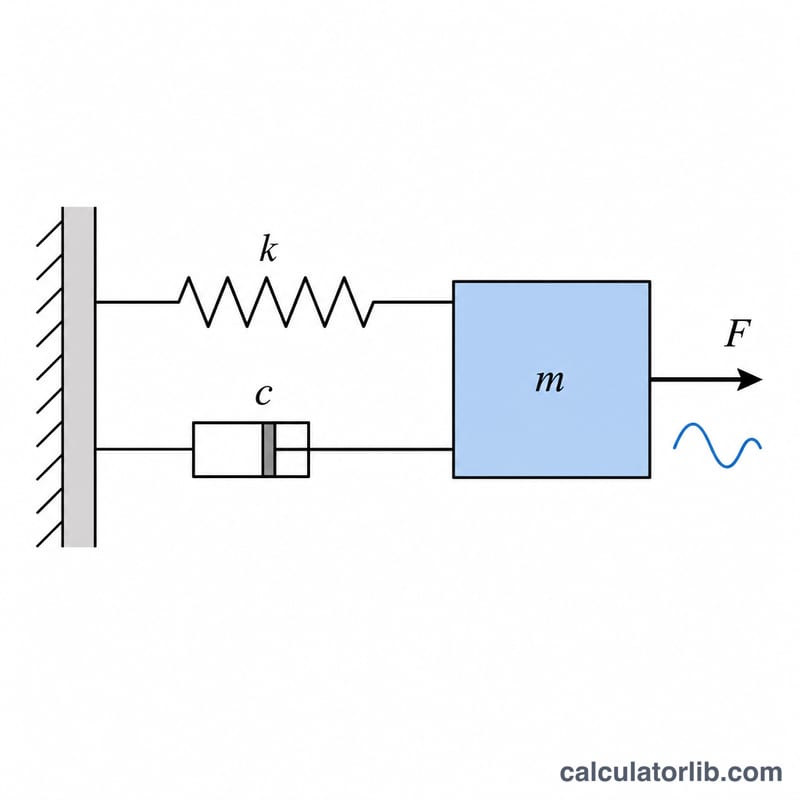
This tool solves the steady-state (particular) response of a damped harmonic oscillator that is driven by a sinusoidal force. The mass-normalized equation of motion is $$\frac{d^{2}x}{dt^{2}} + 2\kappa\frac{dx}{dt} + \omega_0^{2}x = f\cos(\omega t),$$ where \(\omega_0\) is the natural angular frequency, \(\kappa\) is the resistance (damping) coefficient, \(f\) is the driving amplitude per unit mass, and \(\omega\) is the driving angular frequency. The steady-state solution has the form \(x(t) = A\cos(\omega t - \delta)\).
How to use it
Enter the natural angular frequency, the resistance coefficient, the driving angular frequency and the driving amplitude in consistent SI units (rad/s, 1/s, rad/s, m/s²). Pick the number of divisions used to sample the displacement curve over four driving periods. The calculator returns the steady-state amplitude A, the phase lag δ in radians and degrees, and the driving period.
The formula explained
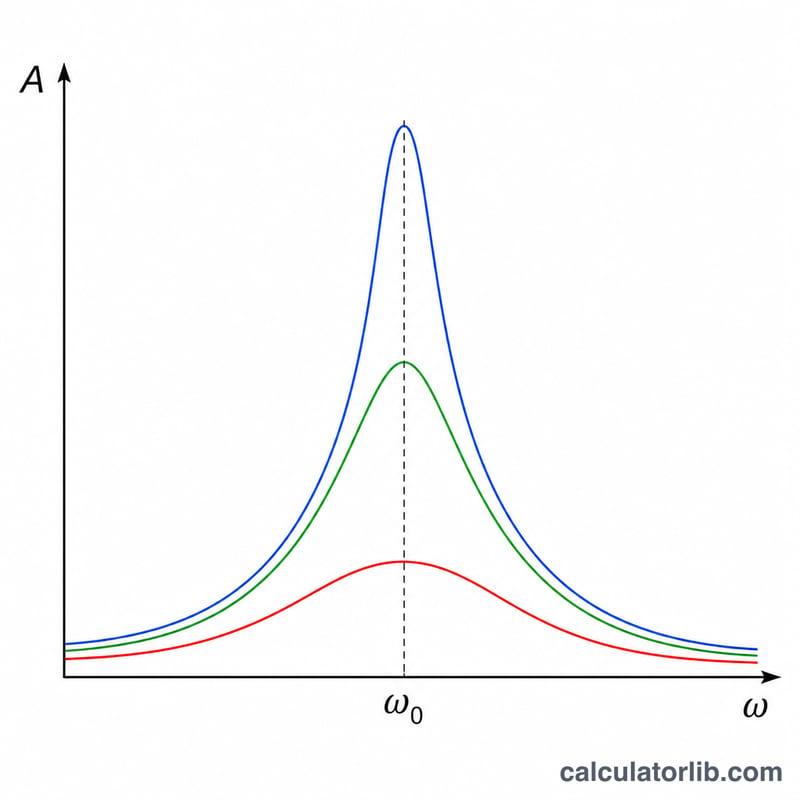
The amplitude is $$A = \frac{f}{\sqrt{\left(\omega_0^{2} - \omega^{2}\right)^{2} + \left(2\omega\kappa\right)^{2}}},$$ the standard amplitude response of a driven oscillator. The phase lag is $$\delta = \operatorname{atan2}\!\left(2\omega\kappa,\; \omega_0^{2} - \omega^{2}\right),$$ which places \(\delta\) in the range 0 to \(\pi\) and correctly handles the resonance crossing where \(\omega_0^{2} = \omega^{2}\) (then \(\delta = \pi/2\)).
Worked example
With \(\omega_0 = 5\), \(\kappa = 1\), \(\omega = 10\), \(f = 100\): \(\omega_0^{2} - \omega^{2} = -75\) and \(2\omega\kappa = 20\). The denominator is $$\sqrt{75^{2} + 20^{2}} = \sqrt{6025} = 77.621,$$ so \(A = 100 / 77.621 = 1.2883\) m. The phase is \(\delta = \operatorname{atan2}(20, -75) = 2.8806\) rad \(= 165.04^\circ\).
FAQ
Does this include the transient? No. Only the steady-state part is shown; the homogeneous transient decays as \(e^{-\kappa t}\).
What happens at resonance? When \(\omega_0 = \omega\) with \(\kappa > 0\), \(A = f/(2\omega\kappa)\) and \(\delta = \pi/2\). If \(\kappa = 0\) as well, the amplitude is infinite (undamped resonance).
What units should I use? Any consistent set; SI is assumed so displacement comes out in meters.