
What Is Wien's Displacement Law?
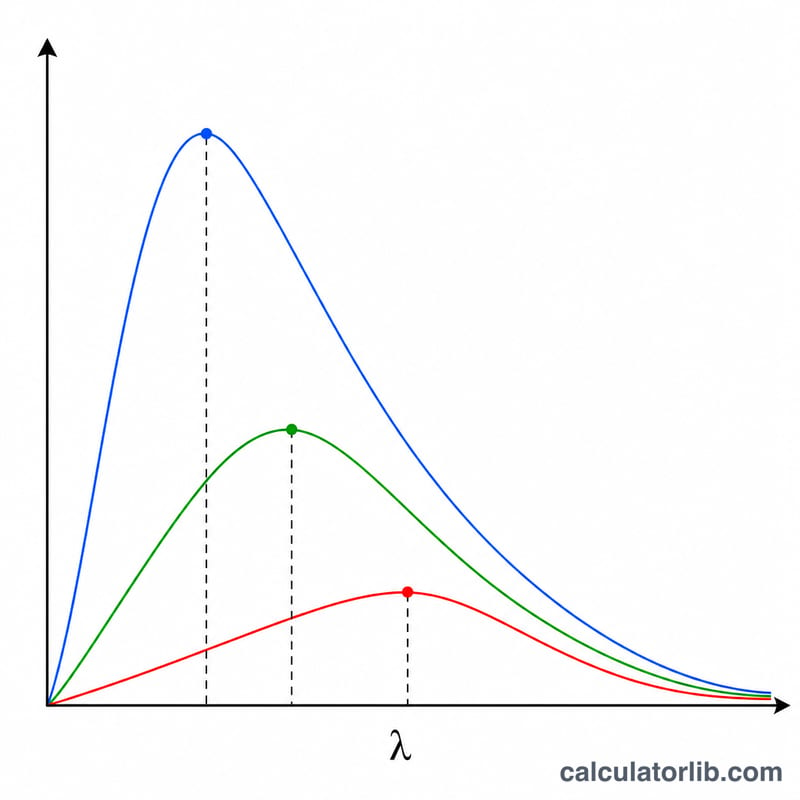
Wien's displacement law describes how the wavelength at which a black body emits the most radiation shifts with temperature. Hotter objects glow at shorter wavelengths (toward blue), while cooler objects peak at longer wavelengths (toward red and infrared). The law is universal — it applies to stars, incandescent filaments, planets, and any idealized thermal emitter.
How to Use This Calculator
Enter the absolute temperature of the object in Kelvin (K). The calculator divides Wien's displacement constant \(b = 2.897 \times 10^{-3}\ \text{m}\cdot\text{K}\) by that temperature to give the peak wavelength \(\lambda_{\text{max}}\), reported in both nanometers and meters. Remember to convert Celsius to Kelvin first by adding 273.15.
The Formula Explained
The relationship is $$\lambda_{\text{max}} = \frac{b}{T}$$ where \(T\) is the absolute temperature in Kelvin and \(b\) is Wien's displacement constant. Because \(\lambda_{\text{max}}\) is inversely proportional to \(T\), doubling the temperature halves the peak wavelength. This is why a heated metal first glows dull red, then orange, yellow, and finally bluish-white as it gets hotter.
Worked Example
The Sun's surface temperature is about 5778 K. Applying the formula: $$\lambda_{\text{max}} = \frac{2.897 \times 10^{-3}}{5778} \approx 5.014 \times 10^{-7}\ \text{m} = 501.4\ \text{nm}$$ This falls in the green-blue region of visible light, consistent with the Sun being a near-perfect black body radiator.
FAQ
What units does the temperature need to be in? Always Kelvin. To convert from Celsius, add 273.15.
Why is the result in nanometers? Visible and near-infrared wavelengths are conveniently expressed in nanometers (\(1\ \text{nm} = 10^{-9}\ \text{m}\)); we also show the raw value in meters.
Does this assume a perfect black body? Yes. Real objects emit slightly differently, but Wien's law gives an excellent first approximation for thermal sources.