
What is immersed (apparent) weight?
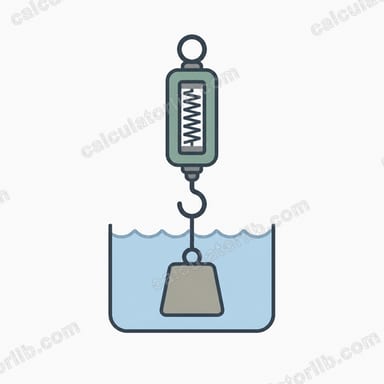
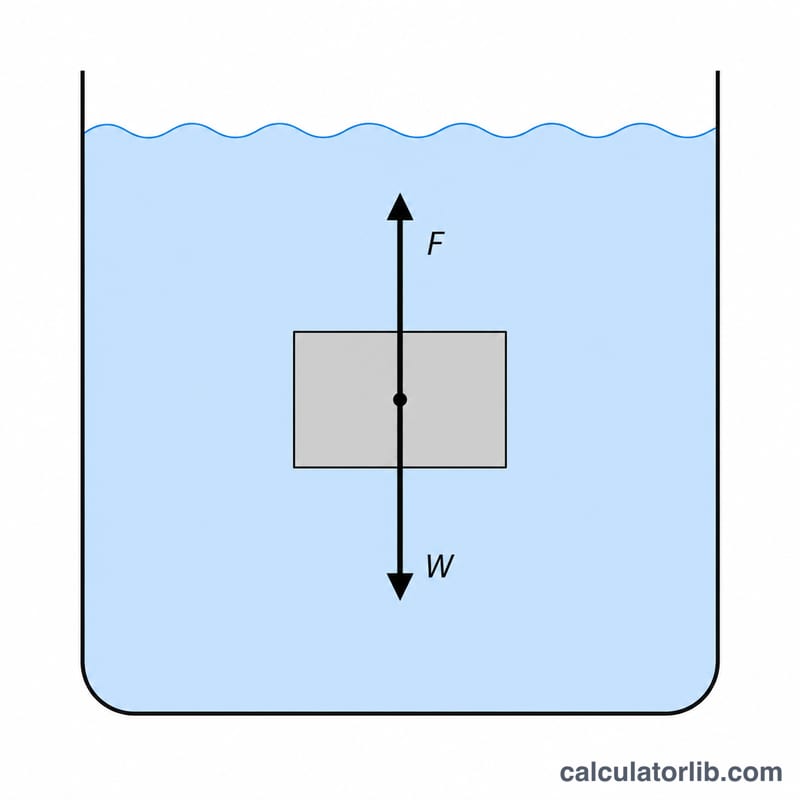
When an object is submerged in a fluid, the fluid pushes up on it with a buoyant force. As a result, the object feels lighter than its true weight in air. This reduced weight — what a scale would read if the object were hanging in the fluid — is called the apparent weight or immersed weight. This is a universal physics tool that works with any consistent SI inputs.
How to use this calculator
Enter the object's mass in kilograms, its volume in cubic metres, the density of the surrounding fluid in kg/m³, and the local gravitational acceleration (9.81 m/s² on Earth). The calculator returns the apparent weight in newtons, along with the true weight, the buoyant force, and the equivalent apparent mass a scale would show.
The formula explained
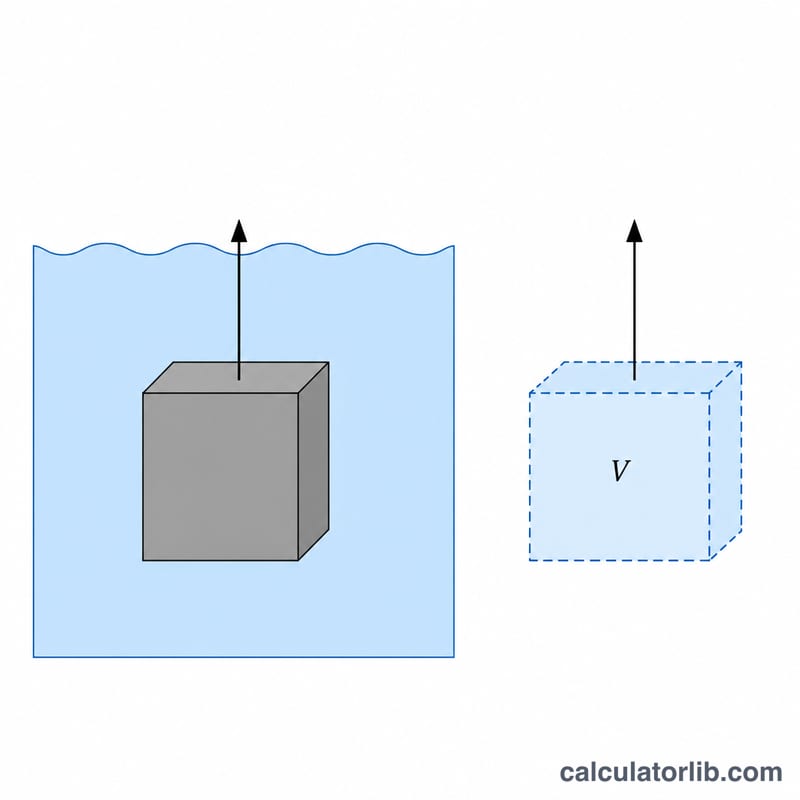
The governing equation is $$W_{apparent} = m \cdot g - \rho \cdot V \cdot g$$ The first term, \(m \cdot g\), is the true weight (gravity acting on the mass). The second term, \(\rho \cdot V \cdot g\), is the buoyant force from Archimedes' principle — it equals the weight of the fluid displaced, where \(\rho\) is the fluid density and \(V\) is the displaced (submerged) volume. Subtracting buoyancy from true weight gives the net downward force, the apparent weight.
Worked example
A solid object of mass 10 kg and volume 0.005 m³ is fully submerged in water (\(\rho = 1000\) kg/m³), with \(g = 9.81\) m/s². True weight $$= 10 \times 9.81 = 98.1 \text{ N}$$ Buoyant force $$= 1000 \times 0.005 \times 9.81 = 49.05 \text{ N}$$ Apparent weight $$= 98.1 - 49.05 = \mathbf{49.05 \text{ N}}$$ equivalent to about 5 kg on a scale.
FAQ
Can the apparent weight be negative? Yes — if the buoyant force exceeds the true weight, the value is negative, meaning the object floats and would need to be held down.
What volume should I use? Use the submerged volume of the object. For a fully immersed solid, this is its total volume.
Does this work for any fluid? Yes. Use the correct fluid density (e.g. ~1000 kg/m³ for water, ~1.2 kg/m³ for air, ~13534 kg/m³ for mercury).