What this calculator does
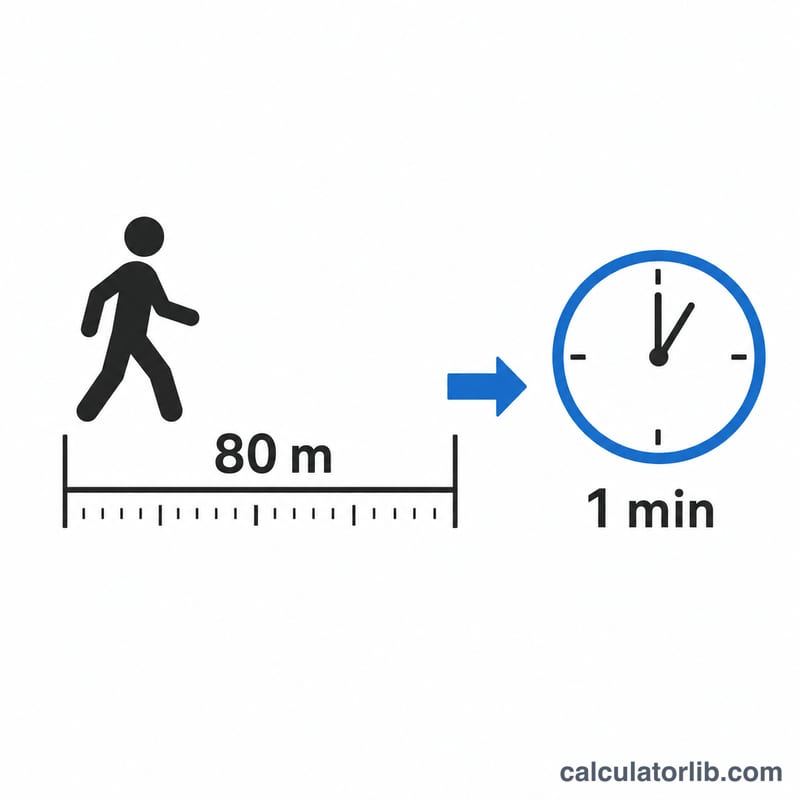
This tool converts a walking distance into a walking time. It is built around a Japanese real-estate convention: in Japan, property advertisements state distance to the nearest station as "X minutes on foot," computed from the road distance using a fixed standard walking speed of 80 meters per minute. This rule comes from Japan's Fair Competition Code for Real Estate Advertising. The default speed here (80 m/min) reproduces that standard, but because the underlying math (time = distance / speed) is universal, you can change the speed and units to suit any country or pace.
How to use it
Enter the distance and pick its unit (meters, kilometers, feet, or miles). Use the road/path distance you actually walk, not the straight-line distance. Then enter your walking speed and its unit (m/min, km/h, or mph). The calculator converts everything to meters and minutes, divides distance by speed, and shows the result down to the second, plus the total minutes, total seconds, and a whole-days component for long routes.
The formula explained
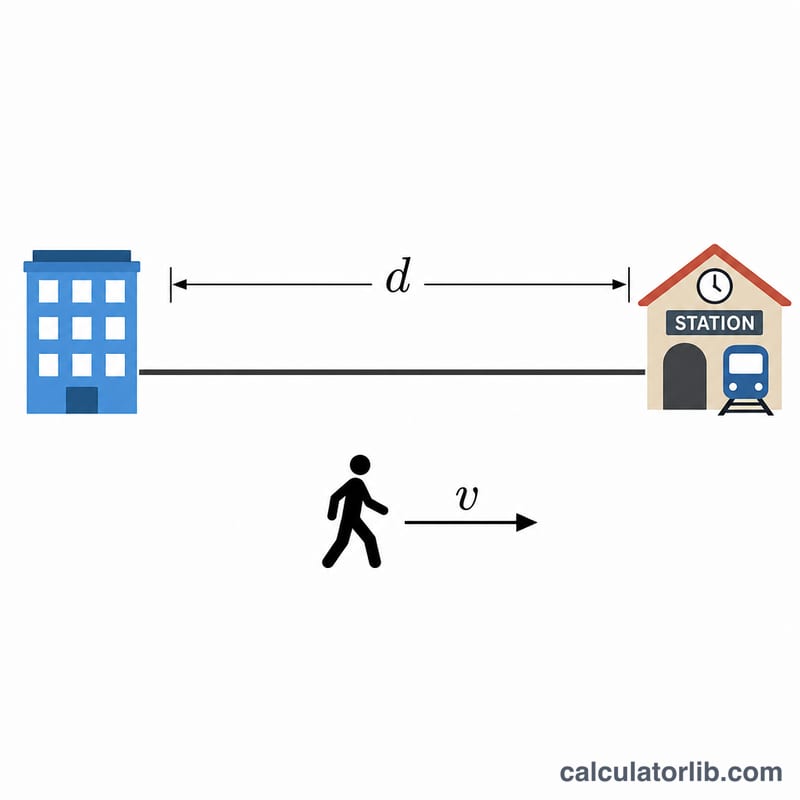
First, distance is converted to meters and speed to meters per minute. Then total minutes = distance(m) / speed(m/min), and total seconds = total minutes x 60. The readable time splits total seconds into hours (floor of seconds/3600), minutes, and seconds. Days = floor(total seconds / 86400).
$$\text{Time (min)} = \frac{\text{Distance} \cdot f_d}{\text{Speed} \cdot f_s}$$
$$\begin{gathered} \text{Time (min)} = \frac{d_m}{v_m} \\[1.5em] \text{where}\quad \left\{ \begin{aligned} d_m &= \text{Distance} \times f_d \\ v_m &= \text{Speed} \times f_s \end{aligned} \right. \end{gathered}$$
Worked example
A property is 1200 m from the station; standard speed is 80 m/min. Total minutes = $$\frac{1200}{80} = 15 \text{ minutes} = 900 \text{ seconds},$$ so the walk is "15 min 0 sec." Under the Japanese advertising convention this property would be listed as a 15-minute walk.
Standard Walking Distance to Minutes Reference Table
Japan's real-estate advertising rules fix walking speed at a single value: 80 metres per minute. The figure comes from the Fair Competition Code on Real Estate Advertising (不動産の表示に関する公正競争規約), the industry code administered by Japan's regional Fair Trade Councils for real estate, and it is the reason a Japanese listing that says "8 minutes from the station" is describing roughly 640 m of road distance rather than a measured stroll. Outside Japan there is no equivalent legal walking speed — agents in other markets usually quote an estimate, so treat the numbers below as the Japanese convention unless your local code says otherwise.
At the standard speed the arithmetic is simply:
$$\text{Time (min)} = \frac{\text{Distance (m)}}{80\ \text{m/min}}$$The second rule that matters is rounding. The Code requires that any fraction of a minute be rounded up to the next whole minute, so advertised times are never shorter than the computed walk. A 650 m walk works out to 8.13 minutes and must therefore be advertised as 9 minutes, not 8.
| Distance | Exact time (min) | Exact time (min:sec) | Advertised minutes (rounded up) |
|---|---|---|---|
| 80 m | 1.00 | 1:00 | 1 |
| 160 m | 2.00 | 2:00 | 2 |
| 300 m | 3.75 | 3:45 | 4 |
| 400 m | 5.00 | 5:00 | 5 |
| 560 m | 7.00 | 7:00 | 7 |
| 650 m | 8.13 | 8:07.5 | 9 |
| 800 m | 10.00 | 10:00 | 10 |
| 1,000 m | 12.50 | 12:30 | 13 |
| 1,200 m | 15.00 | 15:00 | 15 |
| 1,500 m | 18.75 | 18:45 | 19 |
| 1,600 m | 20.00 | 20:00 | 20 |
| 2,400 m | 30.00 | 30:00 | 30 |
Reading the table backwards is just as useful: each advertised minute covers an 80 m band of distance. "5 minutes" means more than 320 m and up to 400 m; "10 minutes" means more than 720 m and up to 800 m. Because the distance is measured along a walkable route rather than in a straight line, the same property can be 9 minutes from one entrance of a station and 12 from another.
Walking Speed Unit Conversions
The calculator accepts speed in metres per minute (m/min), kilometres per hour (km/h) or miles per hour (mph), so it helps to know how the three scales line up. The exact conversions follow from 1 minute = 60 seconds and the international mile of exactly 1,609.344 m:
$$1\ \text{m/min} = 0.06\ \text{km/h} = 0.03728\ \text{mph}$$$$1\ \text{km/h} = 16.667\ \text{m/min}, \qquad 1\ \text{mph} = 26.822\ \text{m/min}$$| Pace | m/min | km/h | mph | Minutes per km |
|---|---|---|---|---|
| Slow / unhurried | 60 | 3.6 | 2.24 | 16.7 |
| Japanese real-estate standard | 80 | 4.8 | 2.98 | 12.5 |
| Typical adult pace (5.0 km/h) | ≈83 (exactly 83.33) | 5.0 | 3.11 | 12.0 |
| Brisk | 100 | 6.0 | 3.73 | 10.0 |
Note that the 83 m/min row is the rounded form of 83.33 m/min, which is exactly 5.0 km/h and 3.11 mph; entering a flat 83 gives 4.98 km/h, a difference of well under a second over a short walk. The 80 m/min standard sits deliberately a little below a typical unobstructed adult pace, since real routes include crossings, stairs and traffic lights.
Distance unit factors
Distances are converted to metres before the division, using these exact factors:
| Input unit | Metres | Time at 80 m/min |
|---|---|---|
| 1 m | 1 | 0.0125 min (0.75 s) |
| 1 km | 1,000 | 12.5 min |
| 1 ft | 0.3048 | 0.00381 min (0.23 s) |
| 1 mile | 1,609.344 | 20.12 min |
So a listing phrased in imperial units converts cleanly: half a mile (804.672 m) is 10.06 minutes at the standard pace — essentially the familiar "10 minutes to the station" — while 1,000 ft (304.8 m) is 3.81 minutes, advertised as 4 under the Japanese rounding-up rule.
FAQ
Why 80 m/min? It is the legally fixed standard walking speed used for Japanese real-estate ads, roughly 4.8 km/h.
Does it include traffic-light waits? No. Waiting time at signals or railroad crossings is not counted, matching the standard.
Why isn't the time rounded up like an ad? Japanese ads round up to whole minutes, but this tool gives the precise time to the second so you can interpret it yourself.