What this calculator does
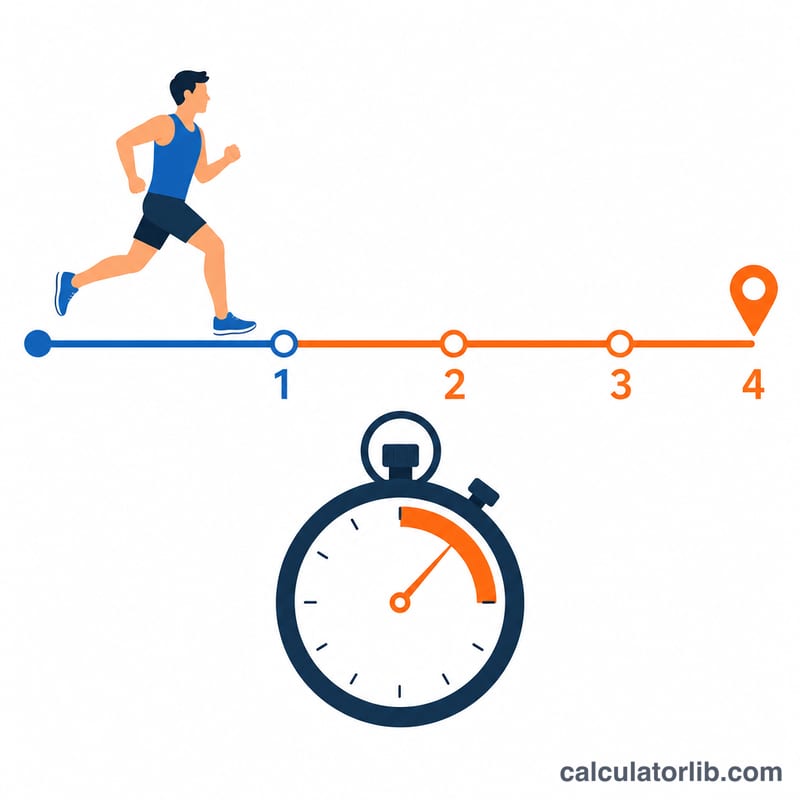
The Time From Distance and Pace Calculator tells you how long an activity will take when you know the total distance and your pace per unit. It works for any unit of distance — kilometers, miles, laps, meters — as long as your pace is expressed in time per that same unit. It is ideal for runners, cyclists, swimmers and walkers planning a session or estimating a finish time for a race.
How to use it
Enter the total distance you plan to cover. Then enter your pace per unit, split into minutes and seconds (for example 5 minutes 30 seconds per kilometer). The calculator multiplies your distance by your pace and returns the total time in hours, minutes and seconds, plus the total in minutes and seconds for quick reference.
The formula explained
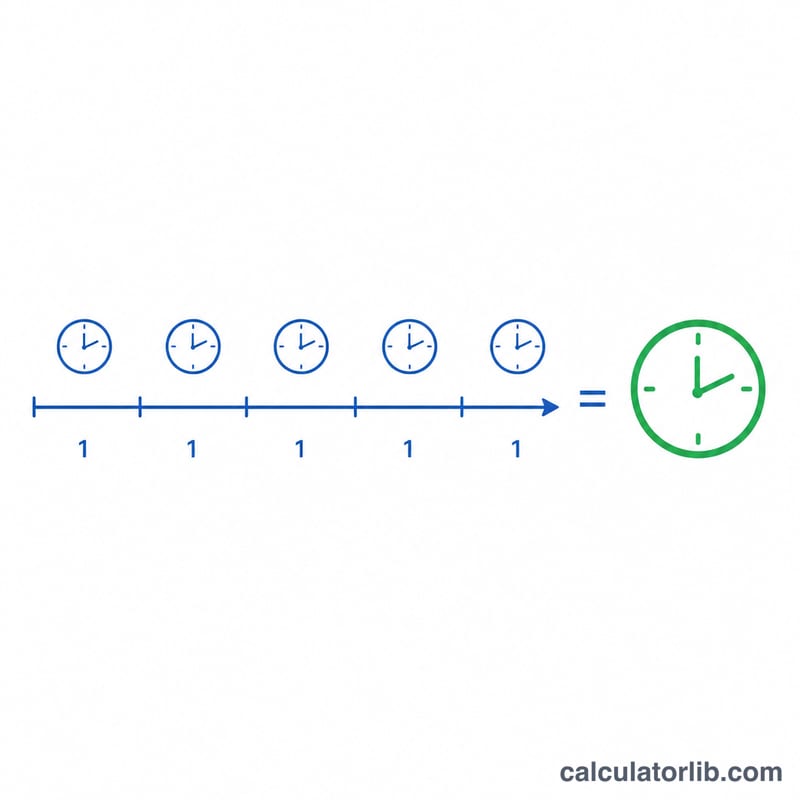
The core equation is simply total time = distance × pace per unit. Because pace is most natural in minutes and seconds, the tool first converts your pace into seconds per unit: $$\text{pace seconds} = (\text{minutes} \times 60) + \text{seconds}$$ It multiplies that by the distance to get total seconds, then breaks the result into hours, minutes and seconds:
$$T = \text{Distance} \times \left( 60 \times \text{Pace (min)} + \text{Pace (sec)} \right)$$
Worked example
Suppose you run 10 km at a pace of 5:30 per km. Pace in seconds = \((5 \times 60) + 30 = 330\) seconds per km. Total time:
$$10 \times 330 = 3{,}300 \text{ seconds} = 55 \text{ minutes exactly (0 hours, 55 minutes, 0 seconds).}$$
Finish Times at Common Distances and Paces
Finish time is distance × pace. Paces below are per kilometre, converted to seconds (4:30 = 270 s, 5:00 = 300 s, 5:30 = 330 s, 6:00 = 360 s, 6:30 = 390 s). Times are h:mm:ss, rounded to the nearest second. The half marathon is 21.0975 km and the marathon is 42.195 km.
| Pace (per km) | 5K (5 km) | 10K (10 km) | Half marathon | Marathon |
|---|---|---|---|---|
| 4:30 | 0:22:30 | 0:45:00 | 1:34:56 | 3:09:53 |
| 5:00 | 0:25:00 | 0:50:00 | 1:45:29 | 3:30:59 |
| 5:30 | 0:27:30 | 0:55:00 | 1:56:02 | 3:52:04 |
| 6:00 | 0:30:00 | 1:00:00 | 2:06:35 | 4:13:10 |
| 6:30 | 0:32:30 | 1:05:00 | 2:17:08 | 4:34:16 |
Worked example: a 10 km run at 5:00 per km. Pace in seconds = 60 × 5 + 0 = 300 s/km, so
$$T = 10 \times (60 \times 5 + 0) = 3000\ \text{s}$$
and 3000 s = 50 minutes, i.e. 50:00.
Half marathon at 5:00/km: \(21.0975 \times 300 = 6329.25\) s ≈ 1:45:29. Marathon at 6:00/km: \(42.195 \times 360 = 15190.2\) s ≈ 4:13:10.
Pace and Distance Unit Conversions
Pace and distance must use the same unit. These are the standard conversions between kilometres and miles.
| Quantity | Kilometres | Miles |
|---|---|---|
| 1 mile | 1.609344 km (exact) | 1 mi |
| 1 kilometre | 1 km | 0.621371 mi |
| 5K | 5 km | 3.107 mi |
| 10K | 10 km | 6.214 mi |
| Half marathon | 21.0975 km | 13.109 mi |
| Marathon | 42.195 km | 26.219 mi |
| 400 m track lap | 0.4 km | 0.249 mi |
To convert a pace from min/km to min/mi, multiply the seconds per km by 1.609344. Sample conversions:
| Pace per km | Calculation | Pace per mile |
|---|---|---|
| 5:00 | \(300 \times 1.609344 = 482.8\) s | ≈ 8:03 |
| 5:30 | \(330 \times 1.609344 = 531.1\) s | ≈ 8:51 |
| 6:00 | \(360 \times 1.609344 = 579.4\) s | ≈ 9:39 |
| 6:30 | \(390 \times 1.609344 = 627.6\) s | ≈ 10:28 |
To go the other way, divide a per-mile pace in seconds by 1.609344. A 400 m lap at 5:00/km takes \(0.4 \times 300 = 120\) s, or 2:00.
Key Terms: Pace, Split and Finish Time
- Pace: the time taken to cover one unit of distance, such as minutes per kilometre or minutes per mile. \(\text{pace} = \text{time} \div \text{distance}\).
- Speed: distance covered per unit of time (for example km/h). It is the inverse of pace. \(\text{speed (km/h)} = 3600 \div \text{pace in seconds per km}\). A 5:00/km pace (300 s) is \(3600 \div 300 = 12\) km/h.
- Split: the time recorded for one segment of a run, such as each kilometre, mile or lap. Even splits mean every segment takes about the same time.
- Finish time: the total elapsed time for the whole distance. \(T = \text{distance} \times (60 \times \text{pace minutes} + \text{pace seconds})\), giving seconds, which are then converted to hours, minutes and seconds.
- Unit matching: the distance unit must match the pace unit. A pace per km needs a distance in km, and a pace per mile needs a distance in miles. Mixing them (for example 10 miles at a per-km pace) gives a wrong result.
Note that this calculation assumes a constant pace for the entire distance. Real races usually include pace variation from hills, wind, fatigue and stops.
FAQ
Does the unit matter? No — the calculator is unit-agnostic. Just make sure the distance unit matches the unit your pace is measured against (e.g. miles with min/mile, km with min/km).
Can I use it for swimming or cycling? Yes. Use laps or meters with a per-lap or per-100m pace, or miles/km for cycling. The math is identical.
What if my pace has no seconds? Leave the seconds field at 0 and just fill in the minutes value.