What is the UTC to GMT Converter?
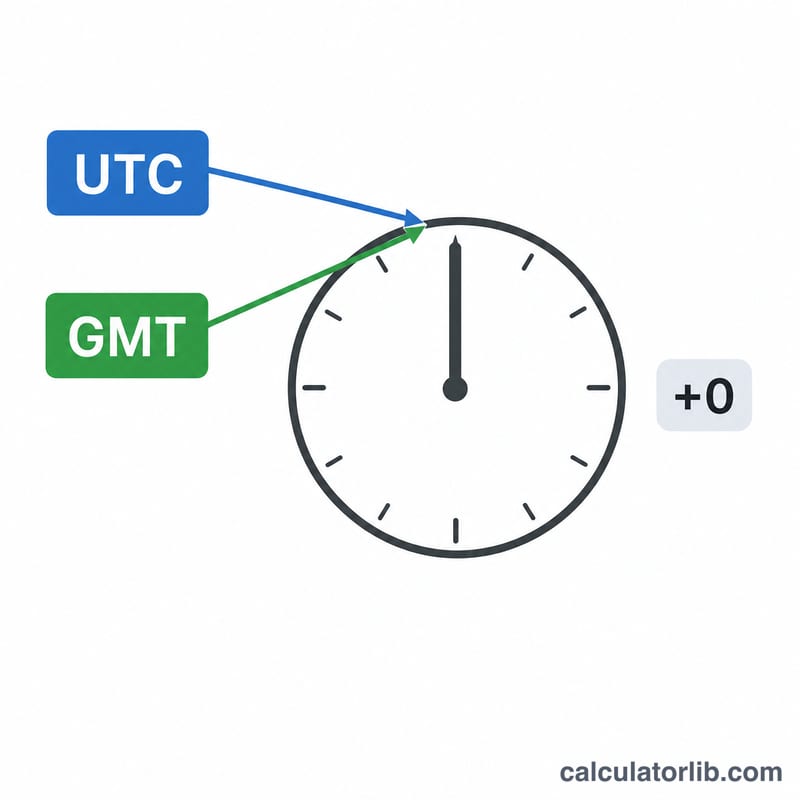
This tool converts a time given in Coordinated Universal Time (UTC) to Greenwich Mean Time (GMT). The key fact is that GMT and UTC have a zero-hour offset between them, so for everyday purposes a time expressed in UTC is the same as the time expressed in GMT. This converter confirms that equivalence and presents the result in clear hour:minute format alongside the numeric offset.
How to use it
Enter the hour (0–23) and minute (0–59) of your UTC time, then submit. The result shows the equivalent GMT time, plus the offset (always 0 hours) and a decimal-hour representation that is handy for spreadsheet calculations.
The formula explained
The conversion is simply $$\text{GMT} = \text{UTC} + 0$$ Because the offset is zero, both the hour and minute components remain unchanged. The decimal-hour value is computed as \(\text{hour} + \text{minute} \div 60\), which is useful when you need to add or subtract durations numerically.
Worked example
Take 14:30 UTC. Adding the zero offset gives 14:30 GMT — identical. As a decimal that is $$14 + 30 \div 60 = 14.5 \text{ hours}$$
UTC, GMT and Common UK/Europe Local Offsets
For everyday purposes, UTC and GMT show the same clock time, so converting UTC to GMT means adding an offset of zero: \(\text{GMT} = \text{UTC} + 0\). For example, 14:30 UTC is 14:30 GMT. The table below shows how UTC and GMT relate to common UK and European time zones.
| Name | Offset from UTC | Daylight saving (DST) applies? |
|---|---|---|
| UTC (Coordinated Universal Time) | +00:00 | No |
| GMT (Greenwich Mean Time) | +00:00 | No (the time standard itself does not change) |
| WET (Western European Time) | +00:00 (winter) | Yes, it is replaced by WEST in summer |
| WEST (Western European Summer Time) | +01:00 (summer) | This is the summer-time form of WET |
| BST (British Summer Time) | UTC+1 (late March to late October) | Yes, it is the UK's summer time |
| CET (Central European Time) | +01:00 | Yes, it is replaced by CEST in summer |
| CEST (Central European Summer Time) | +02:00 | This is the summer-time form of CET |
Notes: The United Kingdom uses GMT in winter and switches to BST (UTC+1) in summer, so UK local time equals UTC only in winter. Iceland and Ghana use GMT all year round and do not change their clocks. Other countries use different rules, so check the rules for your own location.
Key Terms: UTC, GMT, Offset and Leap Seconds
- UTC (Coordinated Universal Time)
- The global civil time standard. It is based on International Atomic Time (atomic clocks), and the BIPM (International Bureau of Weights and Measures) maintains it with leap seconds added when needed to keep it aligned with Earth's rotation.
- GMT (Greenwich Mean Time)
- Originally the mean solar time at the Royal Observatory in Greenwich, London, measured from the 0° meridian. In everyday and civil use it is treated as equal to UTC (offset +00:00).
- UT1
- A time scale based on the actual rotation of the Earth, measured by astronomical observation. It is the modern scientific successor to mean solar time at Greenwich.
- Time offset
- The difference between a local time and UTC, written as +HH:MM or −HH:MM. For example, CEST has an offset of +02:00, while UTC and GMT have an offset of +00:00.
- BST (British Summer Time)
- The UK's daylight saving time, equal to UTC+1. It runs from late March to late October. In this context BST means British Summer Time, not other abbreviations that share the letters.
- Prime Meridian
- The 0° line of longitude, which passes through Greenwich, London. It is the reference for longitude and, historically, for GMT.
- Leap second
- A one-second adjustment to UTC that keeps it within 0.9 seconds of UT1.
Because leap seconds keep UTC and UT1 within 0.9 seconds of each other, the two can differ by a fraction of a second. This difference matters in precise scientific work such as astronomy and satellite navigation, but it does not affect everyday clock times, where UTC and GMT are interchangeable.
FAQ
Are UTC and GMT exactly the same? For civil timekeeping yes; both use the 0° meridian as their reference and have no offset. UTC is the modern atomic-clock-based standard, while GMT is the older astronomical term.
Why does the offset show 0? Because no time difference exists between the two scales — the converter highlights this so you can be confident no adjustment is needed.
Does this account for daylight saving? No. Both UTC and GMT are fixed reference scales and never observe daylight saving time. Local times like BST may differ from GMT.