

What Is the Dog Years to Human Years Calculator?
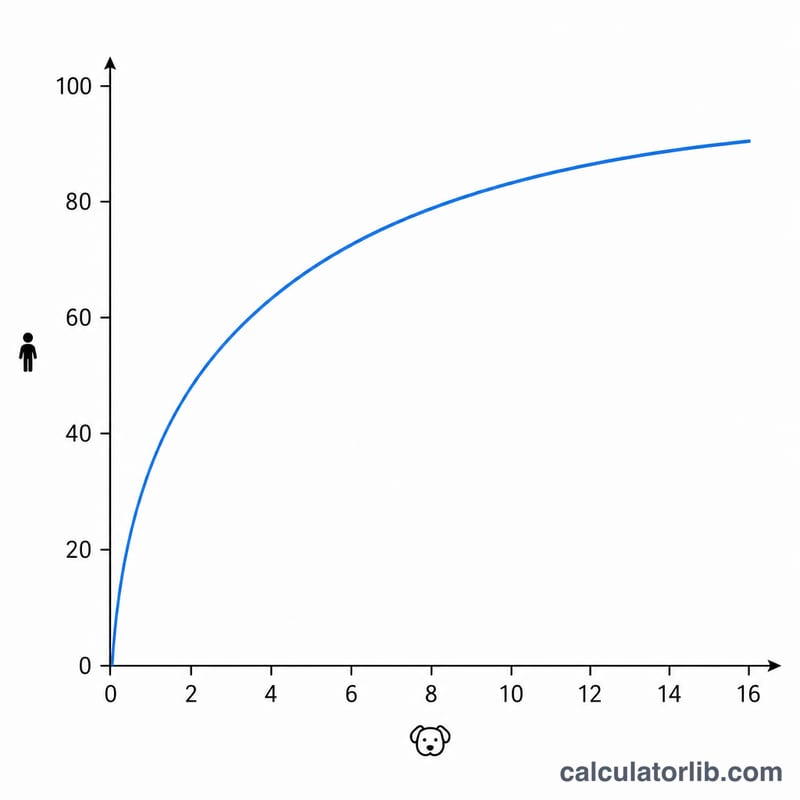
This tool converts your dog's chronological age into the equivalent human age. The old "multiply by 7" rule is a myth — dogs mature very fast in their first two years and then age more gradually. This calculator instead uses a logarithmic formula derived from a 2019 study of DNA methylation (epigenetic aging) in dogs and humans, which gives a far more realistic picture of how old your dog really is in human terms.
How to Use It
Simply enter your dog's age in years (decimals are fine — for example, a 6-month-old puppy is 0.5). Click calculate and you'll instantly see the equivalent human age, along with a summary of your dog's actual and human-equivalent ages.
The Formula Explained
For dogs aged one year and older, the calculator applies:
$$\text{Human Years} = 16 \cdot \ln\!\left(\text{Dog Years}\right) + 31$$
Here ln is the natural logarithm. Because the natural log grows quickly at first and then flattens out, this captures the rapid aging of a young dog and the slower aging of a senior dog. For puppies under one year, the logarithm produces unrealistic values, so a simple linear estimate (\(15 \times \text{age}\)) is used instead.
Worked Example
Suppose your dog is 5 years old. \(\ln(5) \approx 1.6094\). Multiply by 16 to get about 25.75, then add 31 for a total of roughly 56.8 human years. So a 5-year-old dog is comparable to a human in their late 50s.
$$\text{Human Years} = 16 \cdot \ln(5) + 31 \approx 16 \cdot 1.6094 + 31 \approx 56.8$$
FAQ
Is the 7-year rule accurate? No. Dogs age much faster early in life, so a flat multiplier badly overestimates puppies and underestimates seniors.
Does breed and size matter? Yes. Smaller breeds tend to live longer, so this formula is a general guide rather than a breed-specific result.
Why does it use a logarithm? Research comparing dog and human DNA aging markers found the relationship follows a logarithmic curve, which this calculator reproduces.