
What This Calculator Does
The Percentage of Year Completed Calculator tells you how far through a calendar year a given date is, expressed as a percentage. It converts your chosen date into its day-of-year number (January 1 = day 1, December 31 = day 365 or 366), then divides that by the total number of days in the year. It is a universal tool — it works for any year and correctly handles leap years.
How to Use It
Choose a year, pick a month from the dropdown, and enter the day of the month. Press calculate. The tool shows the percentage of the year that has elapsed, the day-of-year number, the total days in that year, the percentage remaining, and the number of days left in the year.
The Formula Explained
The core equation is $$\text{pct} = \frac{\text{dayOfYear}}{365 + \text{leap}} \times 100$$ where leap is 1 in a leap year and 0 otherwise. The day-of-year is the count of days from January 1 up to and including your date. A year is a leap year when it is divisible by 4, except for century years which must be divisible by 400 — so 2000 and 2024 are leap years, but 1900 is not.
Worked Example
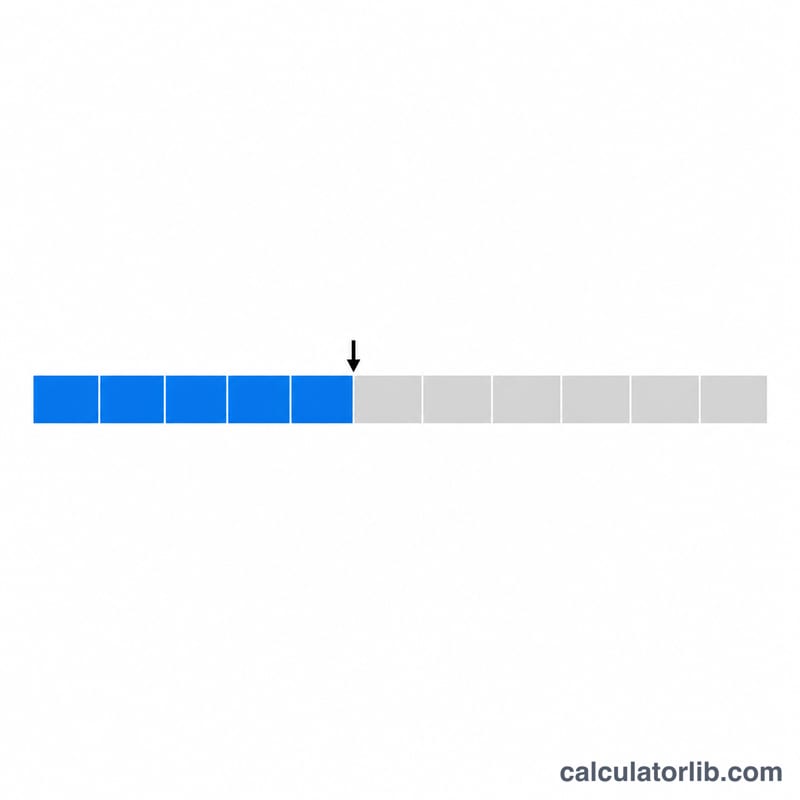
Take July 1, 2024. 2024 is a leap year, so the year has 366 days. The cumulative days before July are 181 (Jan–Jun, with the leap day in February), plus 1 for July 1 gives day-of-year 183. Then $$\text{pct} = \frac{183}{366} \times 100 = 50\%$$ Exactly half the year has passed, with 183 days remaining.
FAQ
Does it account for leap years? Yes. The denominator becomes 366 and February has 29 days, automatically shifting later dates.
Is January 1 counted as 0% or a small percentage? January 1 is day 1, so it returns roughly 0.27% \(\left(1/365\right)\) — the year is just beginning, not zero.
Does December 31 give 100%? Yes. The last day of the year equals the total days in the year, so \(\text{pct} = 100\%\).