

What Is Time and a Half Pay?
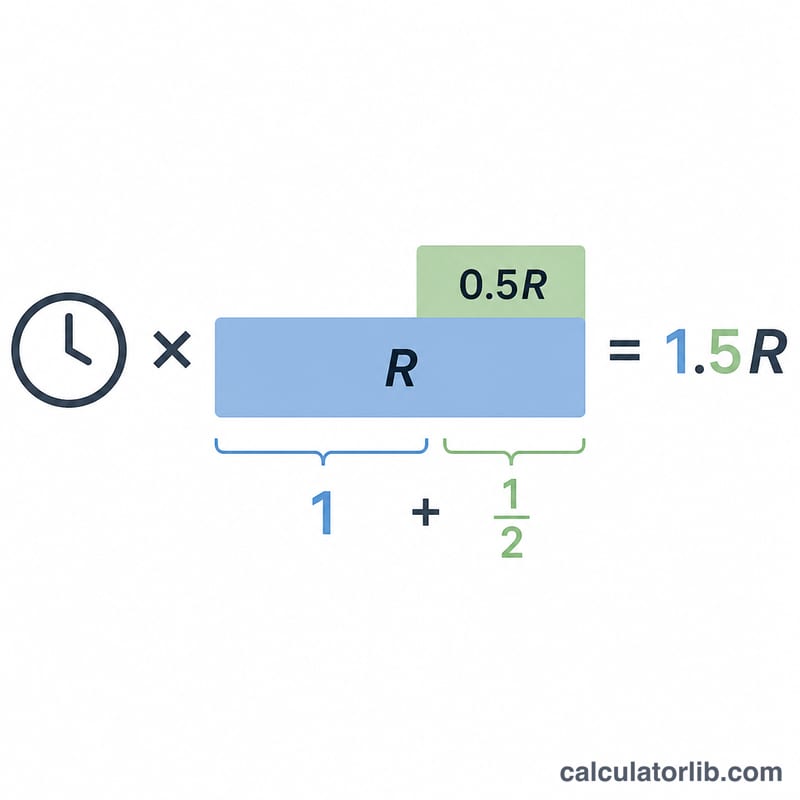
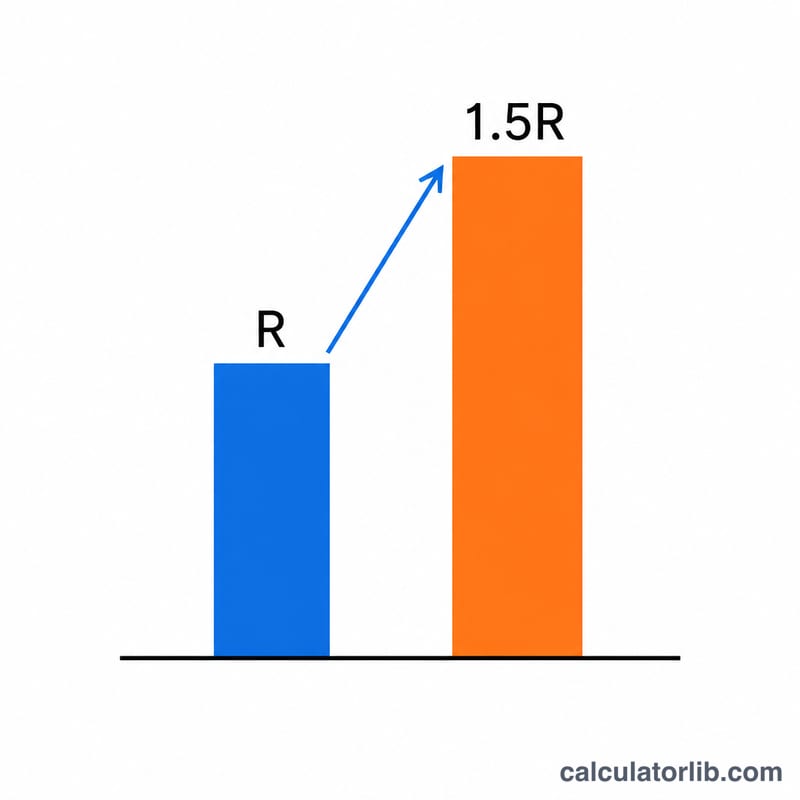
"Time and a half" is an overtime pay rate equal to 1.5 times an employee's regular hourly wage. It is the standard overtime premium used in many workplaces — and under U.S. federal law (the Fair Labor Standards Act), non-exempt employees must generally be paid at least time and a half for hours worked beyond 40 in a workweek. This calculator quickly converts your regular hourly rate into a time-and-a-half rate and shows your total overtime earnings.
How to Use the Calculator
Enter your regular hourly rate (what you normally earn per hour) and the number of overtime hours you worked. The calculator multiplies your hourly rate by 1.5 to get the overtime rate, then multiplies by your overtime hours to find your total overtime pay. Fractional hours such as 2.5 or 0.75 are supported.
The Formula Explained
The math is two simple steps:
\(\text{OT Rate} = \text{Hourly Rate} \times 1.5\) — this is your premium pay rate.
\(\text{OT Pay} = \text{OT Rate} \times \text{OT Hours}\) — this is what you earn for the overtime hours.
$$\text{Overtime Pay} = \text{Hourly Rate (\$)} \times 1.5 \times \text{Overtime Hours}$$
Worked Example
Suppose you earn $20.00 per hour and work 10 overtime hours. Your time-and-a-half rate is \(\$20 \times 1.5 = \$30.00\) per hour. Your overtime pay is \(\$30 \times 10 = \$300.00\). That $300 is in addition to your regular wages for normal hours.
FAQ
Does this include my regular pay? No — this shows only the overtime portion. Add it to your standard hours pay for total earnings.
When does time and a half apply? In the U.S., typically for hours over 40 in a workweek for non-exempt workers. Some states and employers have additional daily overtime rules.
Is overtime always 1.5×? Time and a half is the most common premium, but some shifts (e.g., holidays) may use double time (2×) under certain policies.