
What is the Half-Life Time Calculator?
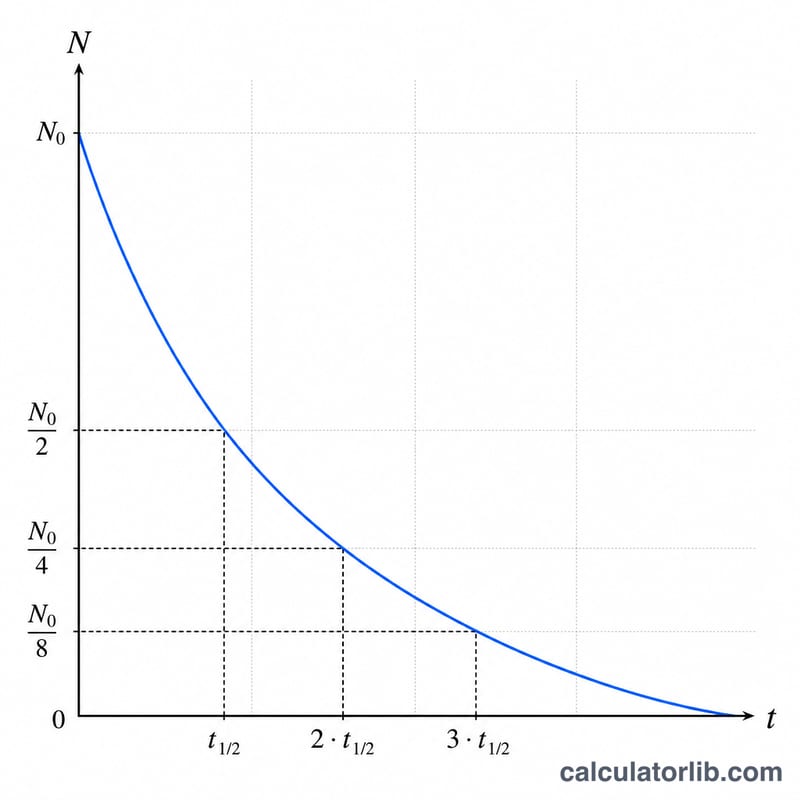
This calculator tells you how long it takes for a decaying quantity — such as a radioactive isotope, a drug concentration, or any exponentially decaying substance — to fall from an initial amount (\(N_0\)) to a remaining amount (\(N\)), given the substance's half-life. A half-life is the time required for exactly half of the material to decay, and the process is universal across radioactivity, pharmacology, and chemistry.
How to use it
Enter three values: the half-life (in any time unit you like — seconds, hours, days, or years), the initial quantity \(N_0\), and the remaining quantity \(N\). The result is reported in the same time units you used for the half-life. The calculator also shows how many half-lives have passed and the remaining fraction as a percentage.
The formula explained
Exponential decay follows $$N = N_0 \cdot \left(\frac{1}{2}\right)^{t/t_{1/2}}.$$ Solving for time gives:
$$t = t_{1/2} \cdot \frac{\ln\!\left(\dfrac{N_0}{N}\right)}{\ln 2}$$
The ratio \(N_0/N\) tells you how much has decayed; taking its base-2 logarithm (written here as \(\ln(N_0/N)/\ln 2\)) gives the number of half-lives elapsed, and multiplying by the half-life converts that into actual time.
Worked example
Carbon-14 has a half-life of 5730 years. Suppose a sample retains 25% of its original carbon-14 (\(N_0 = 100\), \(N = 25\)). The ratio is \(100/25 = 4\), and \(\log_2(4) = 2\) half-lives. So $$t = 5730 \times 2 = \textbf{11{,}460 years}.$$
FAQ
What units does the answer use? Whatever unit you used for the half-life. If the half-life is in days, the time is in days.
Can N be greater than N₀? No — decay only reduces the quantity, so \(N\) must be less than or equal to \(N_0\). If they are equal, the time is zero.
Does it work for any decaying quantity? Yes, as long as the decay is exponential (constant half-life), including radioactive isotopes and first-order drug elimination.