
What Is Heron's Formula?
Heron's formula lets you compute the area of a triangle when you know the lengths of all three sides — without needing the height or any angles. Named after Heron of Alexandria, it is one of the most elegant results in classical geometry and is especially handy for surveying, construction, and any situation where measuring an altitude is impractical.
How to Use This Calculator
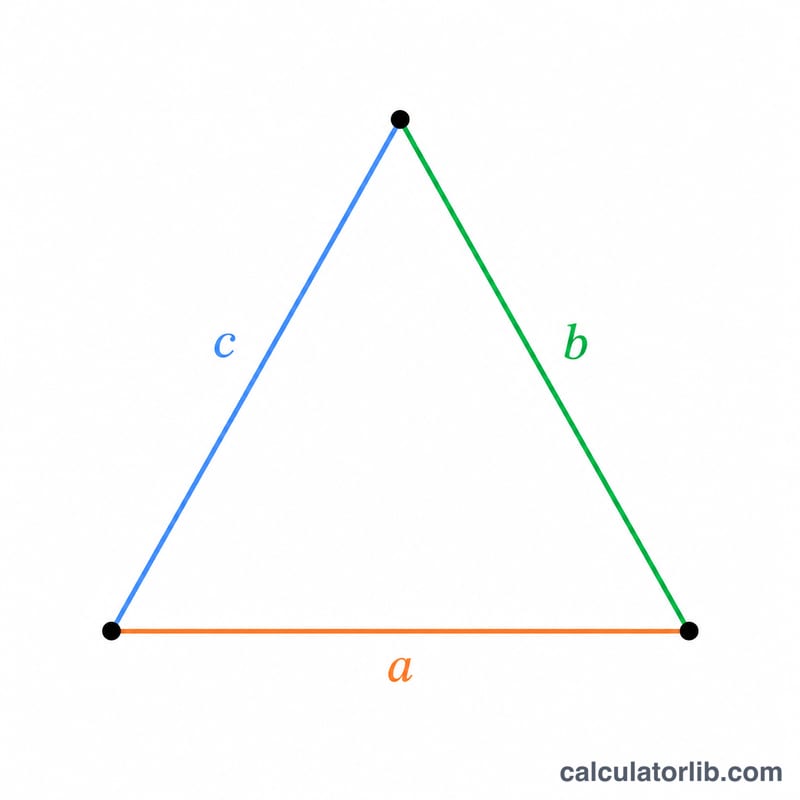
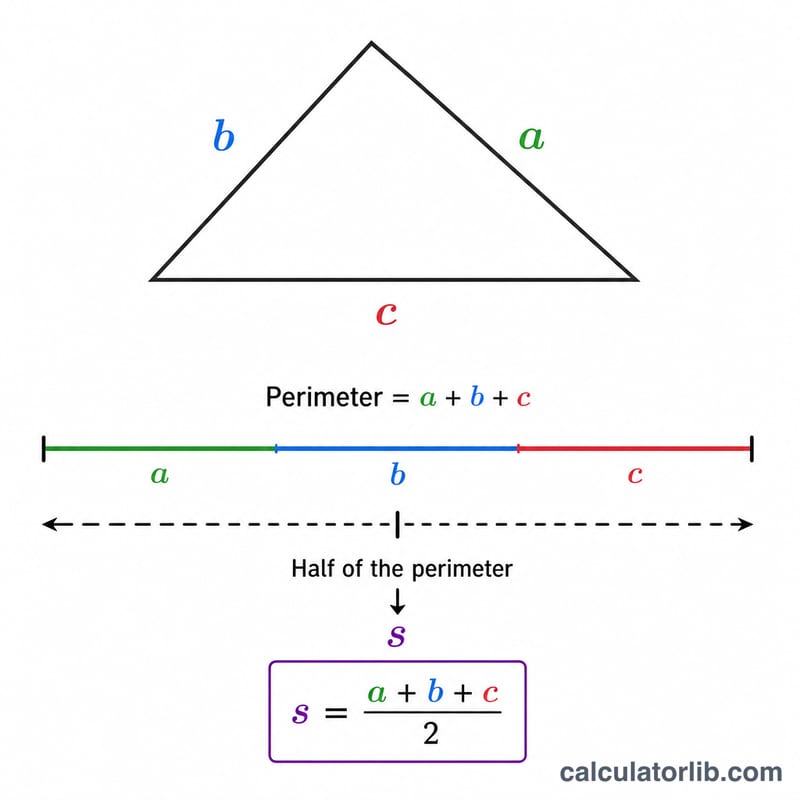
Enter the three side lengths a, b, and c in any consistent unit (cm, m, inches, etc.). The calculator first finds the semi-perimeter, then returns the triangle's area in square units along with its perimeter. If the values can't form a real triangle, you'll be warned.
The Formula Explained
First compute the semi-perimeter: \(s = (a + b + c) / 2\). Then the area is $$A = \sqrt{s\,(s-a)\,(s-b)\,(s-c)}$$ The expression inside the square root is only positive when the three sides satisfy the triangle inequality (each side is less than the sum of the other two), which is exactly when a valid triangle exists.
Worked Example
For a triangle with sides a = 3, b = 4, c = 5: the semi-perimeter is \(s = (3 + 4 + 5) / 2 = 6\). Then $$A = \sqrt{6 \times (6-3) \times (6-4) \times (6-5)} = \sqrt{6 \times 3 \times 2 \times 1} = \sqrt{36} = 6 \text{ square units}.$$ (This is the familiar 3-4-5 right triangle, whose area also equals \(\tfrac{1}{2} \times 3 \times 4 = 6\).)
FAQ
Do I need angles? No — Heron's formula uses only the three side lengths.
What units does the area use? Whatever unit you enter the sides in, squared. If sides are in metres, the area is in square metres.
Why do I get a "not a valid triangle" message? If any side is zero, negative, or longer than the sum of the other two, no real triangle exists and the area is undefined.