
What this calculator does
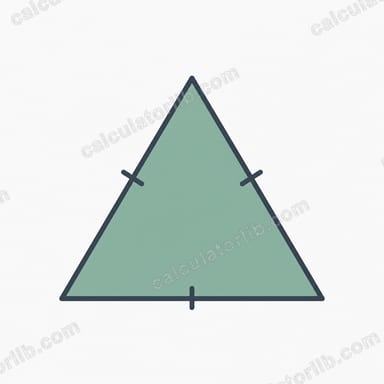
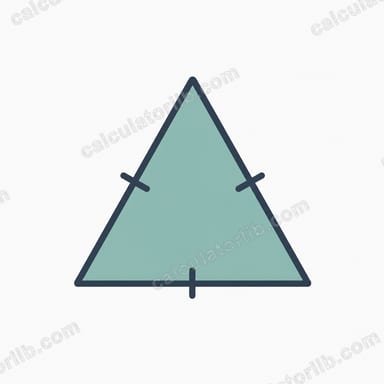
This tool computes the area of a triangle when you know the lengths of all three sides, using Heron's formula. You do not need the height or any angles — just the three sides. Heron's formula works for any triangle (scalene, isosceles, equilateral, acute, right or obtuse), making it one of the most versatile area formulas in geometry.
How to use it
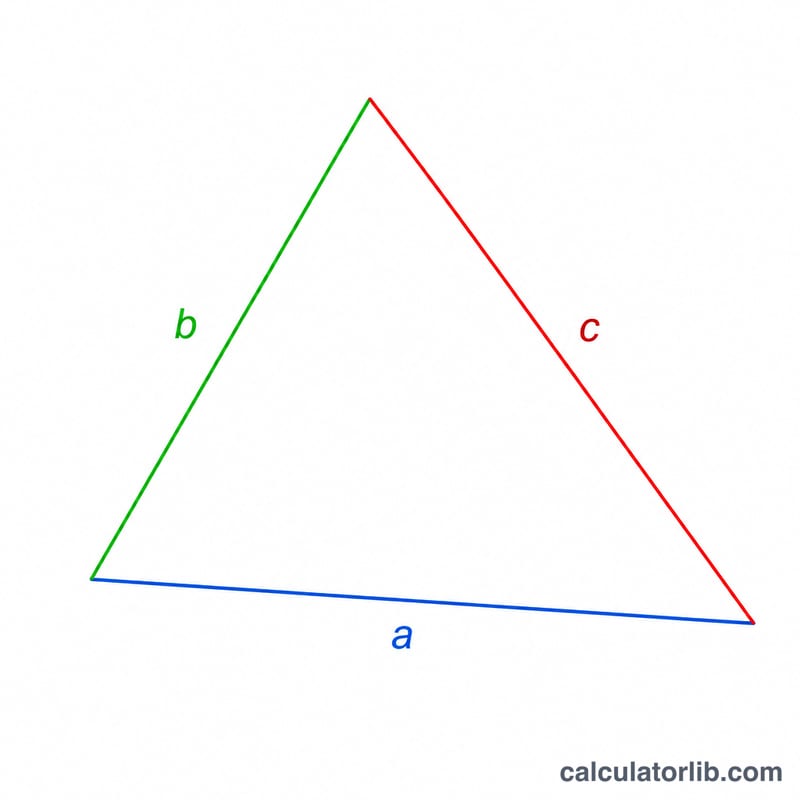
Enter the three side lengths labeled a, b and c. They must all be measured in the same unit (all centimeters, all inches, etc.) — there is no unit dropdown. The result, area S, comes out in that unit squared. For example, if you enter sides in meters, the area is in square meters. All three sides must be positive numbers.
The formula explained
First the calculator finds the semi-perimeter, which is half the perimeter: \( s = \frac{a + b + c}{2} \). Then it applies $$ S = \sqrt{s\,(s - a)\,(s - b)\,(s - c)} $$ Each factor \((s - a)\), \((s - b)\) and \((s - c)\) must be positive; this is exactly the triangle inequality requirement — any two sides must add up to more than the third. If the sides cannot form a real triangle, the value under the square root would be negative and the calculator reports an error instead of a number.
Worked example
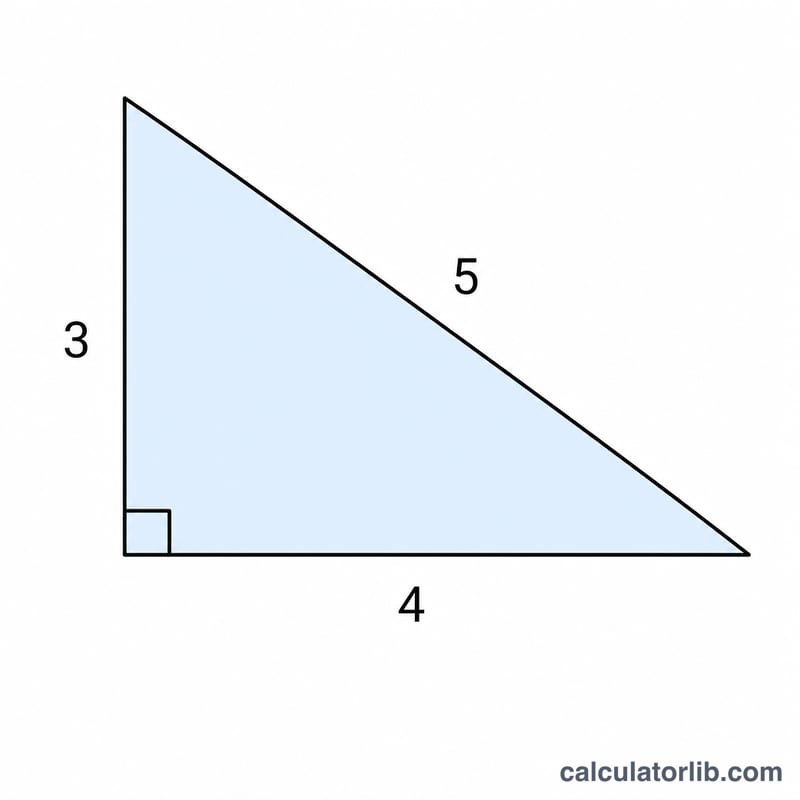
Take a 3-4-5 right triangle: \(a = 5\), \(b = 4\), \(c = 3\). The semi-perimeter is \( s = \frac{5 + 4 + 3}{2} = 6 \). Then $$ S = \sqrt{6\,(6-5)\,(6-4)\,(6-3)} = \sqrt{6 \cdot 1 \cdot 2 \cdot 3} = \sqrt{36} = 6 $$ square units. This matches the standard right-triangle area \( \frac{1}{2} \cdot \text{base} \cdot \text{height} = \frac{1}{2} \cdot 3 \cdot 4 = 6 \).
FAQ
What if the sides don't form a triangle? If the largest side is greater than or equal to the sum of the other two, no triangle exists and the calculator shows a "Not a valid triangle" error.
Do the sides need a specific unit? No — any unit works as long as all three sides share it. The area is reported in that unit squared.
Does it work for equilateral and isosceles triangles? Yes. Heron's formula works for every valid triangle regardless of shape.