
What Is Real Wage Growth?
Real wage growth measures how much your earning power actually changes after accounting for inflation. A 5% pay rise sounds great, but if prices rose 8% over the same period, your money buys less than before. This is especially relevant during stagflation — a period of high inflation combined with stagnant wages and weak economic growth — when nominal raises routinely fail to keep up with the cost of living.
How to Use This Calculator
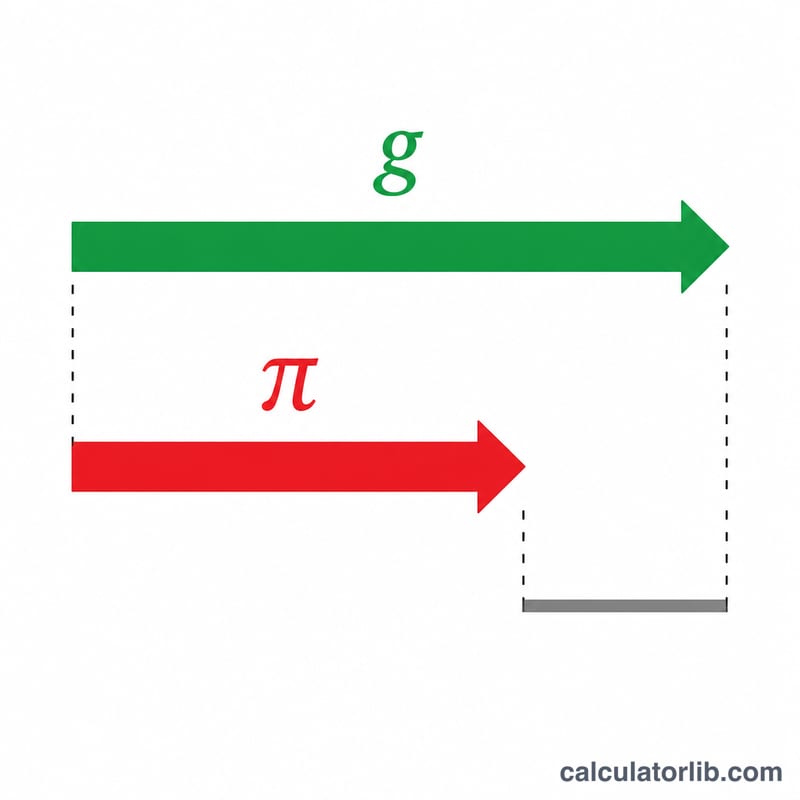
Enter your nominal wage growth — the headline percentage increase in your pay — and the inflation rate over the same period. The calculator returns your real wage growth as a percentage. A positive number means your purchasing power improved; a negative number means you effectively took a pay cut in real terms.
The Formula Explained
The precise formula is:
$$\text{Real Wage Growth} = \left( \frac{1 + \dfrac{\text{Nominal Growth (\%)}}{100}}{1 + \dfrac{\text{Inflation (\%)}}{100}} - 1 \right) \times 100$$
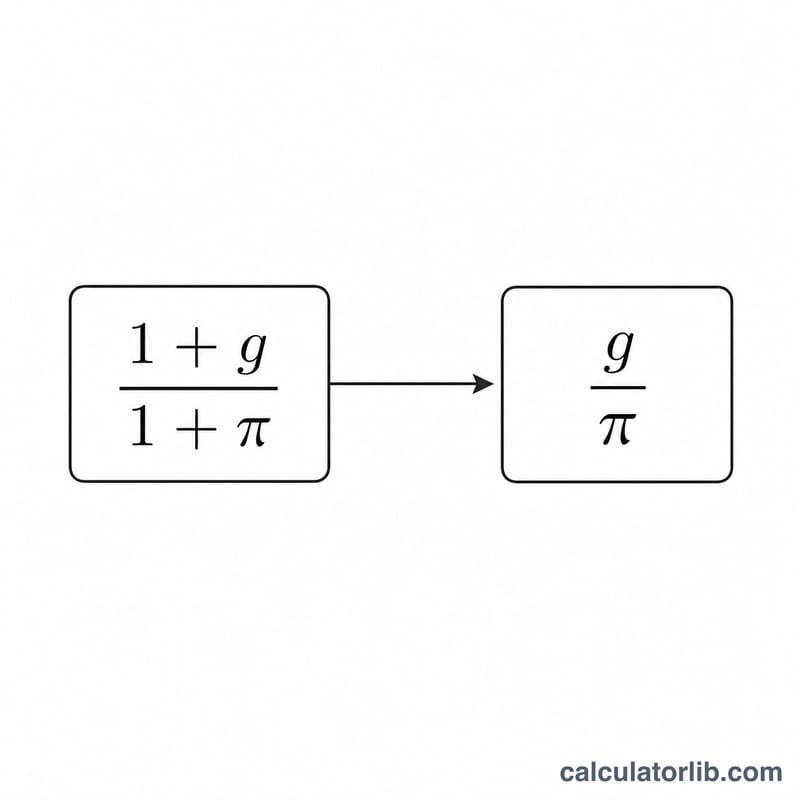
Both rates are expressed as decimals. Dividing the wage factor by the inflation factor isolates the genuine change in buying power. A common shortcut simply subtracts inflation from the nominal rise, but the division method is more accurate, particularly when rates are large — which is exactly the case under stagflation.
Worked Example
Suppose you receive a 5% raise while inflation runs at 8%. Plugging in: $$\left( \frac{1.05}{1.08} \right) - 1 = 0.97222 - 1 = -0.02778$$ or about −2.78%. Despite a "raise," your real income fell by roughly 2.78%. The simple subtraction method would have estimated −3%, slightly overstating the loss.
FAQ
Why not just subtract inflation from my raise? Subtraction is a quick approximation. The division formula correctly compounds the two rates and is the standard economic definition.
What does a negative result mean? Your wage increase did not keep pace with prices, so your purchasing power declined — a real-terms pay cut.
Can I use this for salary or hourly pay? Yes. The percentages are unitless, so it works for any wage measure as long as both figures cover the same time period.