

What Is a Living Wage?
A living wage is the hourly pay a person must earn to cover their basic cost of living — housing, food, transportation, healthcare, and other essentials — without falling into financial hardship. Unlike a legal minimum wage, which is set by governments, a living wage is tied directly to real-world expenses in your area. This calculator helps you work out the exact hourly rate you need based on your own yearly costs and the number of hours you work each week.
How to Use This Calculator
Enter your total annual living costs (the full amount you need to spend in a year) and the number of hours you work per week. The calculator assumes a standard 52-week year and divides your annual costs by the total hours you work to reveal the hourly wage required to break even.
The Formula Explained
The core calculation is simple:
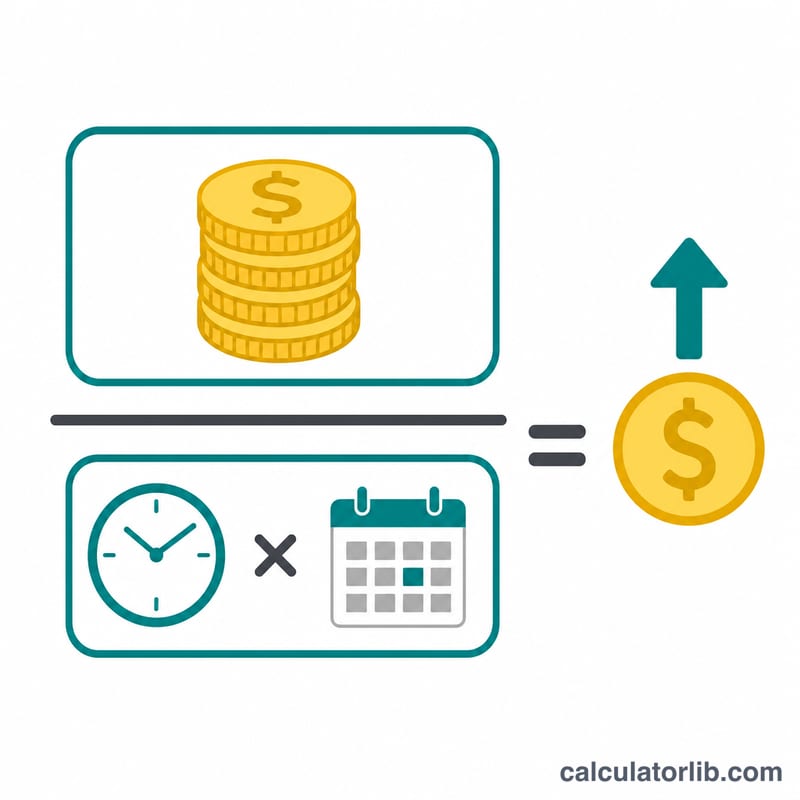
$$\text{Living Wage} = \dfrac{\text{Annual Living Costs}}{\text{Hours per Week} \times 52}$$
First, weekly hours are multiplied by 52 to get total annual working hours. Your annual living costs are then divided by that figure to give the per-hour amount you must earn.
Worked Example
Suppose your annual living costs are $45,000 and you work 40 hours per week. Your total annual hours are $$40 \times 52 = 2{,}080.$$ Dividing $45,000 by 2,080 gives approximately $21.63 per hour. That means you'd need to earn at least $21.63 an hour to cover your essential expenses.
FAQ
Does this include taxes? No. The result is a gross break-even figure based on your stated costs. If you want to cover taxes, increase your annual living costs accordingly or use your post-tax income needs.
Why 52 weeks? A standard year contains 52 weeks. If you take unpaid time off, reduce your weekly hours or adjust your annual costs to reflect actual paid hours.
Is a living wage the same as minimum wage? No. Minimum wage is a legal floor set by law, while a living wage reflects the true cost of living and is usually higher.