
What Is a PTO Payout?
Paid Time Off (PTO) payout is the cash value of vacation or paid leave hours you have earned but not used. Many employers pay out unused PTO when you leave a job, and some allow cash-outs during employment. This calculator gives you a quick estimate of the gross dollar value of your accrued PTO based on your hourly rate.
How to Use It
Enter the number of unused PTO hours you have accrued and your hourly pay rate. The calculator multiplies the two to show your gross payout. If you are salaried, convert your annual salary to an hourly rate first: divide your annual salary by your total yearly work hours (typically 2,080 for full-time).
The Formula Explained
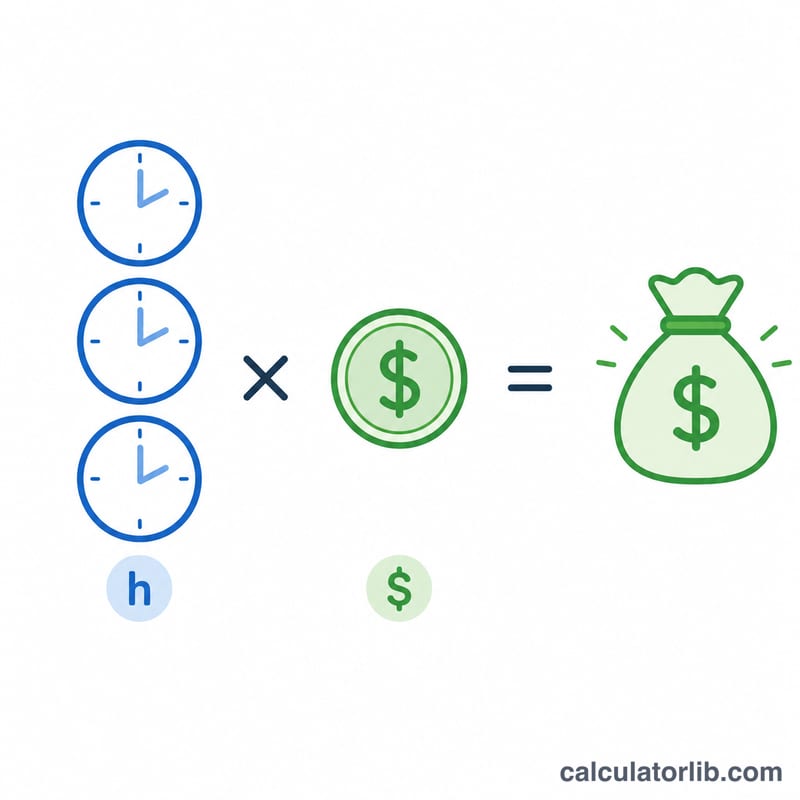
The calculation is straightforward: $$\text{Payout} = \text{Accrued Hours} \times \text{Hourly Rate}$$. For example, 80 accrued hours at $25/hour gives \(80 \times 25 = \$2{,}000\). This figure is gross pay — taxes, Social Security, and other withholdings will reduce the actual amount you receive.
Worked Example
Suppose you are leaving a job with 120 hours of unused vacation and earn $30 per hour. Your estimated payout is \(120 \times 30 = \$3{,}600\) gross. After typical withholding, your take-home amount will be lower.
FAQ
Is PTO payout taxed? Yes. PTO payouts are treated as supplemental wages and are subject to income tax, Social Security, and Medicare withholding.
Do all employers pay out unused PTO? No. Payout rules vary by employer and by state/country law. Some jurisdictions require payout of accrued vacation; others let company policy decide.
What if I'm salaried? Convert your salary to an hourly rate (annual salary ÷ annual work hours, e.g. ÷ 2,080) before entering it here.