
What Is the Dividend Payout Ratio?
The dividend payout ratio measures the proportion of a company's net income that is paid out to shareholders as dividends. It is a key metric for income investors because it shows how much of the company's profit is returned to owners versus how much is retained to fund growth. A high ratio signals a generous, mature dividend payer, while a low ratio suggests the company is reinvesting in its own expansion.
How to Use This Calculator
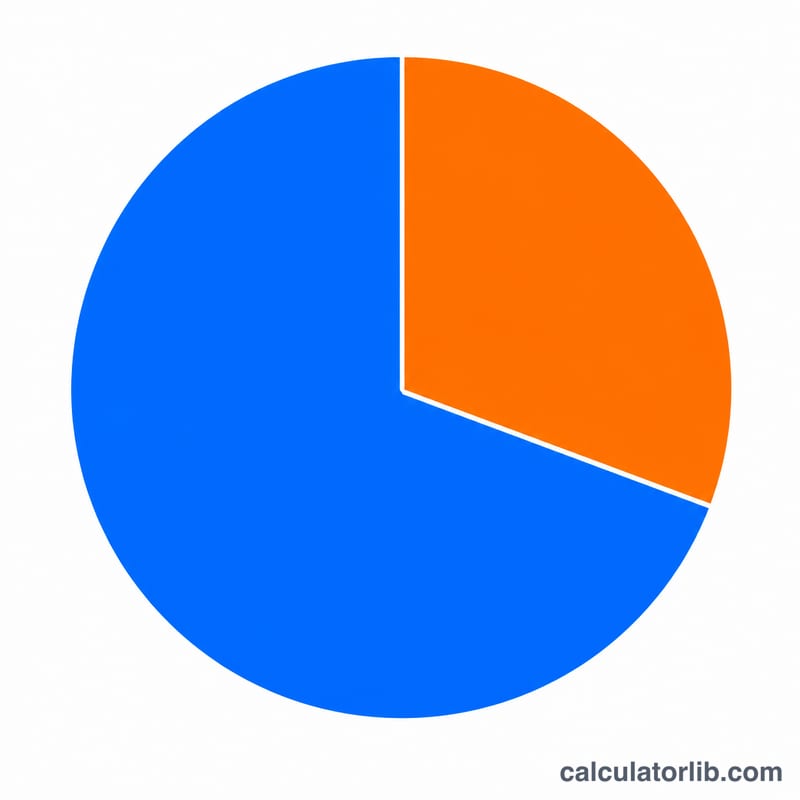
Enter the total dividends paid during the period and the company's net income for the same period (both figures are usually found on the income statement and cash flow statement). The calculator returns the payout ratio as a percentage, along with the retention ratio — the percentage of earnings the company keeps.
The Formula Explained
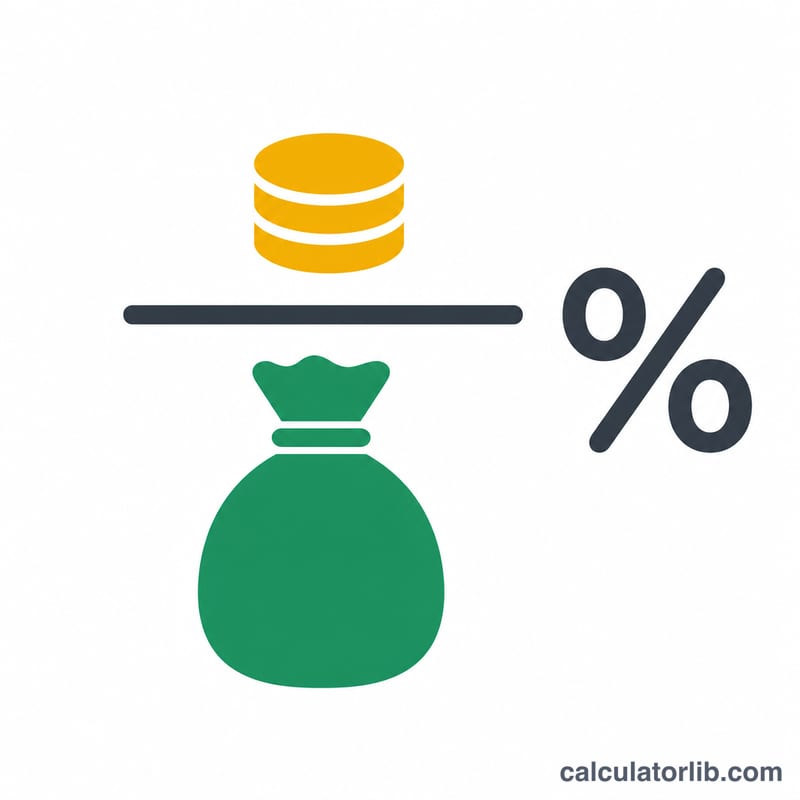
$$\text{Payout Ratio} = \frac{\text{Total Dividends Paid}}{\text{Net Income}} \times 100\%$$ You can also compute it on a per-share basis as \(\text{Dividends per Share} \div \text{Earnings per Share}\), which gives an identical result. The retention ratio is simply \(100\%\) minus the payout ratio, representing reinvested profits.
Worked Example
Suppose a company earns $200,000 in net income and pays $50,000 in dividends. The payout ratio is $$50{,}000 \div 200{,}000 = 0.25 = 25\%.$$ This means the company distributes \(25\%\) of its profit to shareholders and retains the remaining \(75\%\) for reinvestment or debt reduction.
FAQ
What is a good payout ratio? It depends on the industry. Mature utilities may pay 60–80%, while growth companies often pay 0–25% (or nothing) to fund expansion. Ratios above 100% mean a company is paying more than it earns, which may be unsustainable.
Can the ratio exceed 100%? Yes, if dividends paid are larger than net income. This can happen temporarily but is generally a warning sign.
Is payout ratio the same as dividend yield? No. Payout ratio compares dividends to earnings, while dividend yield compares the annual dividend to the share price.