
What Is the Dividend Income Calculator?
This calculator helps investors estimate the cash income they will receive from dividend-paying stocks. By entering the number of shares you own, the dividend paid per share, and the current share price, you instantly see your total annual dividend income, your dividend yield, and how much you'll receive in each individual payment. It works for any market and currency — the math is universal.
How to Use It
Enter the number of shares you hold, the annual dividend per share (the total declared for the year), the current price of one share, and how often dividends are paid. The tool multiplies shares by dividend per share to get your yearly income, divides the dividend per share by the price to get yield, and splits the yearly income across your chosen payment frequency.
The Formula Explained
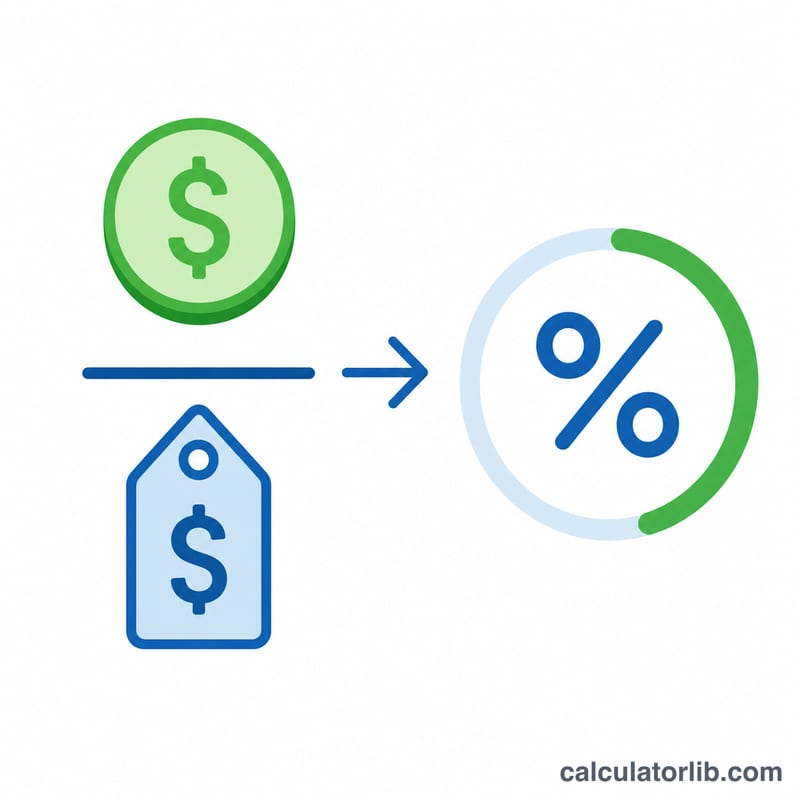
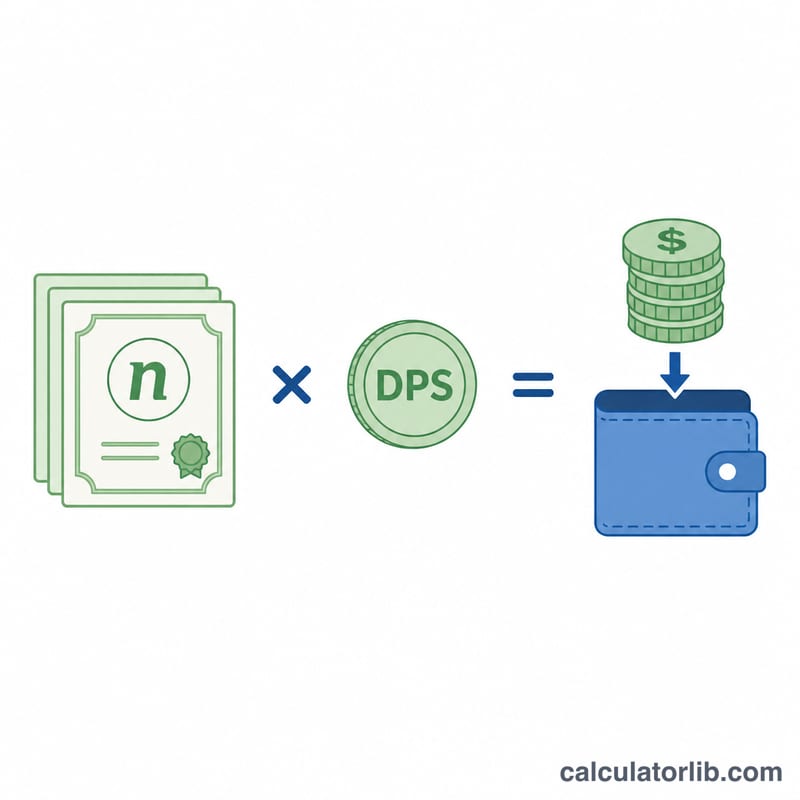
The core relationships are simple. Annual income is shares × dividend per share. Yield is (dividend per share ÷ share price) × 100, expressed as a percentage that lets you compare income against the price you pay. Income per payment is the annual figure divided by the number of payments per year (1 for annual, 2 semi-annual, 4 quarterly, 12 monthly).
$$\text{Annual Dividend} = \text{Shares} \times \text{Dividend per Share}$$
$$\text{Yield} = \frac{\text{Dividend per Share}}{\text{Share Price}} \times 100$$
Worked Example
Suppose you own 100 shares paying $2.50 per share annually, with a share price of $50, paid quarterly. Annual dividend = $$100 \times \$2.50 = \mathbf{\$250}$$ Yield = $$\left(2.50 \div 50\right) \times 100 = \mathbf{5\%}$$ Each quarterly payment = $$\$250 \div 4 = \mathbf{\$62.50}$$ Total invested = $$100 \times \$50 = \mathbf{\$5{,}000}$$
FAQ
Is dividend yield the same as total return? No. Yield only measures income relative to price; it ignores capital gains or losses from price movement.
Should I use forward or trailing dividends? Use the figure that matches your goal — trailing reflects the past 12 months, forward estimates the next 12 based on the latest declared rate.
Does a high yield mean a better investment? Not always. An unusually high yield can signal a falling share price or an unsustainable payout, so review the company's fundamentals too.