
What Is the Passive Income Calculator?
This calculator estimates how much regular income an investment can generate without active work. By entering the amount you have invested and the expected annual yield (the percentage return the investment pays each year), it shows your projected monthly, weekly, daily and annual passive income. It works for any income-producing asset measured by a yield — dividend stocks, bonds, REITs, savings accounts, rental yield estimates and high-yield ETFs.
How to Use It
Enter your invested amount in dollars and the annual yield as a percentage. For example, a dividend ETF paying a 4% yield would use 4. Click calculate and you'll see the income broken down across different time periods so you can plan budgets, retirement goals or reinvestment strategies.
The Formula Explained
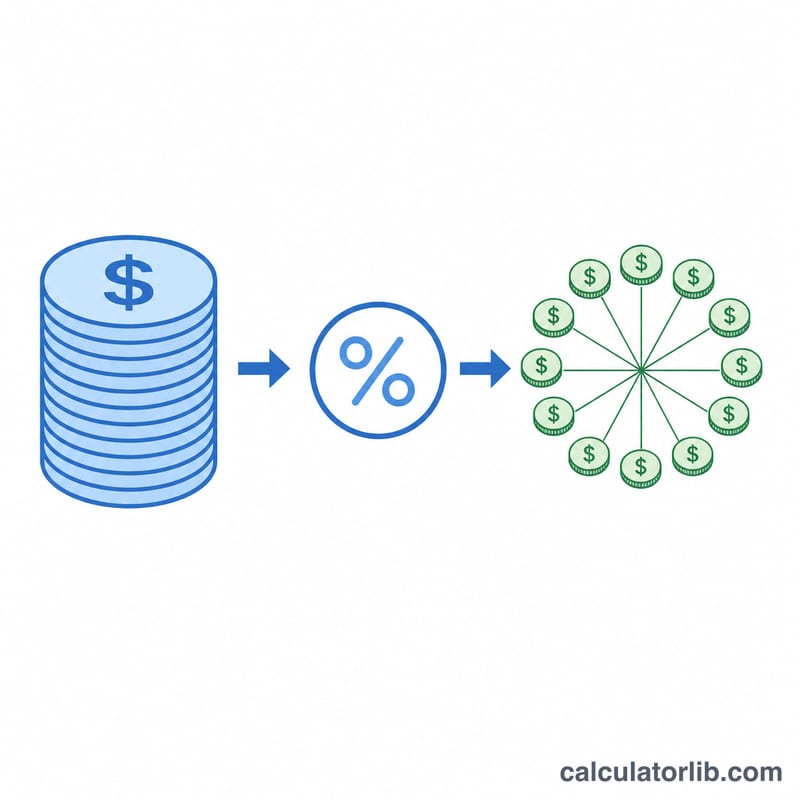
The core equation is simple: $$\text{Monthly Income} = \frac{\text{Invested Amount} \times \text{Annual Yield}}{12}$$ The annual yield percentage is first converted to a decimal (divide by 100). Multiplying by the invested amount gives the total income earned in a year, and dividing by 12 spreads it evenly across the months. The same annual figure divided by 52 gives weekly income and by 365 gives daily income.
Worked Example
Suppose you invest $100,000 at a 5% annual yield. The annual income is $$\$100{,}000 \times 0.05 = \$5{,}000.$$ Dividing by 12 gives roughly \(\$416.67\) per month, about \(\$96.15\) per week, and around \(\$13.70\) per day. Doubling the yield to 10% would double every figure.
FAQ
Does this account for compounding? No — it assumes income is withdrawn rather than reinvested, giving a steady payout figure. Reinvesting would grow the balance and future income.
Is the yield the same as total return? Not necessarily. Yield reflects income payments only and ignores price appreciation or depreciation of the asset.
Does it include taxes? No. The results are gross income before any taxes or fees, which vary by jurisdiction and account type.