
What This Calculator Does
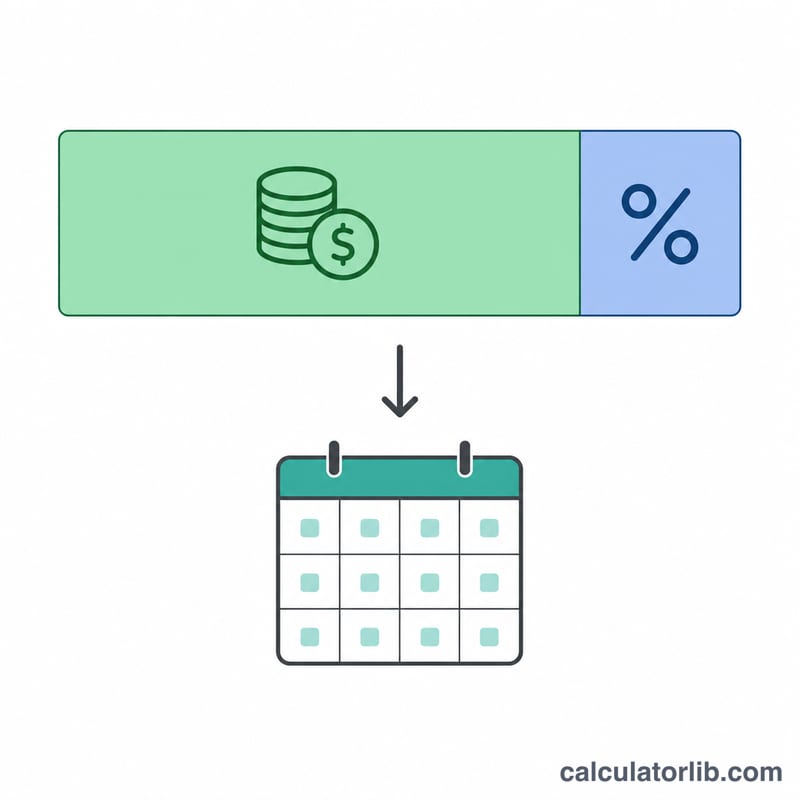
The Monthly Take-Home Pay Calculator converts an annual gross salary into the amount you actually keep each month after tax. It uses a single effective tax rate, making it a quick, country-neutral estimate of net monthly income. Because deductions vary widely by location and personal circumstances, this tool intentionally keeps things simple: you supply the overall percentage of your salary lost to tax, and it does the arithmetic.
How to Use It
Enter your annual gross salary (before any deductions) and your effective tax rate as a percentage. The effective rate is total tax paid divided by gross salary — not your top marginal bracket. The calculator then shows your monthly net pay along with monthly gross, monthly tax, and your annual net and tax figures so you can sanity-check the result.
The Formula Explained
The core formula is $$\text{monthly\_net} = \dfrac{\text{annual\_salary} - \text{annual\_tax}}{12}$$, where \(\text{annual\_tax} = \text{annual\_salary} \times (\text{tax\_rate} / 100)\). First the yearly tax is subtracted from gross pay to give annual net income, then that figure is spread evenly across the twelve months of the year.
Worked Example
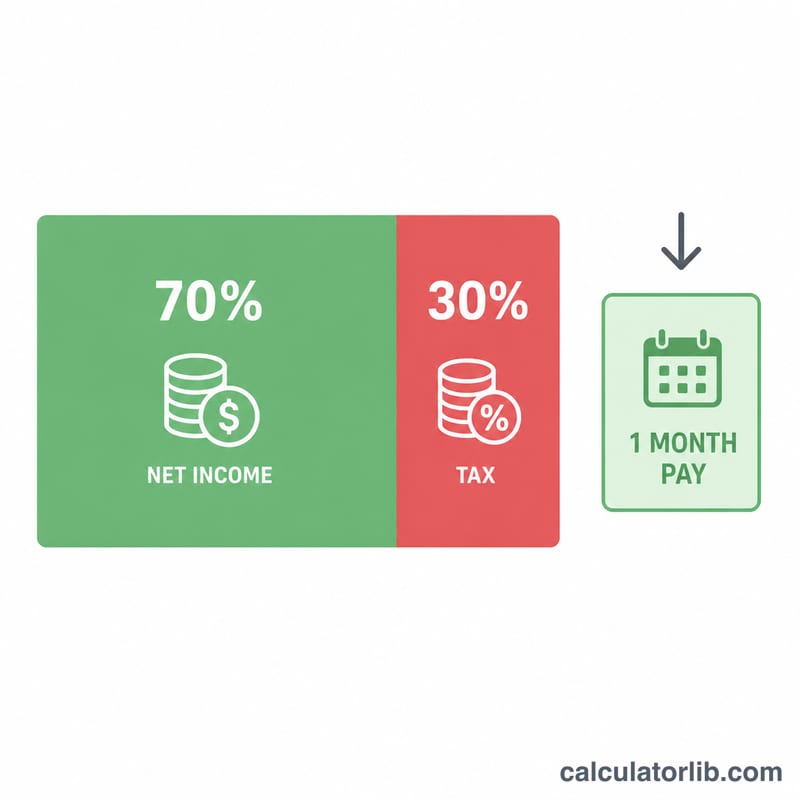
Suppose you earn £60,000 a year with an effective tax rate of 20%. Annual tax is $$60{,}000 \times 0.20 = £12{,}000.$$ Annual net is $$60{,}000 - 12{,}000 = £48{,}000.$$ Dividing by 12 gives a monthly take-home pay of £4,000. Your monthly gross would be £5,000 and monthly tax £1,000.
FAQ
Is this calculator country-specific? No. It works anywhere because you provide the effective tax rate yourself rather than relying on a fixed tax schedule.
What about pension, insurance or other deductions? They are not modelled separately. To include them, fold their cost into the effective tax rate, or treat the result as pre-pension take-home.
Why use an effective rate instead of brackets? Progressive tax systems differ enormously. A single effective rate keeps the tool universal and lets you plug in figures from a payslip or tax return.