

What Is EPS Growth?
Earnings per share (EPS) growth measures how much a company's profit per outstanding share has increased or decreased between two reporting periods. It is one of the most widely watched indicators of corporate performance because it captures profitability on a per-share basis, isolating the value created for each shareholder. A consistently rising EPS often signals an expanding, well-managed business, while falling EPS can flag slowing demand, margin pressure, or share dilution.
How to Use This Calculator
Enter the beginning EPS (the earnings per share at the start of the period) and the ending EPS (the value at the end of the period). The calculator instantly returns the percentage growth and the absolute change in EPS. You can compare two quarters, two fiscal years, or any two points in time as long as both numbers are measured the same way (basic vs. diluted, GAAP vs. adjusted).
The Formula Explained
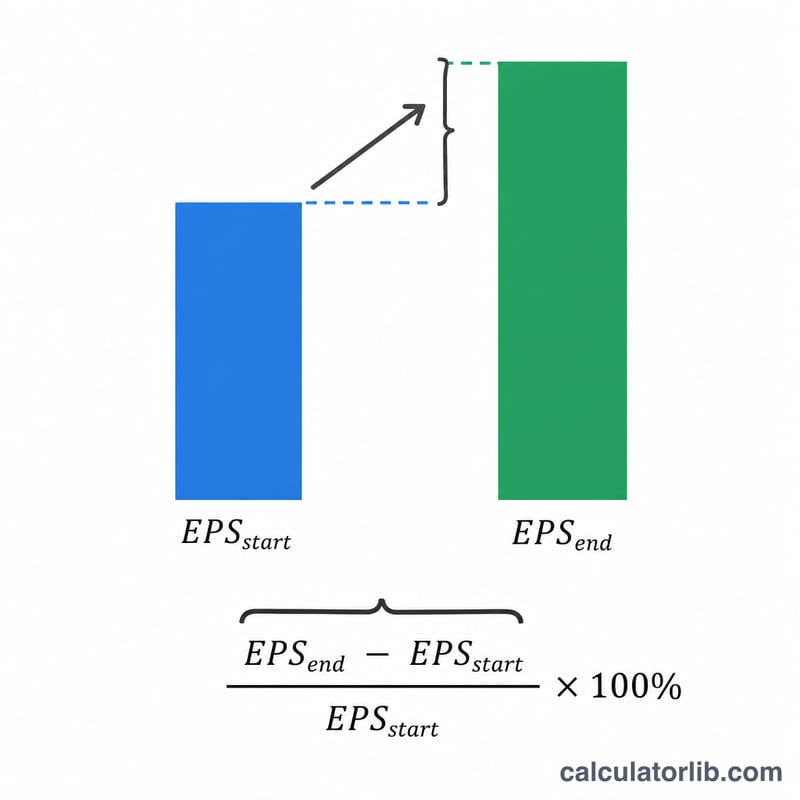
The growth rate is calculated as:
$$\text{EPS Growth} = \frac{\text{EPS}_{end} - \text{EPS}_{start}}{\text{EPS}_{start}} \times 100$$
You subtract the starting EPS from the ending EPS to get the change, divide by the starting EPS to express it relative to the original level, then multiply by 100 to convert to a percentage. A positive result means EPS grew; a negative result means it declined.
Worked Example
Suppose a company reported EPS of $2.50 last year and $3.00 this year. The change is \(\$3.00 - \$2.50 = \$0.50\). Dividing by the starting value gives \(0.50 / 2.50 = 0.20\), and multiplying by 100 yields a 20% EPS growth for the year.
FAQ
What is a good EPS growth rate? It varies by industry and stage. Many investors look for double-digit growth in established companies, but context matters — compare against peers and the company's own history.
Can EPS growth be negative? Yes. If ending EPS is lower than beginning EPS, the growth rate is negative, indicating shrinking per-share profitability.
Why use EPS instead of total earnings? EPS adjusts for the number of shares outstanding, so it reflects the impact of dilution or buybacks on shareholders, making it more comparable across time and companies.