
What Is the Intrinsic Value Calculator?
The intrinsic value of a stock is an estimate of its true, fundamental worth — independent of its current market price. This calculator uses Benjamin Graham's classic formula, first published in The Intelligent Investor, to provide a quick back-of-the-envelope valuation based on a company's earnings and its expected growth.
How to Use It
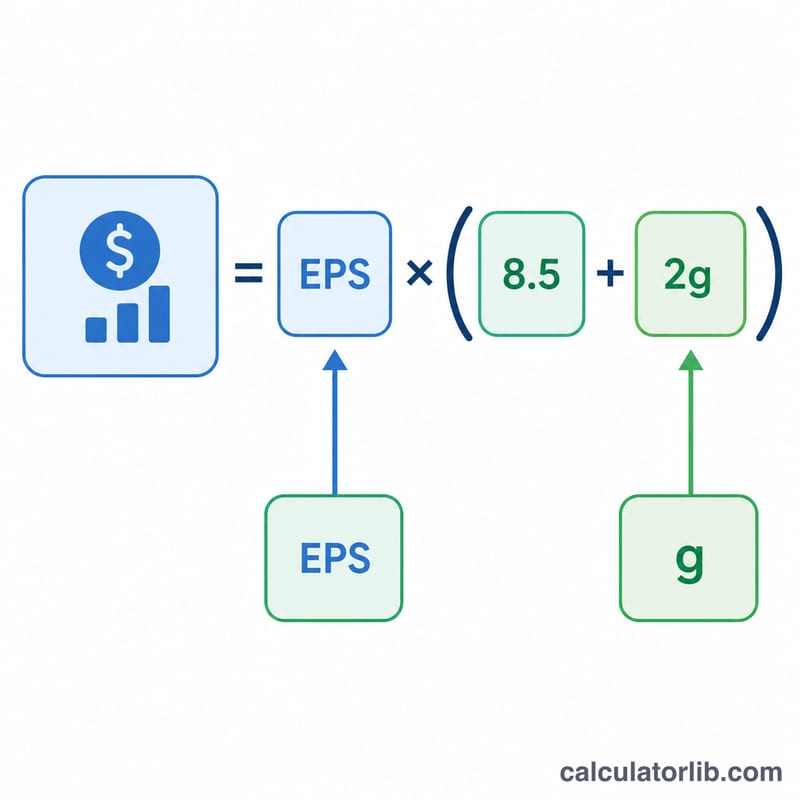
Enter two numbers: the company's Earnings Per Share (EPS) — typically the trailing twelve months figure — and your estimate of its expected annual growth rate over the next 7–10 years, as a percentage. The calculator multiplies EPS by a price/earnings multiplier of 8.5 plus twice the growth rate, returning the intrinsic value per share. Compare this figure to the current market price: a price well below intrinsic value may indicate an undervalued stock.
The Formula Explained
Graham's formula is $$V = \text{EPS} \times \left(8.5 + 2g\right)$$ The constant 8.5 represents the base P/E ratio Graham assigned to a company with no growth. The term \(2g\) adds value for expected growth: each percentage point of growth adds 2 to the multiplier. So a company growing 10% per year earns a multiplier of \(8.5 + 20 = 28.5\).
Worked Example
Suppose a company reports EPS of $5 and you expect 10% annual growth. The multiplier is \(8.5 + (2 \times 10) = 28.5\). Intrinsic value $$= \$5 \times 28.5 = \$142.50$$ per share. If the stock trades at $100, Graham's formula suggests it may be undervalued.
FAQ
Is this formula still accurate? It is a simplified heuristic. Graham himself later revised it to account for prevailing interest rates. Treat the result as a rough screening tool, not a precise valuation.
What growth rate should I use? Use a conservative long-term estimate (often 5–15%) based on historical earnings growth and realistic expectations — avoid extrapolating short-term spikes.
Does it work for unprofitable companies? No. With zero or negative EPS the formula breaks down, so it is best applied to established, profitable businesses.