
What Is Market Capitalization?
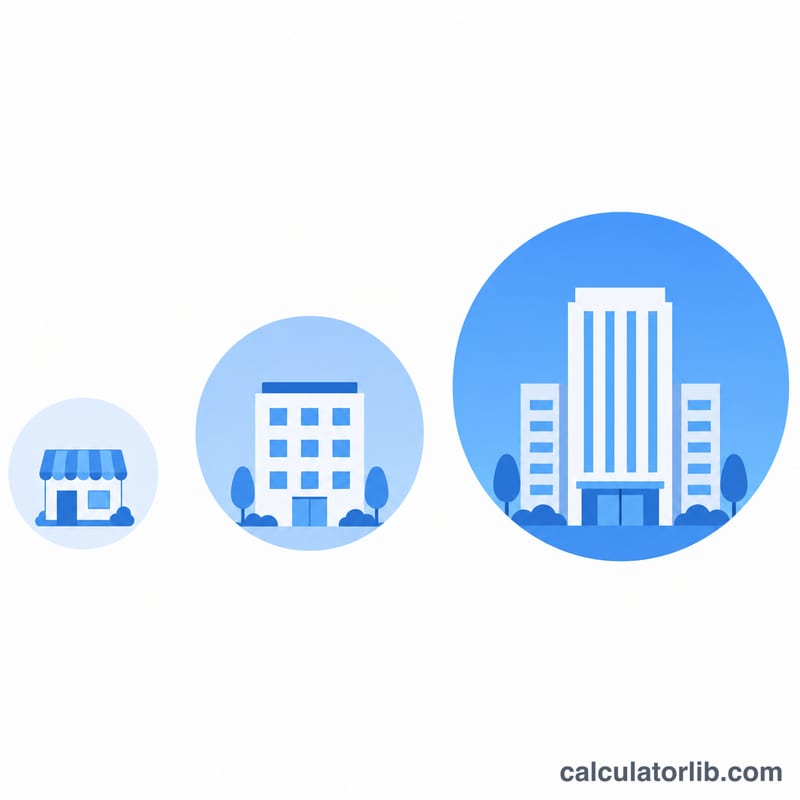
Market capitalization, or "market cap," is the total dollar value of a publicly traded company's outstanding shares of stock. It represents what the market collectively believes the company's equity is worth at a given moment. Market cap is one of the most widely used metrics for sizing companies and is the basis for classifications like large-cap, mid-cap, and small-cap.
How to Use This Calculator
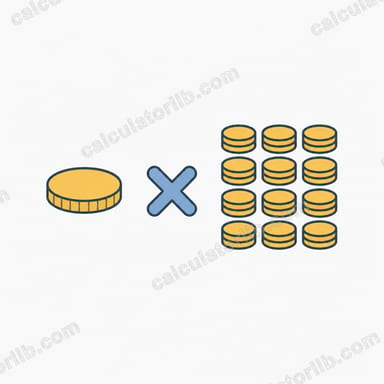
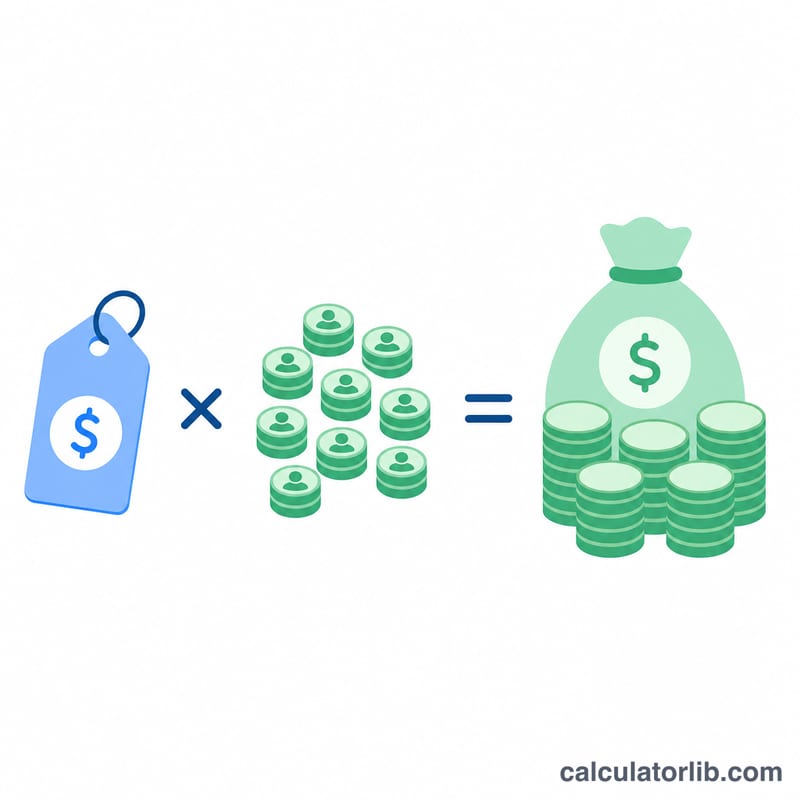
Enter the current share price (the price of one share of stock) and the total shares outstanding (the number of shares the company has issued and that are held by investors). The calculator multiplies the two values and returns the market cap in dollars, along with convenient conversions to millions and billions.
The Formula Explained
The calculation is straightforward:
$$\text{Market Cap} = \text{Share Price (\$)} \times \text{Total Shares Outstanding}$$
Because share price changes constantly during trading, market cap fluctuates in real time. Shares outstanding can change too — through buybacks, new issuance, or stock splits — so always use the most recent figures for an accurate result.
Worked Example
Suppose a company's stock trades at $150 per share and it has 1,000,000,000 (one billion) shares outstanding. Its market cap is:
$$\$150 \times 1{,}000{,}000{,}000 = \$150{,}000{,}000{,}000$$ or $150 billion. This would place the company firmly in large-cap territory.
FAQ
Is market cap the same as company value? Not exactly. Market cap measures equity value only. Enterprise value adds net debt and is often a better measure of total takeover cost.
What counts as large-cap? Conventionally, companies above roughly $10 billion are large-cap, $2–10 billion are mid-cap, and under $2 billion are small-cap.
Why does market cap change daily? Because share price moves with supply and demand in the market, the market cap recalculates every time the price ticks up or down.