

What Is the Price to Earnings Ratio?
The price-to-earnings (P/E) ratio is one of the most widely used valuation metrics in investing. It tells you how much investors are willing to pay for each dollar of a company's earnings. A P/E of 20 means the market values the stock at 20 times its annual per-share profit. This calculator works for stocks in any market — the metric itself is universal.
How to Use This Calculator
Enter the current price per share (what one share trades for) and the company's earnings per share (EPS) — net profit divided by the number of outstanding shares. The tool returns the P/E ratio and the corresponding earnings yield. Use trailing EPS for a trailing P/E or forecast EPS for a forward P/E.
The Formula Explained
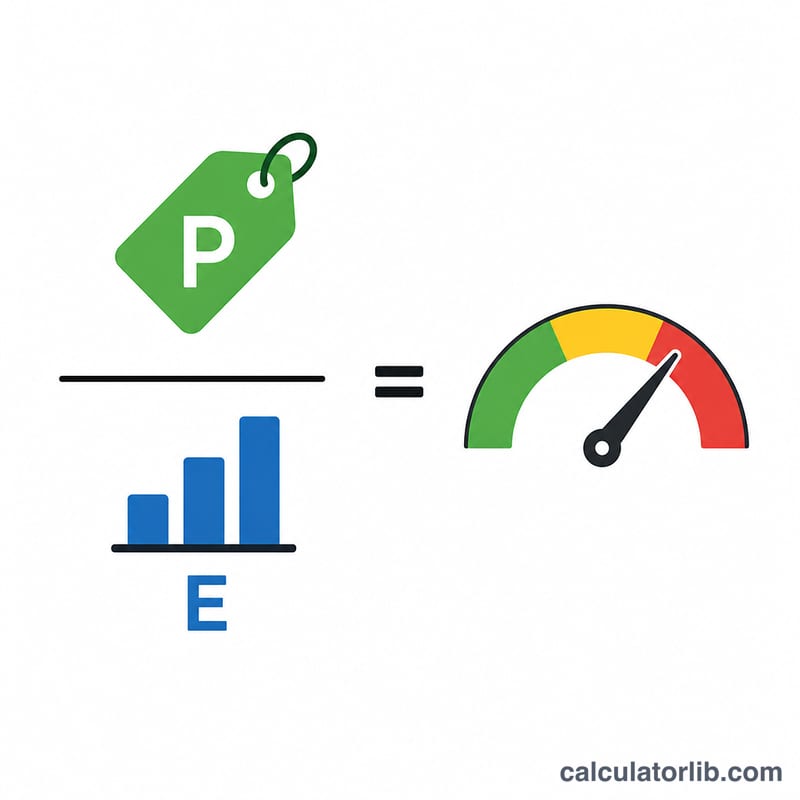
The formula is simply $$\text{P/E} = \frac{\text{Price per Share}}{\text{Earnings per Share}}$$ The earnings yield is the reciprocal: $$\text{Earnings Yield} = \frac{\text{Earnings per Share}}{\text{Price per Share}} \times 100\%$$ which expresses your potential return as a percentage and makes comparison with bond yields easier.
Worked Example
Suppose a stock trades at $150 and reported EPS of $5. The P/E ratio is $$150 \div 5 = 30$$ The earnings yield is $$5 \div 150 \times 100 = 3.33\%$$ A P/E of 30 means investors pay $30 for each $1 of yearly earnings.
FAQ
Is a high P/E good or bad? Neither inherently. A high P/E can signal strong growth expectations or overvaluation; a low P/E can mean a bargain or a struggling business. Always compare within the same industry.
What if EPS is negative? A company with negative earnings has no meaningful P/E ratio — it is typically reported as "N/A".
What is a "normal" P/E? Historically the broad market has averaged roughly 15–20, but this varies widely by sector, growth stage, and economic conditions.