
What is the Price Calculator?
This Price Calculator works out the selling price you should charge per unit to reach a desired profit margin, starting from your unit cost. It also reports your markup on cost, profit per unit, and the total price and profit across any quantity you sell. It is a universal pricing tool with no currency or country restrictions — enter values in any consistent currency.
How to use it
Enter the unit cost (what it costs you to make or buy one item), the profit margin you want as a percentage of the selling price, and the quantity you expect to sell. The calculator returns the price per unit and rolls it up into totals. Margin must be below 100% because a 100% margin would require an infinite price.
The formula explained
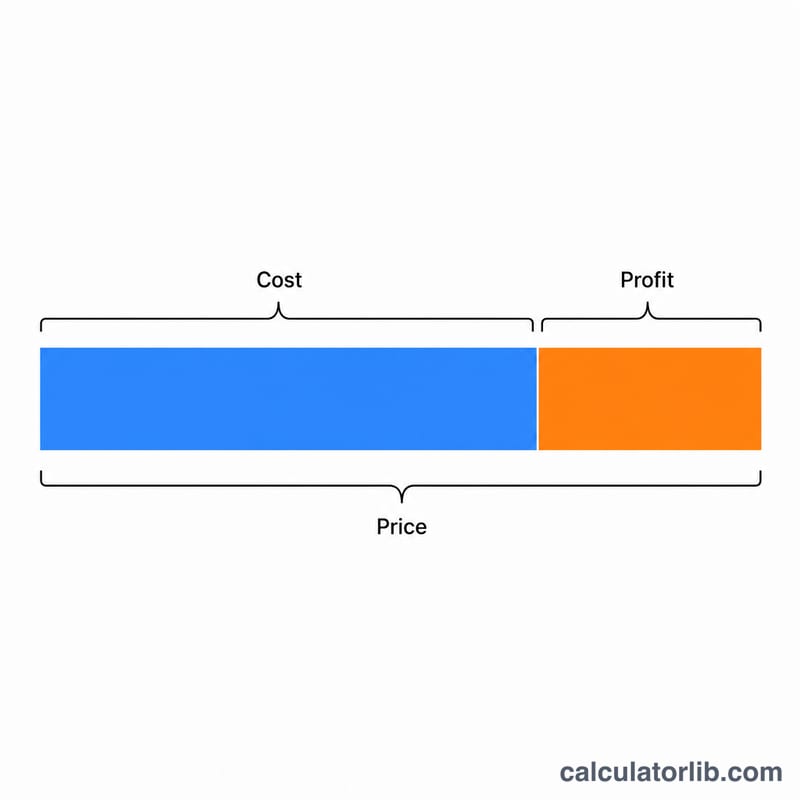
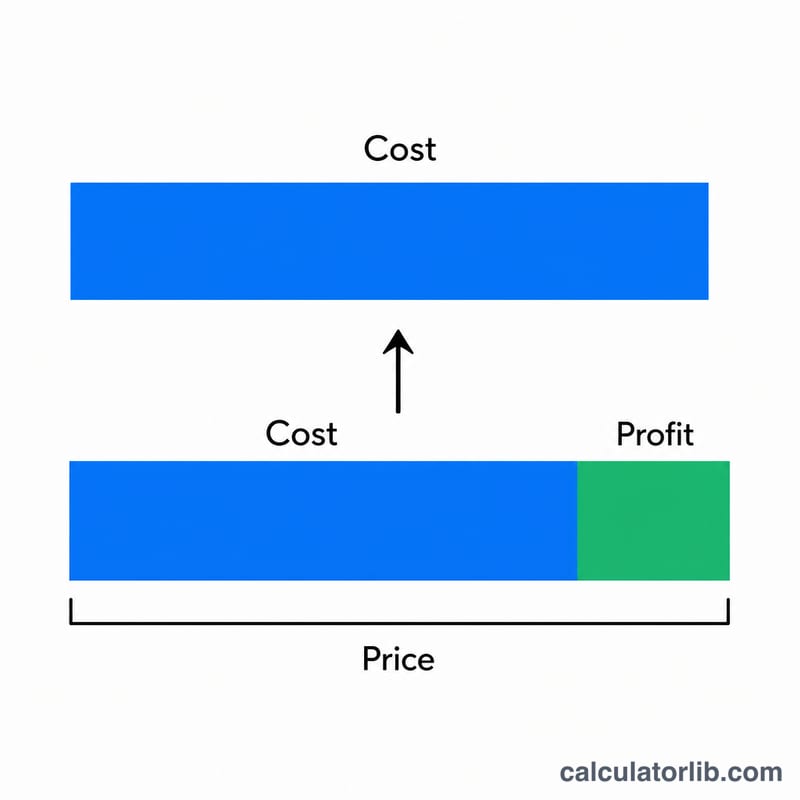
Margin is profit expressed as a fraction of the selling price, so price equals cost divided by (1 − margin). For example, a 40% margin means cost makes up 60% of the price, so $$\text{Price} = \text{Cost} \div 0.60$$ Markup, by contrast, expresses profit as a fraction of cost: $$\text{Markup} = (\text{Price} - \text{Cost}) \div \text{Cost}$$ The two are easy to confuse, which is why this tool shows both.
Worked example
Suppose a product costs $20 and you want a 40% margin selling 10 units. $$\text{Price} = 20 \div (1 - 0.40) = 20 \div 0.60 = \$33.33 \text{ per unit}$$ Profit per unit = $13.33, markup = 66.67%, total price = $333.33 and total profit = $133.33.
FAQ
Is margin the same as markup? No. Margin is based on the selling price; markup is based on cost. A 40% margin equals a 66.7% markup.
Why can't I enter a 100% margin? A margin of 100% means cost is 0% of the price, which mathematically requires an infinite selling price, so margins must stay below 100%.
Can I price multiple units? Yes — set the quantity and the calculator shows total revenue and total profit for the whole batch.