
What Is Cost-Plus Pricing?
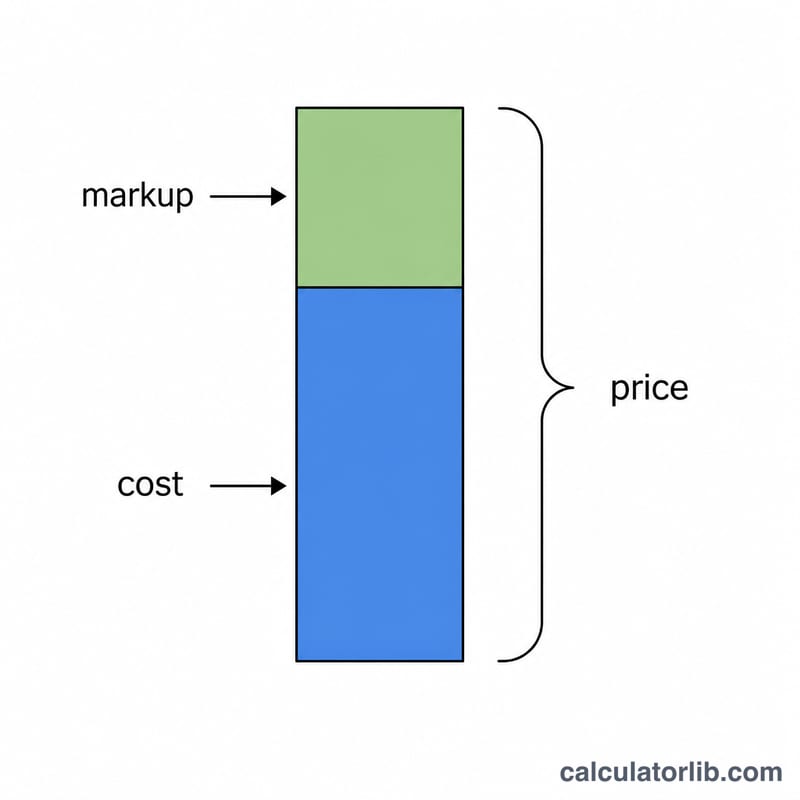
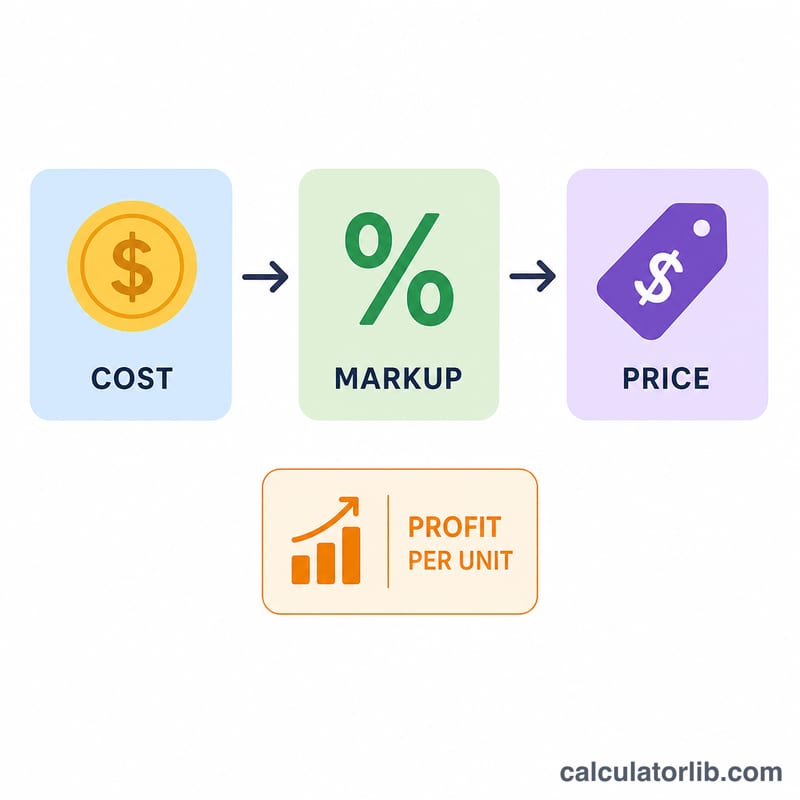
Cost-plus pricing is one of the simplest and most widely used pricing strategies. You take the cost of producing or buying a product and add a fixed percentage markup on top to arrive at the selling price. Because it ties price directly to cost, it guarantees that every sale covers expenses and adds a predictable layer of profit.
How to Use This Calculator
Enter the unit cost — the amount it costs you to produce or acquire one item — and the markup percentage you want to add. The calculator instantly returns the selling price, the profit earned per unit, and the resulting profit margin so you can sanity-check your pricing decision.
The Formula Explained
The core equation is $$\text{Price} = \text{Cost} \times \left(1 + \frac{\text{Markup\%}}{100}\right)$$ The markup percentage is applied to the cost, not the final price, which is the key distinction between markup and margin. Profit per unit is simply \(\text{Price} - \text{Cost}\), and the profit margin is that profit expressed as a percentage of the selling price.
Worked Example
Suppose a product costs you $50 and you want a 40% markup. The selling price is $$50 \times \left(1 + \frac{40}{100}\right) = 50 \times 1.40 = \$70$$ Your profit per unit is \(\$70 - \$50 = \$20\), and your profit margin is \(20 \div 70 \times 100 \approx 28.57\%\). Notice the margin (28.57%) is lower than the markup (40%) — they are never the same number.
FAQ
Is markup the same as margin? No. Markup is profit relative to cost, while margin is profit relative to the selling price. A 40% markup gives roughly a 28.6% margin.
What markup should I use? It varies by industry — retail often uses 50–100%, while groceries may use 10–15%. Pick a markup that covers overhead and your target profit.
Does this include taxes or shipping? Only if you add them into the unit cost. The calculator treats whatever you enter as "cost" as the full cost base.