What is a slope / grade calculator?
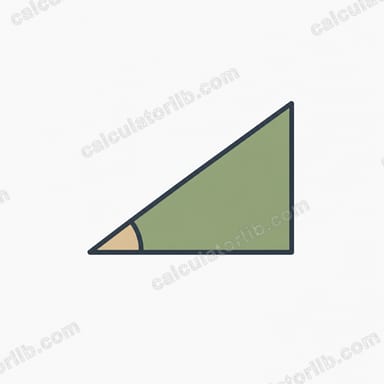
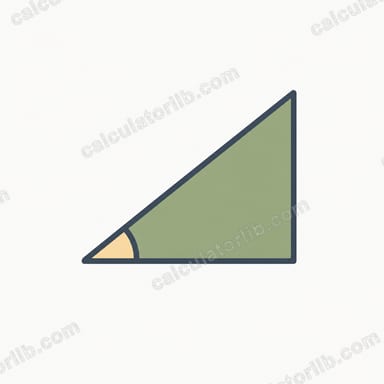
This tool converts a rise (vertical change) and a run (horizontal distance) into a slope expressed several useful ways: as a percent grade, as an angle of incline in degrees, as the true slope length (hypotenuse), and as a "1 in N" ratio. It works with any consistent unit — metres, feet, or inches — because grade and angle are dimensionless.
How to use it
Enter the rise and the run using the same units for both, then read the results. The percent grade is the headline figure most commonly used for roads, ramps, roofs and drainage. The angle is handy for construction and trigonometry, while the 1-in-N ratio is widely used for railways and accessibility ramps.
The formula explained
Grade is simply rise divided by run, multiplied by 100: $$\text{grade}\% = \frac{\text{rise}}{\text{run}} \times 100$$ The angle of incline is the arctangent of rise over run: $$\theta = \arctan\!\left(\frac{\text{rise}}{\text{run}}\right)$$ The true slope length follows the Pythagorean theorem: $$L = \sqrt{\text{rise}^2 + \text{run}^2}$$ A 100% grade is a 45° angle, not vertical — a common misconception.

Worked example
A road climbs 3 m over a horizontal distance of 12 m. Grade $$= \frac{3}{12} \times 100 = \mathbf{25\%}$$ Angle $$= \arctan\!\left(\frac{3}{12}\right) = \arctan(0.25) \approx \mathbf{14.04°}$$ Slope length $$= \sqrt{3^2 + 12^2} = \sqrt{153} \approx 12.369 \text{ m}$$ Ratio $$= \frac{\text{run}}{\text{rise}} = \frac{12}{3} = \mathbf{1 \text{ in } 4}$$
Grade, Angle and Ratio Conversion Table
Percent grade is rise divided by run, times 100. The angle is \(\theta = \arctan(\text{rise}/\text{run})\), and the ratio "1 in N" is \(N = \text{run}/\text{rise}\). Values are rounded.
| Percent grade | Angle (degrees) | Ratio (1 in N) | Rise per 100 units of run |
|---|---|---|---|
| 1% | 0.57° | 1:100 | 1 |
| 2% | 1.15° | 1:50 | 2 |
| 5% | 2.86° | 1:20 | 5 |
| 8.33% | 4.76° | 1:12 | 8.33 |
| 10% | 5.71° | 1:10 | 10 |
| 12.5% | 7.13° | 1:8 | 12.5 |
| 15% | 8.53° | about 1:6.67 | 15 |
| 20% | 11.31° | 1:5 | 20 |
| 25% | 14.04° | 1:4 | 25 |
| 50% | 26.57° | 1:2 | 50 |
| 100% | 45° | 1:1 | 100 |
Rise and run must use the same unit (meters, feet, inches), because the grade is a unitless ratio.
Typical Slope Limits and Standards
The figures below are commonly cited examples. Many are specific to the United States or to general engineering practice. Local building codes, road authorities and railway operators set their own limits, so check the rules that apply to your project.
| Application | Typical limit | Source / note |
|---|---|---|
| Accessible ramp, running slope | Max 1:12 (8.33%), with max 30 in (760 mm) of rise per ramp run | US 2010 ADA Standards for Accessible Design |
| Accessible route, cross slope | Max 1:48 (about 2.08%) | US 2010 ADA Standards |
| Walking surface that is not a ramp | Under 1:20 (5%) | US ADA Standards treat a walking surface steeper than 1:20 as a ramp |
| Roads, maximum grade | About 6–12%, depending on road class, design speed and terrain | General highway design practice (e.g. AASHTO guidance in the US); varies by country and agency |
| Railway main lines | Usually under about 1–4% | General railway practice; varies by country and type of traffic |
| Drainage pipes and surface drainage, minimum fall | About 1% (1:100) | Common rule of thumb; exact minimums depend on pipe size and local plumbing or drainage code |
| Roof pitch | Often 4:12 (33%, 18.4°) to 6:12 (50%, 26.6°) for residential roofs; low-slope roofs start around 1/4:12 (about 2%) | US convention of rise in inches per 12 in of run; material requirements vary by manufacturer and code |
Interpreting Your Slope Result
These descriptive bands are general guides, not code limits:
- 0–2%: nearly flat; visually level, though water drains slowly.
- 2–5%: gentle; typical of walkways and mild terrain.
- 5–10%: moderate; noticeable when walking or cycling. The 8.33% (1:12) accessible ramp limit falls in this band.
- 10–20%: steep; found on steep driveways and mountain roads.
- Over 20%: very steep; stairs, scrambling terrain and steep roofs.
Grade and angle diverge at steep slopes. At low values the two are almost proportional (about 1.75% per 1°). Grade climbs faster as the slope steepens: 45° is 100% grade, and a vertical face would be infinite grade. A 100% grade therefore does not mean 90°.
Slope length is longer than run. It is the hypotenuse: \(L = \sqrt{\text{rise}^2 + \text{run}^2}\). Example: a rise of 2 m over a run of 40 m gives a grade of \(\frac{2}{40} \times 100\% = \) 5%. The angle is \(\arctan(0.05) \approx 2.86^\circ\), and the slope length is \(\sqrt{2^2 + 40^2} = \sqrt{1604} \approx 40.05\) m. On gentle slopes the two lengths are nearly equal, but on steep slopes the difference matters.
Ratio convention. A ratio such as 1:12 is written as 1 unit of rise per N units of run, so the 5% grade above is 1:20. Compare your result with the standards that apply to your project (see the table of limits above), and confirm local requirements before design or construction.
FAQ
Is 100% grade the same as straight up? No. 100% grade means rise equals run, which is a 45° angle. A vertical wall would be an infinite grade.
What units should I use? Any, as long as rise and run share the same unit. The percent and angle are unit-independent.
How do I convert grade to angle? Take the arctangent of the grade expressed as a decimal: \(\theta = \arctan(\text{grade}\% / 100)\).