
What Is the BTU Air Conditioner Calculator?
BTU (British Thermal Unit) measures how much heat an air conditioner can remove from a room in one hour. Choosing the right BTU rating matters: an undersized unit runs constantly and never cools the space, while an oversized unit short-cycles, wastes energy, and leaves the air clammy. This calculator estimates the cooling capacity you need based on the room's floor area, how many people use it, and how much direct sun it gets.
How to Use It
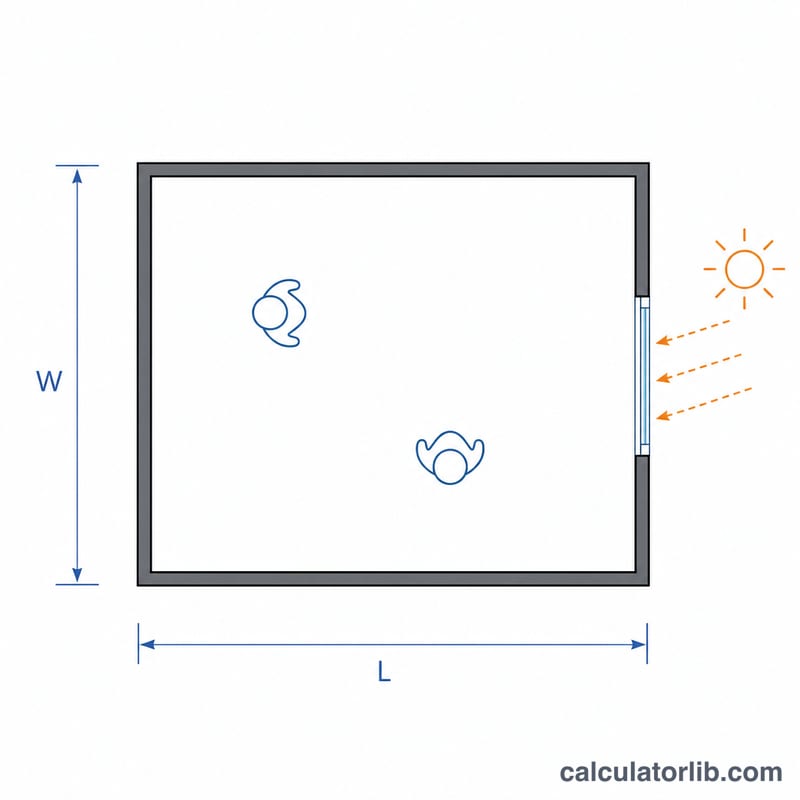
Measure the room and enter its length and width in feet. Enter the number of people who are normally in the room at the same time. Then pick the sun exposure: choose Heavily Shaded to reduce the estimate by 10%, Very Sunny to increase it by 10%, or leave it on Normal. The result is the recommended BTU/hour rating to look for when shopping for a window or portable AC unit.
The Formula Explained
The core rule comes from the U.S. Department of Energy: about 20 BTU per square foot. So a room's base load is its area multiplied by 20. Because each person adds body heat, we add 600 BTU for every occupant beyond the first two. Finally a sun factor of 0.9, 1.0, or 1.1 scales the total for shade or heavy sunlight.
$$\text{BTU} = (\text{Area} \times 20 + \text{People}_{extra} \times 600) \times \text{SunFactor}$$
Worked Example
A 12 ft × 12 ft bedroom has an area of 144 sq ft. Base load = \(144 \times 20 = 2{,}880\) BTU. With 2 occupants there is no people adjustment. Under normal sun the factor is 1.0, so the recommended unit is roughly 2,880 BTU/hour — a small 5,000 BTU window unit would comfortably cover it.
AC BTU Sizes by Room Size
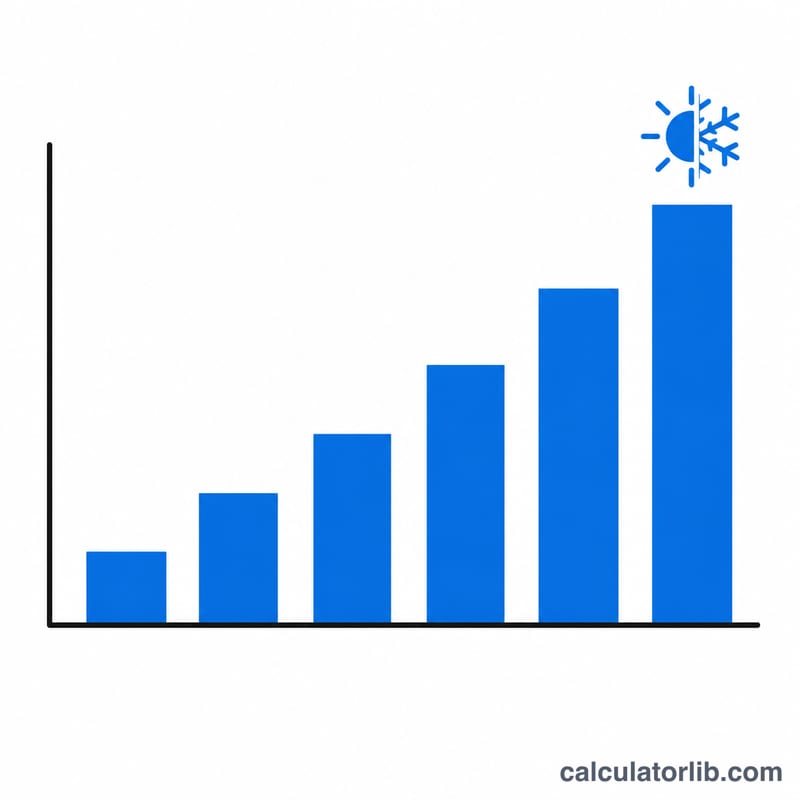
The table below maps common room areas to recommended air-conditioner cooling capacities, following the general sizing guidance published by the U.S. Department of Energy and ENERGY STAR (roughly 20 BTU per square foot of living space). These values assume a standard room with normal ceiling height (about 8 ft), average insulation, and a small number of occupants.
| Room area (sq ft) | Recommended capacity (BTU/hr) |
|---|---|
| 100–150 | 5,000 |
| 150–250 | 6,000 |
| 250–300 | 7,000 |
| 300–350 | 8,000 |
| 350–400 | 10,000 |
| 400–450 | 12,000 |
| 450–550 | 14,000 |
For example, a 200 sq ft room falls in the 150–250 range, so a 6,000 BTU unit is the baseline recommendation. Using the simple rule of 20 BTU per square foot, that same 200 sq ft room computes to 4,000 BTU of base load before rounding up to the nearest standard size and adding for occupants or sun.
Practical AC Sizing Recommendations
A calculated BTU figure is a starting point. Use these practical adjustments to choose the unit you actually buy:
- Round up to the next standard size. Air conditioners are sold in fixed capacities (5,000; 6,000; 8,000; 10,000…). If your calculation lands between two sizes, pick the next one up.
- Add about 10% for heat-prone rooms. If the room is very sunny or has ceilings higher than 8 ft, increase capacity by roughly 10% so the unit can keep up on hot afternoons.
- Add about 4,000 BTU for a kitchen. Cooking appliances add significant heat, so a unit cooling a kitchen should be sized larger than its floor area alone suggests.
- Avoid oversizing. An oversized unit cools the air quickly but cycles on and off too often (short-cycling). It never runs long enough to remove humidity, leaving the room cold and clammy and wasting energy.
- Check coverage and electrical needs. Confirm the unit's rated room-coverage (sq ft), its voltage (115V vs. 230V), and plug type before buying — larger units often require a dedicated circuit.
This is general guidance for typical residential rooms. For unusual layouts, poor insulation, or whole-home systems, consult an HVAC professional who can perform a Manual J load calculation.
FAQ
Should I round up to the next AC size? Yes. AC units come in fixed sizes (5,000, 6,000, 8,000 BTU…). Pick the next standard size at or above your result.
Does ceiling height matter? The 20 BTU/sq ft rule assumes standard 8 ft ceilings. For higher ceilings or very sunny kitchens, size up.
Is this for heating too? No — this estimates cooling capacity. Heating loads depend on climate and insulation and use different rules.