
What is the Time Zone Difference Calculator?
This tool tells you how many hours separate two time zones and converts a local time in one place to the matching local time in another. It works entirely from each location's UTC offset — the number of hours that zone is ahead of (positive) or behind (negative) Coordinated Universal Time. Because it relies on the offset you supply, it works for any country or region worldwide.
How to use it
Enter the UTC offset of your origin (for example New York is −5, or −4 during daylight saving), the UTC offset of your destination (for example Berlin is +1, or +2 in summer), and optionally the current local time at the origin on a 24-hour clock. The calculator returns the hour difference and the equivalent destination local time, plus a day offset showing whether the converted time falls on the previous (−1) or next (+1) day.
The formula explained
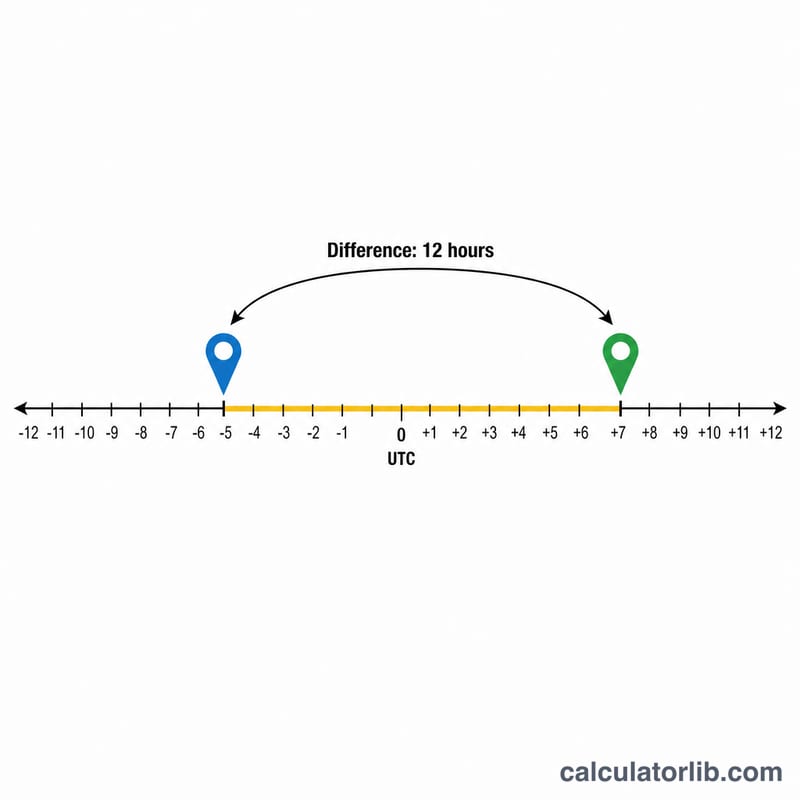
The difference is simply destination offset minus origin offset. A positive result means the destination is ahead. To convert a time, add the difference to the origin time and wrap the answer into the 0–24 range; any whole day that "rolls over" becomes the day offset.
$$\text{diff} = \text{offset}_{dest} - \text{offset}_{origin}$$
$$\Delta h = \text{UTC}_{dest} - \text{UTC}_{origin}$$
$$t_{dest} = (t_{origin} + \Delta h) \bmod 24$$
Worked example
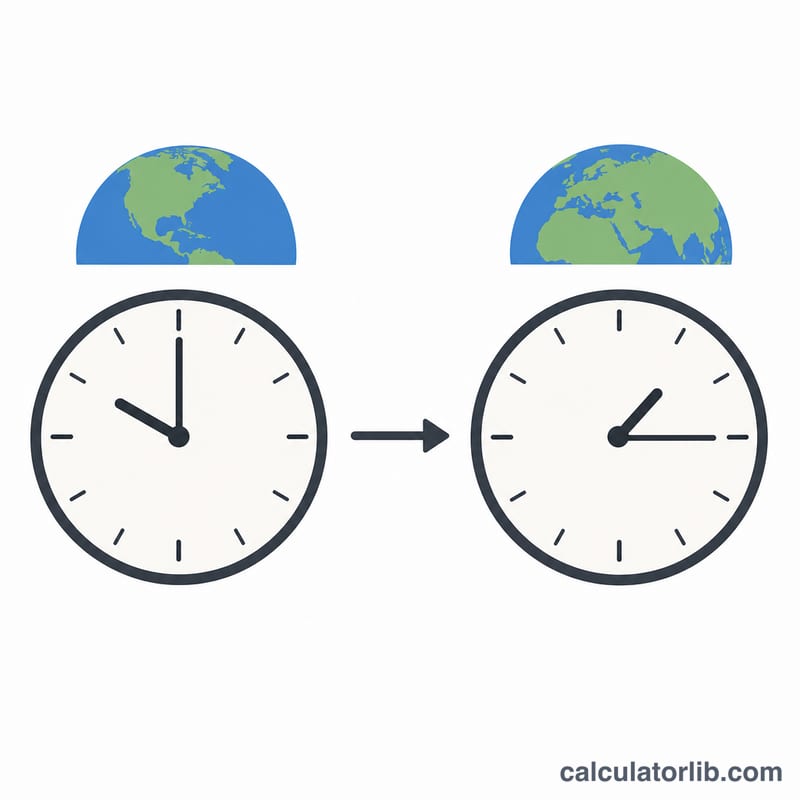
Origin offset −5 (New York), destination offset +1 (Berlin), origin time 12:00. Difference = \(1 - (-5) = 6\) hours. Destination time = \(12 + 6 = 18\):00, day offset 0. So when it is noon in New York it is 6:00 PM the same day in Berlin.
FAQ
Does it handle daylight saving time? Yes, indirectly — just enter the offset that is currently in effect for each location (e.g. use −4 instead of −5 when US Eastern is on DST).
What does the day offset mean? If the converted time crosses midnight, the day offset shows −1 (yesterday) or +1 (tomorrow) relative to the origin date.
Can I use half-hour zones? Yes. India is \(+5.5\) and Nepal is \(+5.75\) — enter decimal offsets directly.