
What Is the Time Zone Difference Calculator?
This tool tells you how many hours separate two locations based on their offset from Coordinated Universal Time (UTC). Whether you are scheduling an international meeting, planning a call with family abroad, or coordinating a flight, knowing the exact hour gap prevents missed connections and awkward 3 a.m. calls.
How to Use It
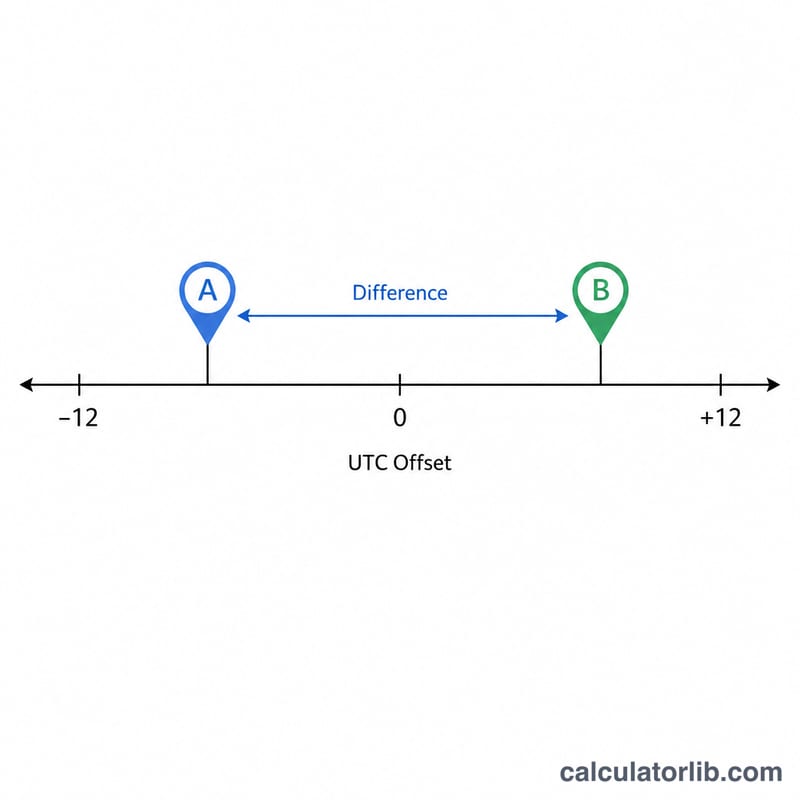
Enter the UTC offset for each city. For example, New York is UTC−5 (Eastern Standard Time), London is UTC+0, Tokyo is UTC+9, and India Standard Time is UTC+5.5. The calculator returns both the absolute number of hours apart and a signed value showing whether City B is ahead of or behind City A. Remember to use the daylight-saving offset if it is currently in effect (e.g. New York becomes UTC−4 in summer).
The Formula Explained
The math is simple subtraction: $$\text{diff} = \text{offset}_B - \text{offset}_A$$ A positive signed result means City B is ahead (its clock shows a later time); a negative result means City B is behind. The absolute value of that difference is how many hours apart the two clocks read at any given moment. Half-hour and 45-minute zones (India +5.5, Nepal +5.75) are supported via decimal offsets.
Worked Example
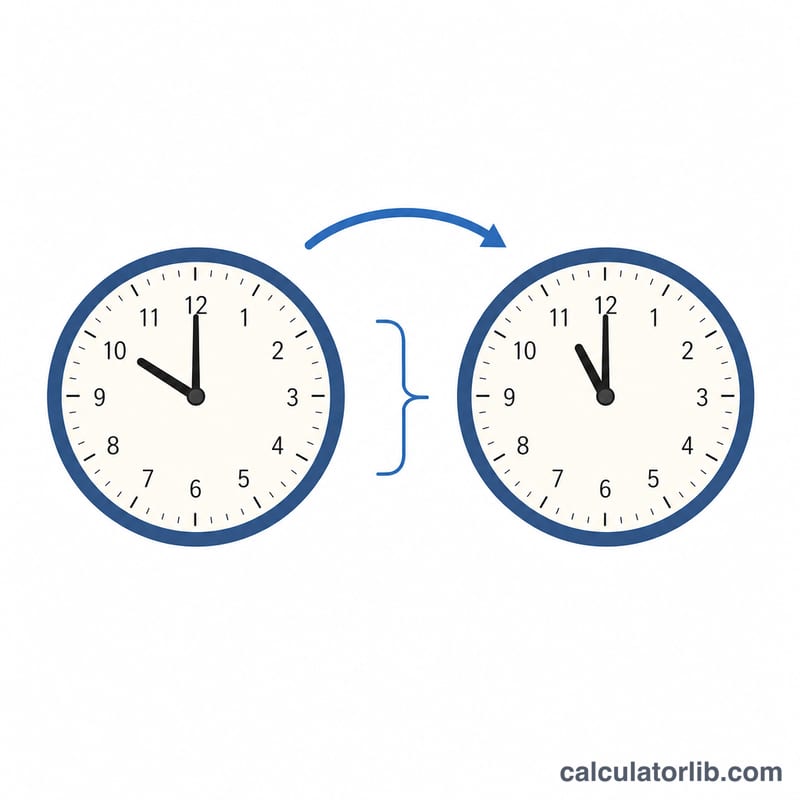
Compare New York (UTC−5) and Tokyo (UTC+9). $$\text{diff} = 9 - (-5) = 14 \text{ hours}$$ Tokyo is 14 hours ahead of New York, so when it is 9 a.m. Monday in New York it is 11 p.m. Monday in Tokyo.
FAQ
Does this account for daylight saving time? Not automatically — enter the offset that is currently active for each location.
How do I handle half-hour zones? Use a decimal, e.g. 5.5 for India or 9.5 for parts of Australia.
What does a negative signed result mean? It means City B is behind City A; its local clock reads an earlier time.