
What Is Return on Invested Capital (ROIC)?
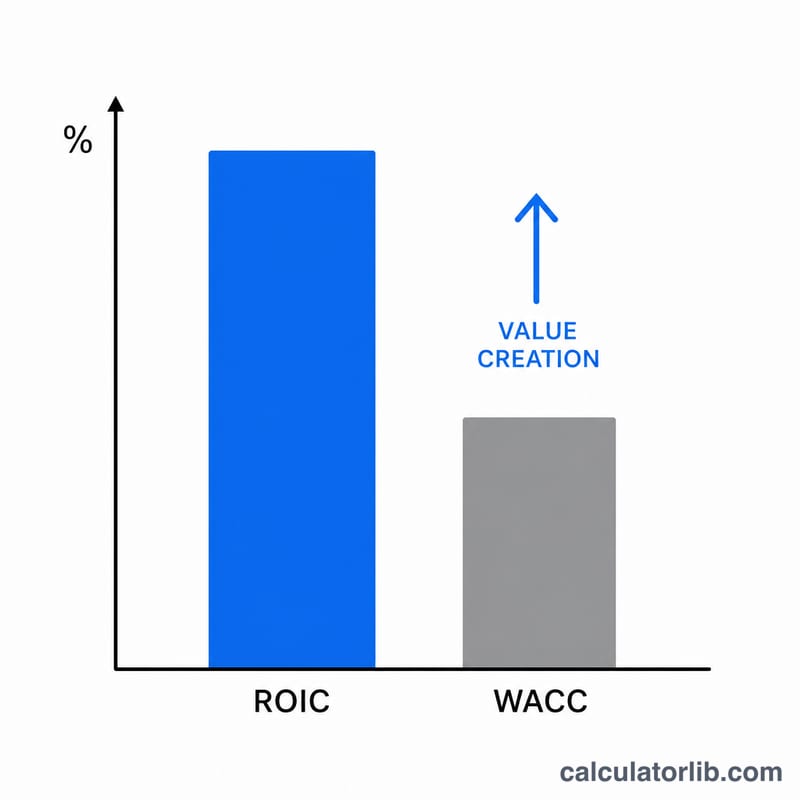
Return on Invested Capital (ROIC) measures how efficiently a company turns the capital it has invested into operating profit. It tells investors and managers whether a business is generating returns above its cost of capital — a core indicator of value creation. A company that consistently earns a ROIC higher than its weighted average cost of capital (WACC) is creating economic value; one that earns less is destroying it.
How to Use This Calculator
Enter two figures: NOPAT (Net Operating Profit After Tax) and Invested Capital. NOPAT is operating profit (EBIT) adjusted for taxes, so it reflects cash earnings from operations regardless of financing. Invested Capital is typically total debt plus equity minus cash (or net working capital plus net fixed assets). The calculator returns ROIC as a percentage.
The Formula Explained
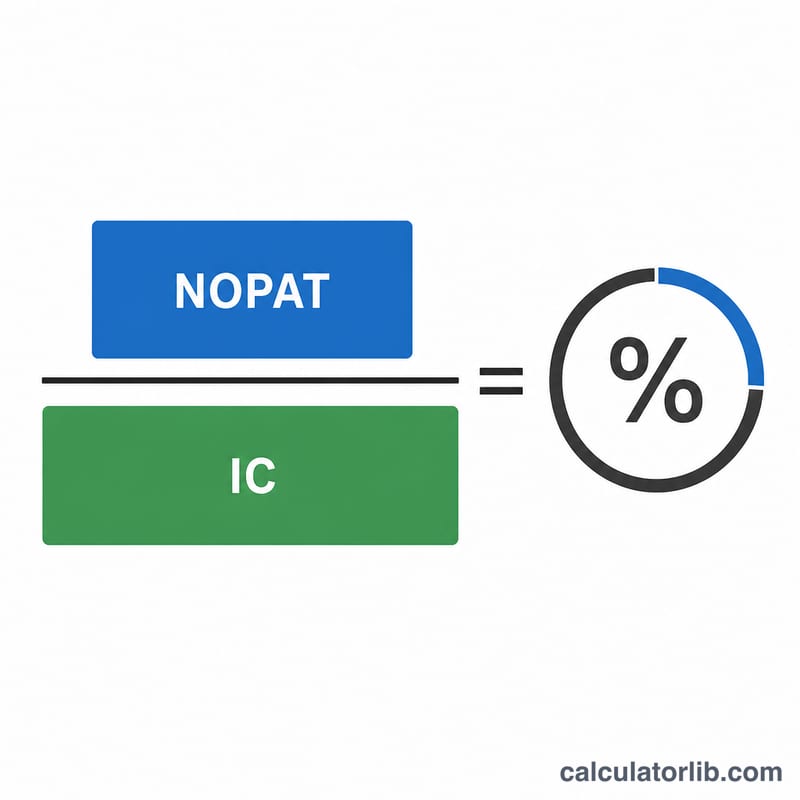
The equation is simple:
$$\text{ROIC \%} = \frac{\text{NOPAT}}{\text{Invested Capital}} \times 100$$NOPAT removes the effect of capital structure by ignoring interest, while Invested Capital captures every dollar put to work in the business. Dividing the two isolates pure operating efficiency. NOPAT itself is often computed as \(\text{EBIT} \times (1 - \text{tax rate})\).
Worked Example
Suppose a company reports NOPAT of $500,000 and Invested Capital of $2,500,000.
$$\text{ROIC} = 500{,}000 \div 2{,}500{,}000 \times 100 = 20\%$$If its WACC is 9%, the firm is creating substantial value because each dollar invested earns far more than it costs.
FAQ
What is a good ROIC? Generally, a ROIC above the company's WACC signals value creation. Many quality businesses sustain ROIC of 15% or more.
How is ROIC different from ROE? ROE measures return on shareholder equity only, while ROIC includes debt and equity, giving a fuller picture of operating efficiency independent of financing.
Where do I find NOPAT? Take EBIT (operating income) from the income statement and multiply by \((1 - \text{effective tax rate})\).