
What is the Gbps to Mbps Converter?
This tool converts data transfer rates from gigabits per second (Gbps) into megabits per second (Mbps). It is useful when comparing internet plans, sizing network links, or interpreting speed-test results that report different units.
How to use it
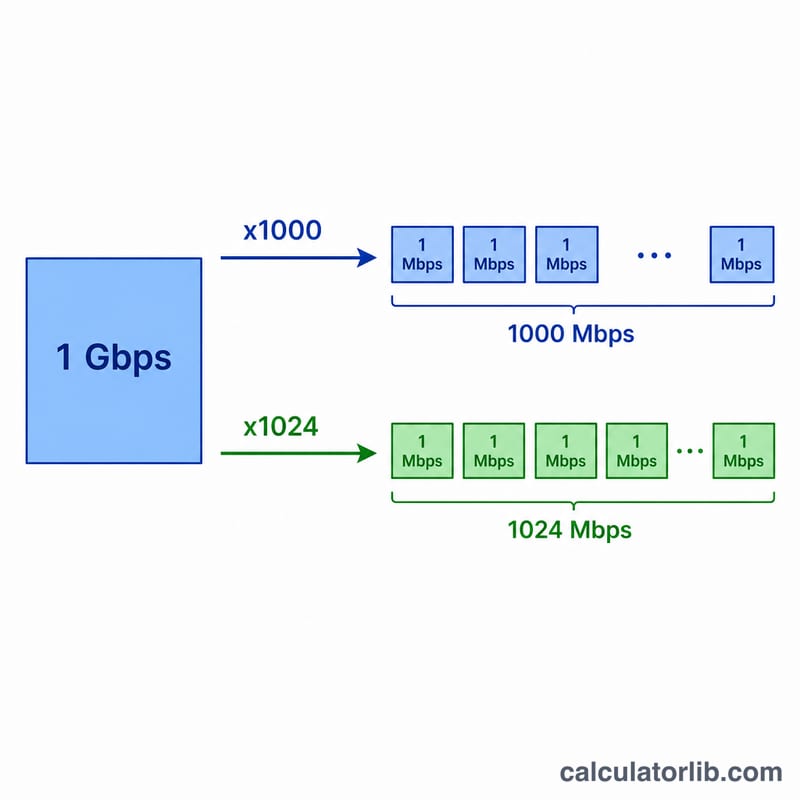
Enter your speed in Gbps, then pick the conversion base. Decimal (×1000) is the standard used by ISPs and networking equipment manufacturers. Binary (×1024) is sometimes used in computing contexts. The converter shows the equivalent Mbps instantly.
The formula explained
In the decimal system, 1 gigabit equals 1000 megabits, so $$\text{Mbps} = \text{Gbps} \times 1000$$ In the binary system, 1 gigabit equals 1024 megabits, so $$\text{Mbps} = \text{Gbps} \times 1024$$ Most real-world networking uses the decimal definition.
Worked example
Suppose you have a 2.5 Gbps fiber connection and want it in Mbps using the decimal base: $$2.5 \times 1000 = 2500 \text{ Mbps}$$ Using the binary base instead: $$2.5 \times 1024 = 2560 \text{ Mbps}$$
FAQ
Which base should I choose? For internet speeds and most networking, use decimal (×1000). It matches how ISPs advertise speeds.
Is Mbps the same as MB/s? No. Mbps is megabits per second; MB/s is megabytes per second. Divide Mbps by 8 to get MB/s.
Why are there two answers for the same speed? Because the gigabit can be defined as 1000 or 1024 megabits. The difference grows with larger speeds.