What is the Speaking Time Calculator?
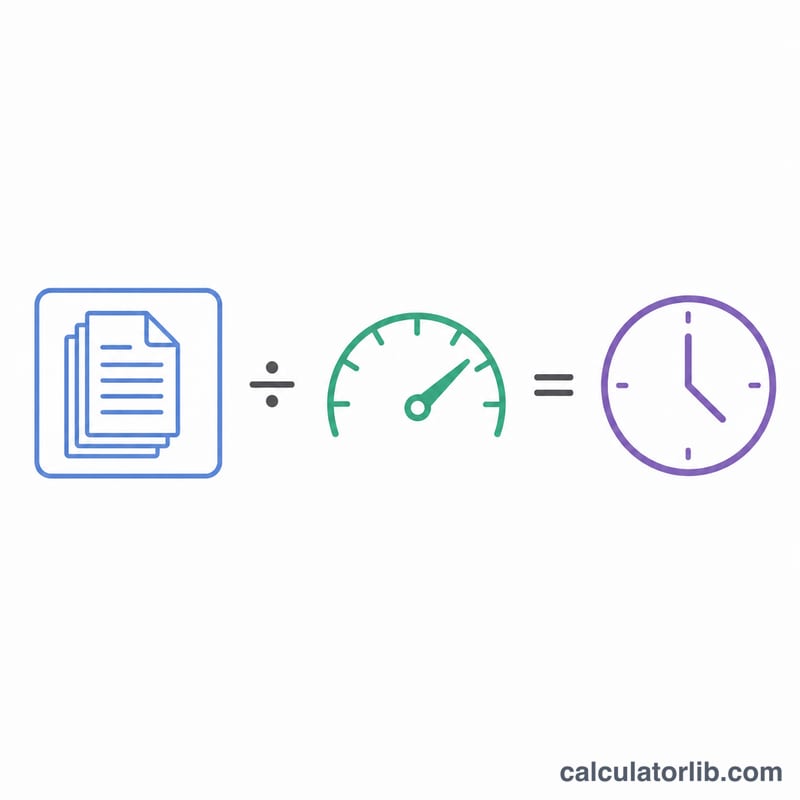
The Speaking Time Calculator estimates how long it will take to deliver a piece of text out loud. By dividing your total word count by your speaking pace in words per minute (WPM), it tells you how many minutes and seconds your speech, presentation, podcast intro, or video script will run.
How to use it
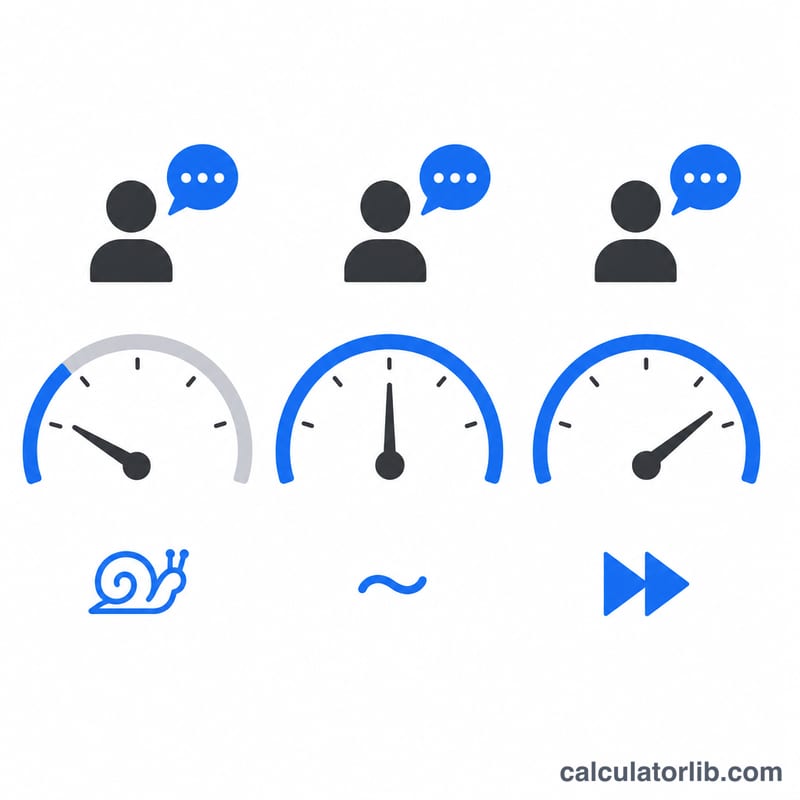
Enter the number of words in your text, then choose a speaking pace. The default of 130 WPM reflects a comfortable, clear presentation pace. Conversational speech is often 120–150 WPM, while fast podcasters or auctioneers may exceed 180 WPM. Audiobook narration is typically around 150 WPM, and slow, deliberate delivery for complex material may drop to 100 WPM.
The formula explained
The core calculation is simply minutes = word count ÷ words per minute:
$$\text{Minutes} = \dfrac{\text{Word Count}}{\text{Speaking WPM}}$$
The decimal result is then split into whole minutes and remaining seconds, where seconds equal the fractional part of the minutes multiplied by 60.
$$s = (t_{min} - \lfloor t_{min} \rfloor) \times 60$$
Worked example
Suppose you have a 1,300-word speech and you speak at 130 WPM. Then $$1{,}300 \div 130 = 10$$ minutes exactly — a clean 10m 0s. If instead you had 1,000 words at 130 WPM, that's $$1{,}000 \div 130 \approx 7.69$$ minutes, which is 7 minutes and about 41 seconds.
Typical Speaking Pace Ranges (WPM)
The figures below are approximate, commonly cited ranges for English speech, not strict standards. Individual speakers, languages, topics, and audiences vary, so treat them as starting points for your estimate.
| Context | Approximate pace (words per minute) | Notes |
|---|---|---|
| Slow or deliberate delivery | ~100 | Useful for complex material, emphasis, or formal or ceremonial occasions |
| Presentations and talks | ~120–150 | A comfortable range for most audiences |
| Conversational speech | ~120–150 | Natural everyday talking, with informal pauses |
| Audiobook narration | ~150–160 | Steady, clear, and sustained pacing |
| Fast talkers and many podcasts | ~170–180+ | Energetic delivery; listeners may find it harder to follow dense content |
| Auctioneers | Higher than the above | Specialized rapid-fire delivery, not typical for speeches |
To use the calculator, divide your word count by your pace. For example, a 1,500-word script at 150 WPM is \(\frac{1500}{150} = 10\) minutes, and at 125 WPM it is \(\frac{1500}{125} = 12\) minutes.
Practical Tips for Timing Your Speech
- Add a buffer. Many speakers add roughly 10–15% to the calculated time to account for pauses, slide changes, demonstrations, laughter, and audience interaction. A 10-minute estimate might become about 11 to 11.5 minutes.
- Measure your own pace. Read your script aloud with a timer, then divide the word count by the minutes taken to find your personal WPM. Use that number in the calculator instead of a generic average.
- Fit the time slot. If you run over, trim words; if you run short, expand key points or add an example. As a rough guide, multiply the minutes you need to change by your WPM to get the number of words to cut or add.
- Plan for Q&A. If questions are expected, reserve part of your slot for them rather than filling the entire time with prepared material.
- Rehearse more than once. Pace often shifts between practice and a live audience, since nerves tend to speed people up. Run through the speech a few times and note the range of timings.
- Remember what words don't capture. Slides, videos, long quotes, and numbers or names that need slower delivery can all change timing, so adjust your estimate for them separately.
These are general suggestions; adapt them to your audience, format, and event requirements.
FAQ
What speaking pace should I use? For most presentations, 130 WPM is a safe default. Practice your delivery and adjust if you naturally speak faster or slower.
Does this include pauses? No. Slides, audience interaction, dramatic pauses, and Q&A add time. Build in a buffer for live events.
How many words is a 5-minute speech? At 130 WPM, about 650 words (\(5 \times 130\)).