
What Is a Generator Size Calculator?
A generator size calculator estimates the wattage your portable or standby generator must deliver to power your appliances safely. Motors and compressors briefly draw far more power when they start than when they run, so a correctly sized generator must handle the total continuous (running) load plus the biggest single starting surge. This tool is unit-based (watts) and applies anywhere in the world.
How to Use It
Add up the running watts of everything you intend to power at the same time and enter that total. Then enter the largest single starting (surge) wattage among those devices — typically a fridge compressor, well pump, or air conditioner. Finally choose a safety margin (15–25% is common) so the generator never runs at 100% capacity. The result is the recommended generator size in watts.
The Formula Explained
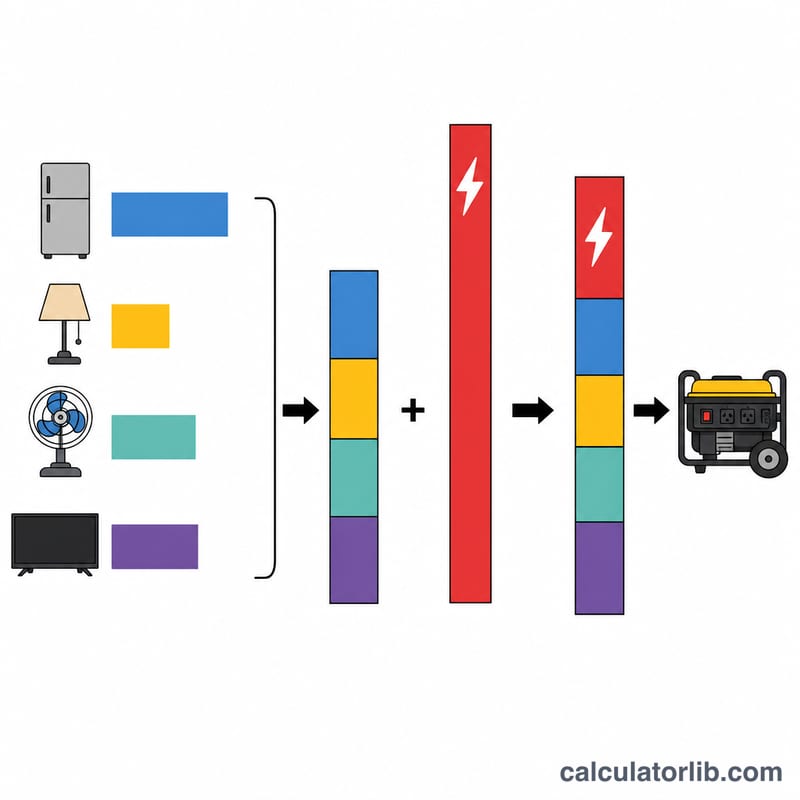
Running watts are summed because they all draw power continuously. Only the single largest surge is added, because appliances rarely start at the exact same instant. The base requirement is therefore $$\text{Required W} = \sum \text{running W} + \max(\text{starting surge W})$$ Multiplying by \((1 + m/100)\) gives headroom for efficiency loss and altitude derating.
Worked Example
Suppose your running loads total 3,000 W and your refrigerator adds an extra 1,500 W when its compressor kicks on. The base requirement is $$3{,}000 + 1{,}500 = 4{,}500 \text{ W}.$$ With a 20% safety margin: $$4{,}500 \times 1.20 = 5{,}400 \text{ W}.$$ A 5,500–6,000 W generator would comfortably cover this.
FAQ
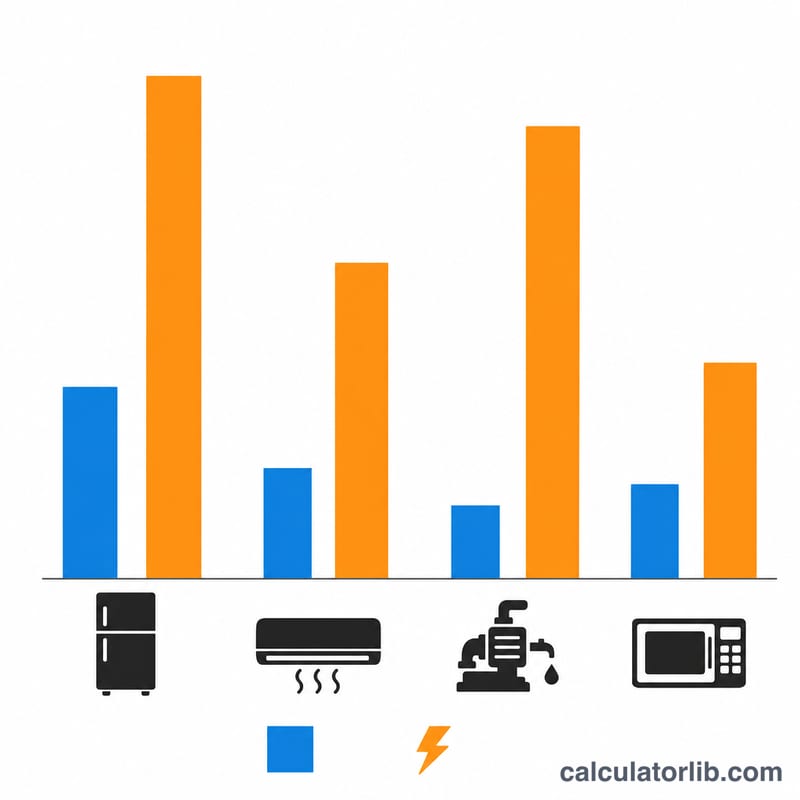
Why add only one surge value? Because it is statistically unlikely that every motor starts simultaneously; sizing for one worst-case surge is the standard practical approach.
What safety margin should I use? 20% is a good default. Use more for sensitive electronics or high-altitude/hot conditions.
Watts vs. starting watts on the nameplate? Running watts are the steady draw; starting (surge) watts are the brief spike. Many labels list amps — multiply amps × volts to get watts.