What Is the Curtain Size Calculator?
This tool helps you work out exactly how wide and how long your curtains should be so they hang beautifully and fully cover your window. It combines your window measurements with a fullness ratio (how gathered the fabric looks) plus practical sewing allowances for the header and hem. The calculator works in centimetres and applies to any standard window or curtain rod.
How to Use It
Measure the width of your window or curtain rod and enter it. Choose a fullness ratio — typically 1.5 for a light gather, 2.0 for a standard look, and 2.5–3.0 for a luxurious, full pleat. Enter the distance from the rod to the floor (or sill), then add your header allowance (the fabric folded over the top, often 8–15 cm) and hem allowance (the bottom turn-up, often 10–20 cm). Finally enter how many panels you want; the calculator divides the total width across them.
The Formula Explained
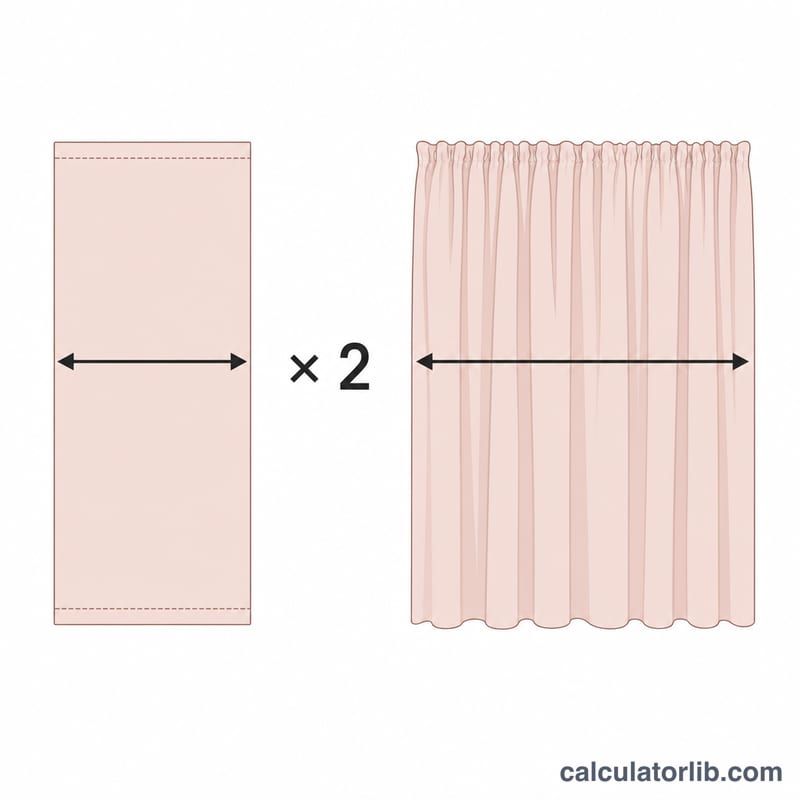
Total curtain width = window width × fullness ratio. A 120 cm window at a fullness of 2 needs 240 cm of fabric width so the curtain still looks full when drawn closed.
$$\text{Width per Panel} = \frac{\text{Window Width} \times \text{Fullness Ratio}}{\text{Panels}}$$Curtain length = rod-to-floor + header + hem. Adding these allowances ensures you have enough fabric to sew the top channel and bottom hem without losing your finished drop.
$$\text{Curtain Length} = \text{Rod to Floor} + \text{Header} + \text{Hem}$$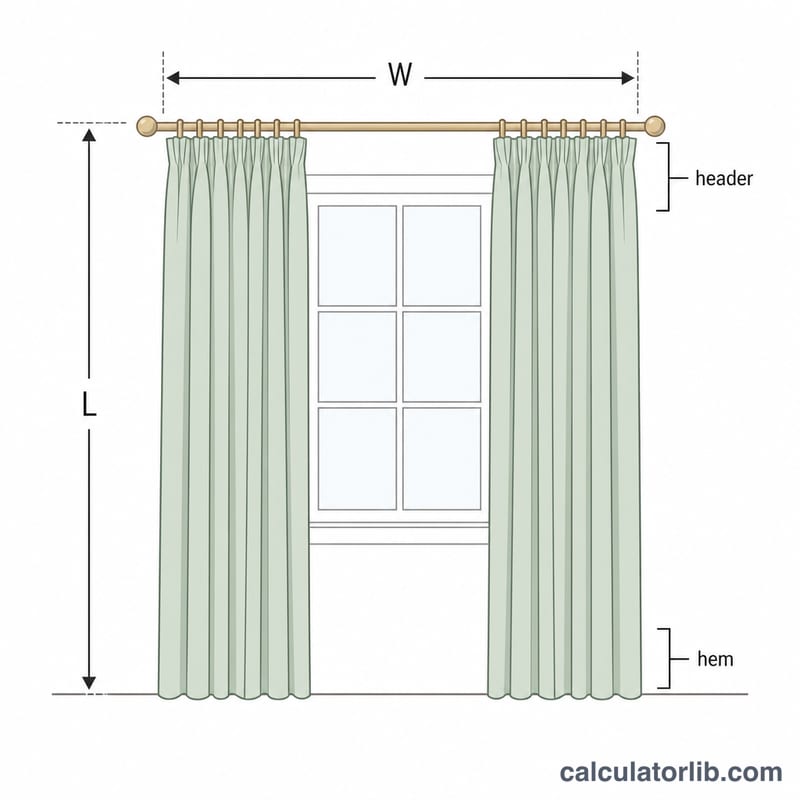
Worked Example
For a 120 cm window with fullness 2, rod-to-floor of 230 cm, a 10 cm header and 15 cm hem across 2 panels: width = \(120 \times 2 = 240\) cm, length = \(230 + 10 + 15 = 255\) cm, and each panel needs \(240 \div 2 = 120\) cm of width.
Standard Curtain Lengths and Placement
These are common conventions, not strict rules. Adjust them for your room, ceiling height and the look you want.
| Item | Typical convention |
|---|---|
| Rod height | 10 – 15 cm above the window frame; higher, toward the ceiling, to make the window and room look taller |
| Side overlap | Rod or track extends about 10 – 20 cm beyond each side of the window, so open curtains don't block the glass |
| Floor length | Hem ends about 1 – 2 cm above the floor |
| Sill length | Ends about 1 cm below the sill, or 10 – 15 cm below the apron if there is one |
| Puddled | Add about 5 – 20 cm extra length so the fabric rests on the floor |
Ready-made sizes
Ready-made curtains are commonly sold in standard drops (lengths) of about 137 cm (54 in), 183 cm (72 in) and 229 cm (90 in). Panel widths differ by country and retailer. Common examples are roughly 117 cm, 137 cm, 168 cm and 228 cm per pair or panel. Check the label, because some sizes are quoted per panel and others per pair.
Finished length is roughly the rod-to-floor measurement, minus the floor clearance, plus the hem and header allowances if you are cutting fabric yourself.
Practical Tips Before You Cut or Order
- Measure after the rod or track is installed. Measure rod-to-floor and rod width in its final position, using a steel tape measure and checking several points, since floors and ceilings are rarely level.
- Add side hems. Allow about 3 – 5 cm per side (6 – 10 cm total per panel) on top of the calculated width. Each join between fabric widths needs a seam allowance too.
- Allow for shrinkage. Cotton and linen can shrink about 3 – 5%. Pre-wash the fabric, or add that percentage to the length and width if you won't pre-wash. Check the care label for synthetic blends.
- Check the fabric roll width. Furnishing fabric is typically about 137 – 150 cm wide. Divide the total flat width needed by the usable roll width and round up to a whole number of drops to join.
- Round up, never down. Order the next whole width or length, and buy a little spare, especially for dye lots, which can differ between batches.
- Consider the pattern repeat. For patterned fabric, add up to one full repeat per drop so the pattern matches across panels and joins. Check the repeat length on the roll label.
- Split evenly across panels. Divide the total width by the number of panels, usually 2 for a pair, so both sides hang the same.
These are general guidelines for home sewing and ordering. Always follow your fabric maker's or curtain supplier's own instructions and size chart.
FAQ
What fullness ratio should I choose? 1.5 is economical, 2.0 is the most popular balanced choice, and 2.5–3.0 gives a rich, heavily gathered look ideal for formal rooms.
Should curtains touch the floor? For a clean look use rod-to-floor exactly; for a puddled or break style, add 5–20 cm to the rod-to-floor measurement before entering it.
Does this include side returns? No — if you want fabric to wrap to the wall, add a few extra centimetres to your window width before calculating.