
What Is an Inverter Size Calculator?
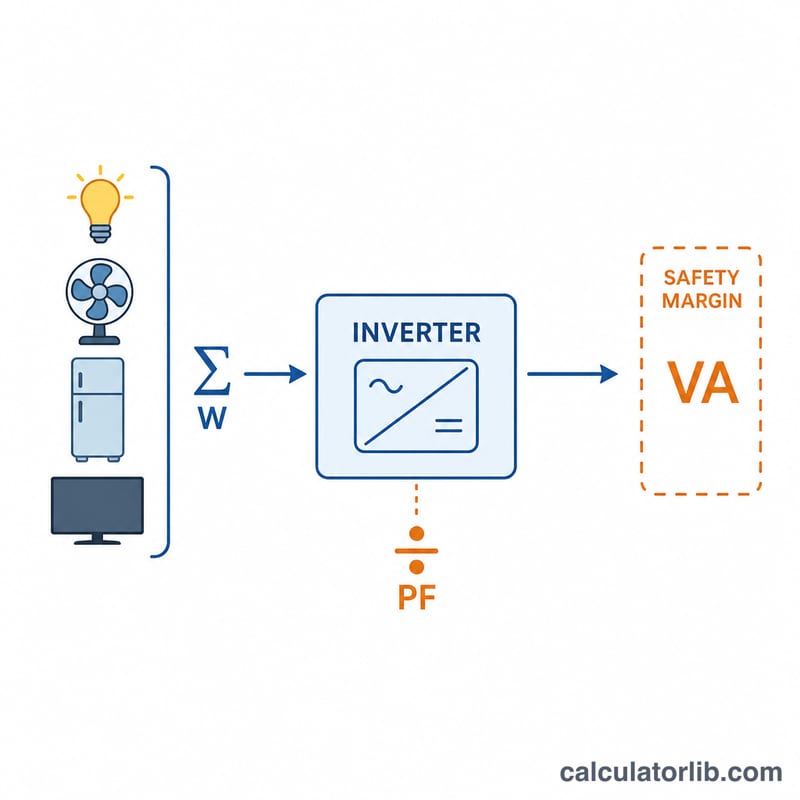
An inverter converts DC power (from a battery or solar array) into AC power for your appliances. Choosing the right inverter size is critical: too small and it overloads or shuts down, too large and you waste money and standby energy. This calculator converts your total appliance load in watts into the apparent power rating (VA) inverters are actually rated by, then adds a safety margin so the unit can handle real-world surges.
How to Use It
Add up the running wattage of every appliance you want to power at the same time and enter that as the total load. Enter the power factor of your loads (use 0.8 for mixed homes, 1.0 for purely resistive loads like heaters and incandescent bulbs, lower for motors and pumps). Then set a safety margin — 25% is a sensible default to cover startup surges and future expansion.
The Formula Explained
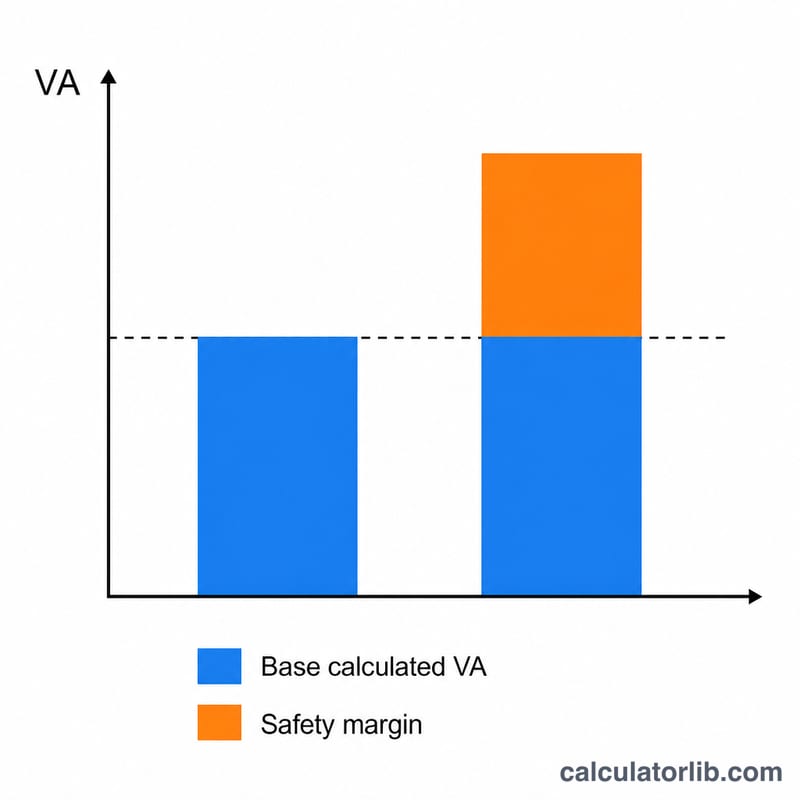
Inverters are rated in volt-amperes (VA), not watts, because reactive loads draw more current than their real power suggests. The relationship is $$\text{VA} = \text{Watts} \div \text{Power Factor}$$. A lower power factor means more apparent power for the same real work. We then multiply by \(1 + \frac{\text{margin}}{100}\) so the inverter isn't running at 100% capacity continuously.
$$\text{Size (VA)} = \frac{\text{Load (W)}}{\text{Power Factor}} \times \left(1 + \frac{\text{Margin (\%)}}{100}\right)$$
Worked Example
Suppose your total load is 800 W with a power factor of 0.8 and a 25% margin. Apparent power \(= 800 \div 0.8 = 1000 \text{ VA}\). Recommended size \(= 1000 \times 1.25 = 1250 \text{ VA}\). So a 1.25 kVA inverter is appropriate, and rounding up to a standard 1.5 kVA unit gives comfortable headroom.
FAQ
Why is the inverter rated in VA, not watts? VA (apparent power) accounts for both the real power doing work and the reactive power circulating with inductive loads, which is what determines the current the inverter must supply.
What power factor should I use? Use 0.8 for typical household mixes, 1.0 for pure resistive loads (heaters, kettles, bulbs), and 0.6–0.7 for heavy motor loads such as pumps and compressors.
How big should my safety margin be? 20–30% is standard. Increase it if you have motors with high inrush currents or plan to add appliances later.