
What is the Battery Size Calculator?
This tool estimates the battery capacity, in milliamp-hours (mAh), needed to power a device for a desired runtime. By accounting for an efficiency (or usable-capacity) factor, it gives a more realistic target than a raw multiplication, helping you avoid undersizing a pack that would otherwise die early.
How to use it
Enter the average current your device draws in milliamps (mA), the number of hours you want it to run, and an efficiency factor between 0 and 1. The efficiency accounts for losses from converters, self-discharge, temperature, and the fact that you rarely want to drain a cell to 0%. Common values are 0.8–0.9 for a healthy margin. The calculator returns the required capacity in mAh and Ah.
The formula explained
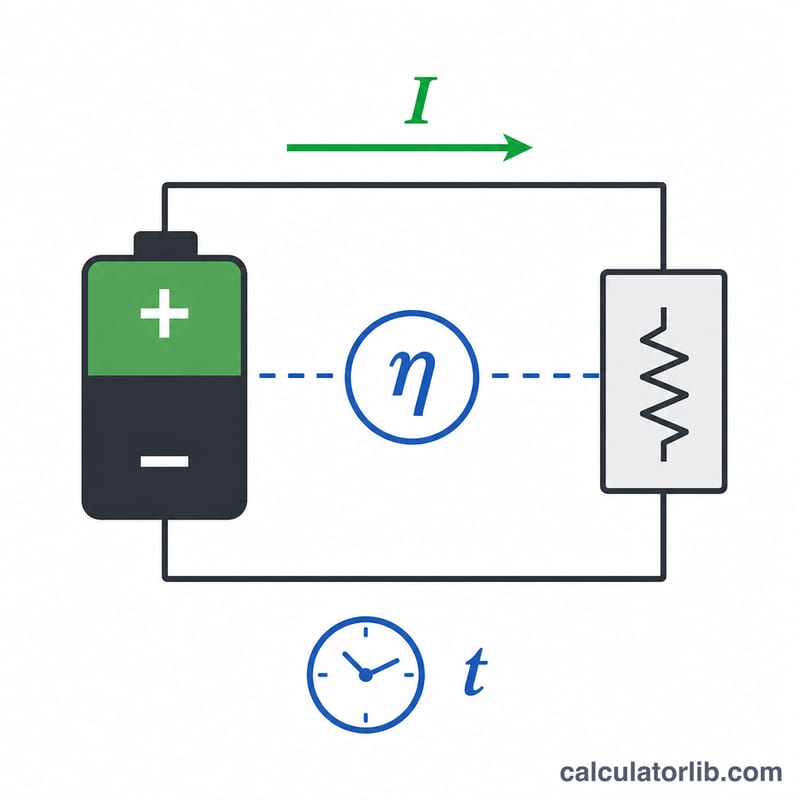
The core relationship is $$\text{Capacity (mAh)} = \frac{\text{Load Current (mA)} \times \text{Runtime (h)}}{\text{Efficiency}}$$. Load current times runtime gives the raw charge demand in mAh; dividing by efficiency inflates that figure so the usable portion of the battery still meets your runtime goal. Dividing the result by 1000 converts mAh to Ah.
Worked example
Suppose a device draws 500 mA and must run for 10 hours, with an efficiency of 0.85. Raw demand = \(500 \times 10 = 5{,}000\) mAh. Dividing by 0.85 gives $$5{,}000 \div 0.85 \approx 5{,}882.35 \text{ mAh},$$ or about 5.88 Ah. So you'd choose a battery rated around 6,000 mAh or higher.
Choosing and Sizing Your Battery
Once the calculator gives you a target capacity, turn that raw number into a real-world battery choice with these steps:
- Round up to the next standard pack size. Cells and packs come in fixed capacities (for example single 18650 cells around 2000–3500 mAh, or pouch LiPo packs at 500, 1000, 2000 mAh, etc.). Always choose the next size up from your calculated requirement rather than the nearest size down.
- Add 20–30% headroom. Usable capacity falls over the battery's life and drops sharply in cold temperatures, and you rarely want to discharge a cell to 0%. Multiplying your calculated capacity by about 1.2–1.3 gives a practical safety margin. For the 1129 mAh example above, that means targeting roughly 1350–1470 mAh.
- Check the discharge C-rating against your peak current. The average current sets capacity, but the battery must also deliver brief peaks (radio transmits, motor start-up). A cell rated 1C at 1000 mAh supplies about 1 A continuously; if your peaks exceed that, pick a higher C-rating or a larger pack so voltage doesn't sag and trip a brownout reset.
- Compare energy in watt-hours when voltages differ. Milliamp-hours only compare fairly at the same voltage. To compare a 3.7 V cell against a 7.4 V pack, convert to watt-hours: a 2000 mAh, 3.7 V cell stores 7.4 Wh. Watt-hours let you weigh size, weight and cost across chemistries and voltages on equal terms.
- Mind the chemistry and cutoff. Lithium-ion/LiPo, NiMH and alkaline have different nominal voltages and usable depth-of-discharge. Build the depth-of-discharge limit into your efficiency factor rather than assuming you can use 100% of the printed capacity.
If your load is specified in watts rather than milliamps, size the pack from energy instead, then convert. This is general engineering guidance for estimating purposes, not a safety certification — follow the manufacturer's datasheet ratings and use an appropriate protection circuit and charger for your battery chemistry.
FAQ
What efficiency should I use? For simple battery-direct circuits use 0.9–0.95; for designs with voltage regulators or that run in cold conditions, 0.7–0.85 is safer.
Does this account for voltage? No — mAh is a charge rating at a single nominal voltage. If you change battery voltage, also compare watt-hours (\(\text{Wh} = \text{Ah} \times \text{V}\)).
Why divide instead of multiply by efficiency? You need extra stored charge to cover losses, so the required capacity is larger than the raw demand — hence division.