
What this calculator does
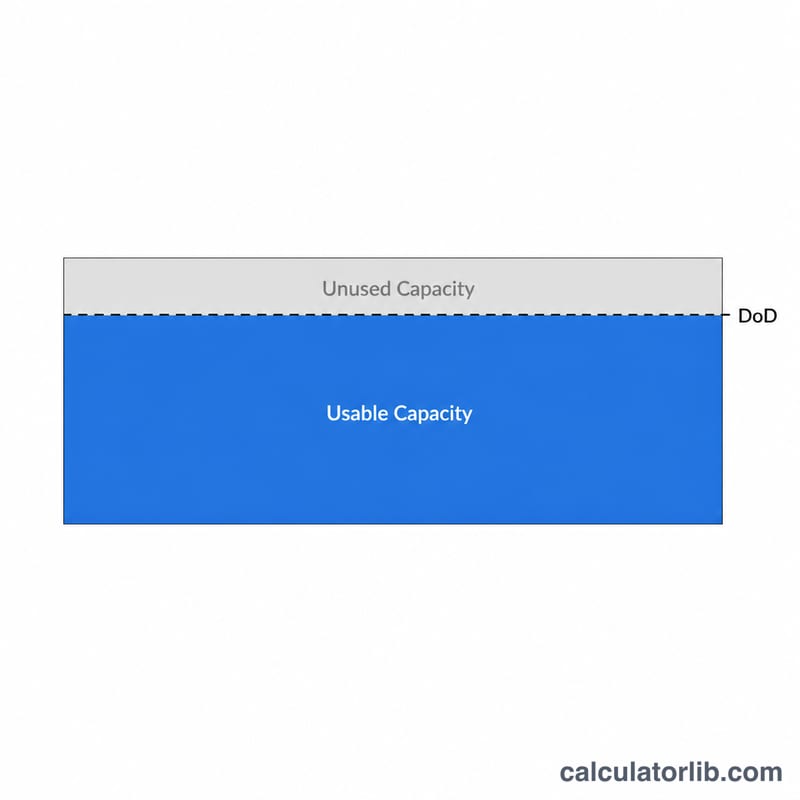
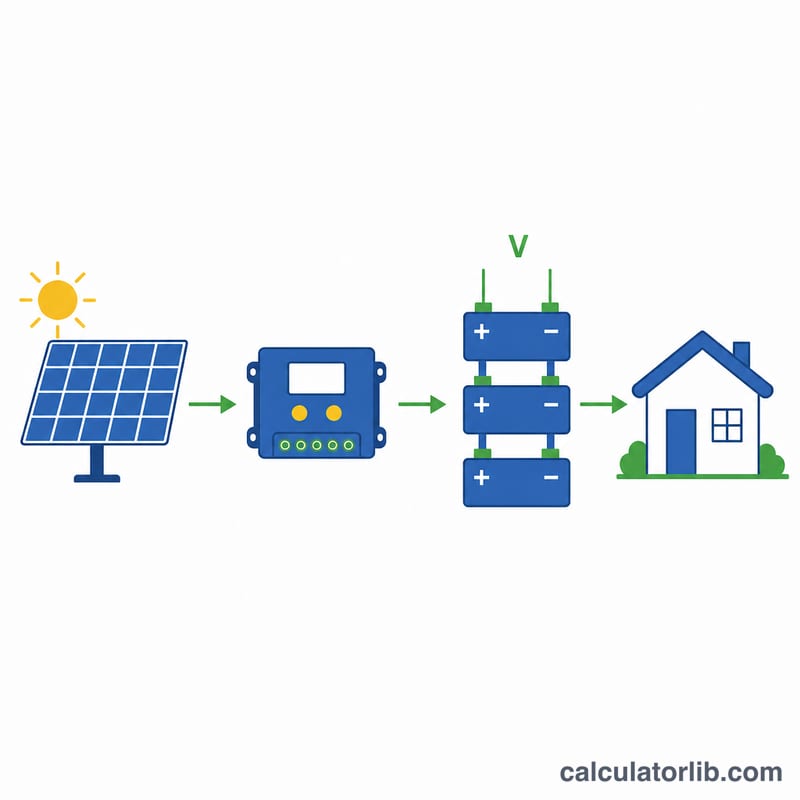
The Solar Battery Bank Size Calculator tells you how much battery capacity, in amp-hours (Ah), an off-grid or backup solar system needs. It accounts for your daily energy consumption, how many days you want the bank to run without sun (days of autonomy), the system voltage, and the safe depth of discharge (DoD) of your batteries. Sizing correctly prevents both under-supply (lights going out) and over-spending on unused capacity.
How to use it
Enter your average daily energy use in watt-hours (Wh) — add up the wattage of each device times the hours it runs. Choose your days of autonomy (1–3 is common for sunny climates, 3–5 for cloudy regions). Pick the system voltage (12 V for small setups, 24 V or 48 V for larger systems), and set the depth of discharge your battery chemistry allows (about 50% for lead-acid, 80–100% for lithium).
The formula explained
The core equation is
$$\text{Ah} = \frac{\text{Daily Wh} \times \text{Days}}{\text{V} \times \text{DoD}}$$where DoD is a fraction (50% = 0.5). The numerator is the total energy you must store; dividing by voltage converts watt-hours to amp-hours, and dividing by DoD adds the margin so you never drain the bank past its safe limit.
Worked example
Suppose you use 1,000 Wh per day, want 2 days of autonomy, run a 12 V system, and use lead-acid batteries at 50% DoD. Total energy = \(1{,}000 \times 2 = 2{,}000\) Wh. Capacity =
$$2{,}000 \div (12 \times 0.5) = 2{,}000 \div 6 = 333.33 \text{ Ah}$$You'd size a 12 V bank of roughly 333 Ah.
FAQ
What DoD should I use? Lead-acid: ~50%. AGM/Gel: 50–60%. Lithium (LiFePO4): 80–100%. Higher DoD means a smaller bank but check your battery's spec sheet.
Why add days of autonomy? So the system keeps running during cloudy stretches when solar panels produce little. More autonomy means a larger, costlier bank.
Does temperature matter? Yes — cold reduces usable capacity. In freezing climates add 10–20% to the result, or keep batteries insulated.