
What This Calculator Does
The Solar Panel Battery Charge Time Calculator estimates how many hours of full sunlight a solar panel needs to fully charge a battery. It combines your battery capacity (in watt-hours), the panel rated power (in watts), and a system efficiency factor that accounts for real-world losses from charge controllers, wiring, heat, and battery charging inefficiency.
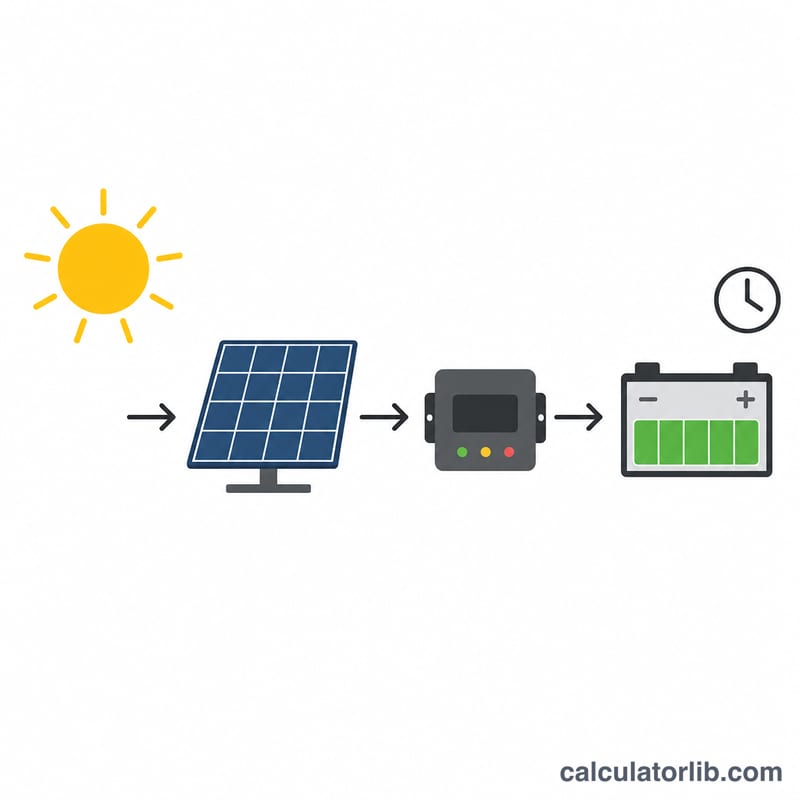
How to Use It
Enter your battery capacity in watt-hours (Wh). If you only know amp-hours, multiply Ah by the battery voltage — for example a 100 Ah, 12 V battery is 1,200 Wh. Enter the panel rated power in watts and a system efficiency percentage. A typical real-world solar charging system runs at 70–85% efficiency, so 75% is a reasonable default.
The Formula Explained
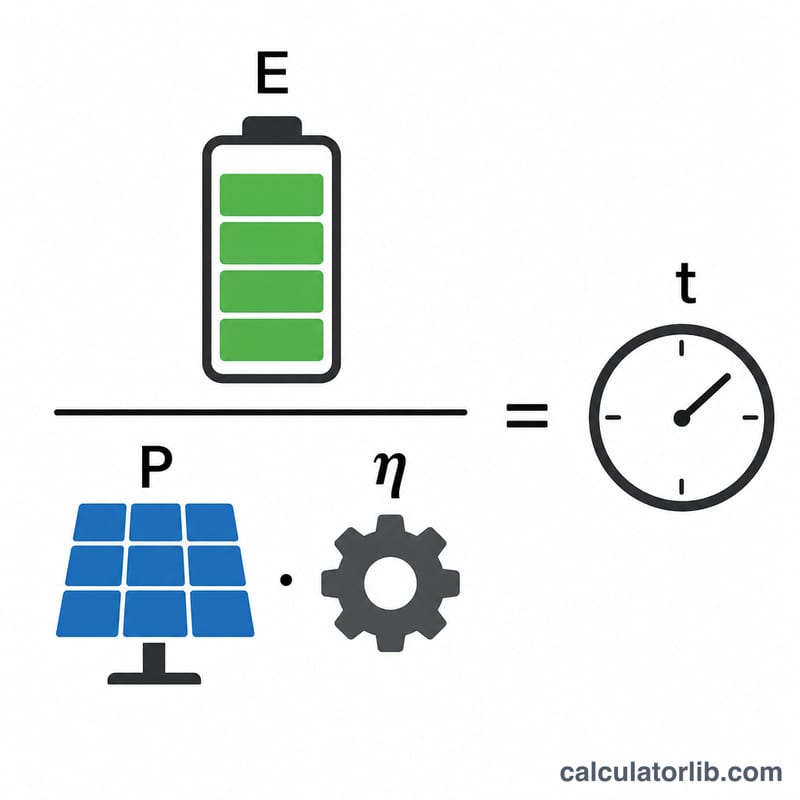
The core equation is $$t = \frac{\text{Battery (Wh)}}{\text{Panel (W)} \times \dfrac{\text{Efficiency (\%)}}{100}}$$ The panel rated power is multiplied by the efficiency to get the effective charging power, and the battery energy is divided by that effective power to get the time in hours. Note this assumes constant full-sun conditions; real charging times are longer because sunlight intensity varies through the day.
Worked Example
Suppose you have a 1,200 Wh battery, a 200 W panel, and 75% system efficiency. Effective power = \(200 \times 0.75 = 150\) W. Charge time = \(1{,}200 / 150 =\) 8 hours of full sun. Since most locations only get 4–6 peak sun hours per day, this would take about 1.5 to 2 days.
FAQ
Why include efficiency? Panels rarely deliver their rated output. Charge controllers, wiring resistance, temperature, and battery charging losses typically cut usable power by 15–30%.
How do I convert amp-hours to watt-hours? Multiply battery amp-hours by the battery voltage: \(\text{Wh} = \text{Ah} \times \text{V}\).
Is this the real daily charge time? No — this is hours of full sun. Divide your result by the peak sun hours your location gets per day to estimate calendar days.