

What is a one-step equation?
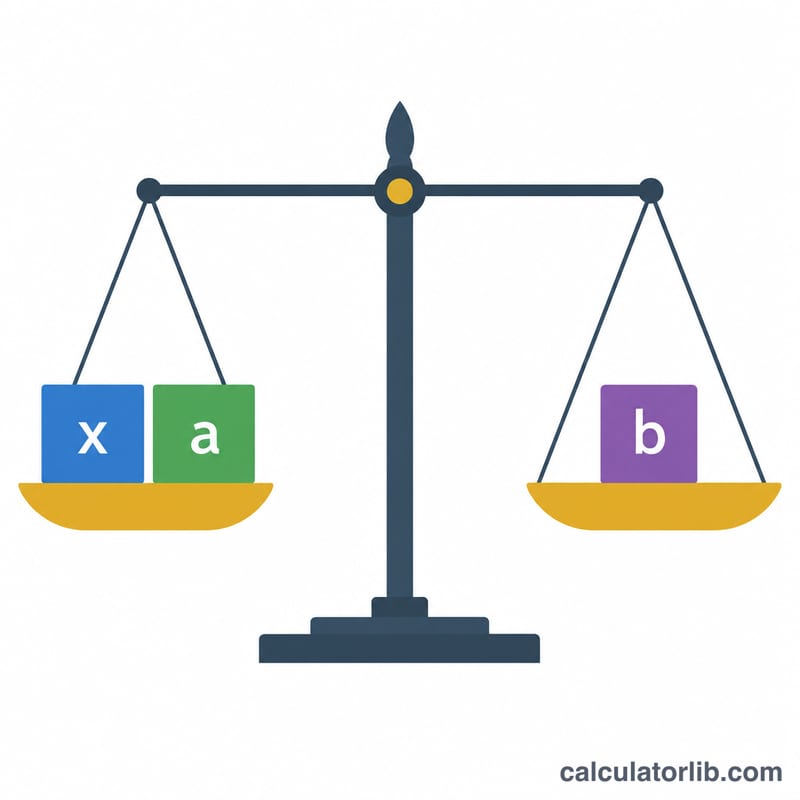
A one-step equation is the simplest type of linear equation — it requires a single inverse operation to isolate the unknown variable, usually written as \(x\). This calculator solves the four classic forms: \(x + a = b\), \(x - a = b\), \(a \cdot x = b\), and \(x / a = b\). You supply the constant terms \(a\) and \(b\), and the tool returns the exact value of \(x\).
How to use it
Pick the equation type that matches your problem, type the value of \(a\) and the value of \(b\), and submit. The calculator applies the matching inverse operation and displays \(x\) immediately. Decimals and negative numbers are fully supported.
The formula explained
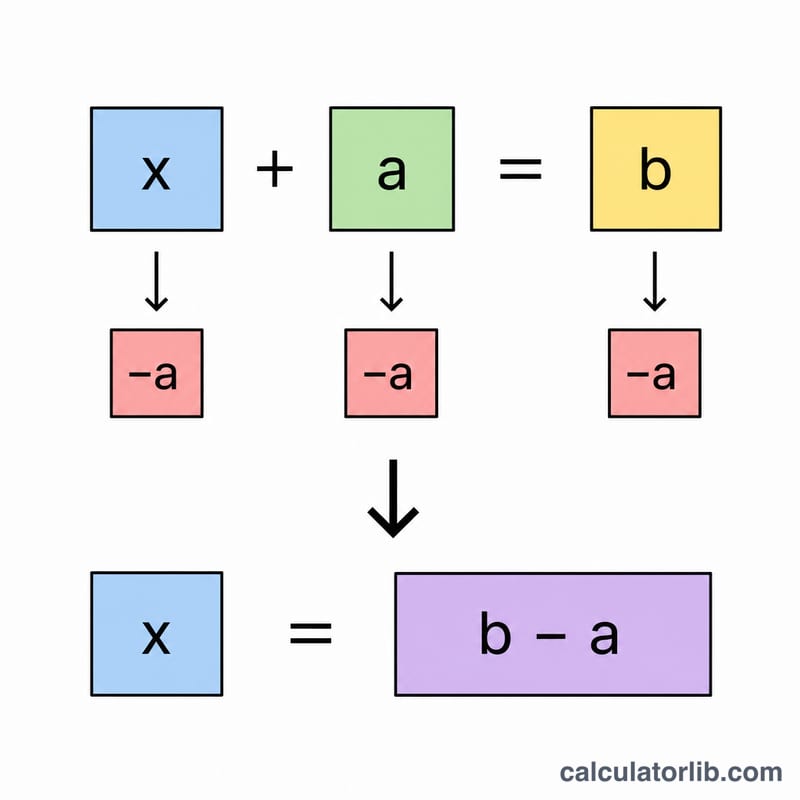
Every equation is solved by "undoing" the operation applied to \(x\). Addition is undone by subtraction, so $$x + a = b \;\Rightarrow\; x = b - a$$ Subtraction is undone by addition: $$x - a = b \;\Rightarrow\; x = b + a$$ Multiplication is undone by division: $$a \cdot x = b \;\Rightarrow\; x = b \div a \quad (a \neq 0)$$ Division is undone by multiplication: $$\frac{x}{a} = b \;\Rightarrow\; x = b \cdot a$$
Worked example
Solve \(4 \cdot x = 20\). This is the multiplication form, so $$x = b \div a = 20 \div 4 = 5$$ Check: \(4 \times 5 = 20\). ✓ For \(x + 7 = 12\), use $$x = b - a = 12 - 7 = 5$$
FAQ
What if \(a = 0\) in \(a \cdot x = b\)? Then there is no unique solution: if \(b = 0\) every number works, otherwise no number works. The calculator flags this case.
Can I use negative or decimal values? Yes. Enter values like \(-3\) or \(2.5\) freely; the inverse operations work the same way.
Does the order of \(a\) and \(b\) matter? Yes — \(a\) is the number combined with \(x\), and \(b\) is the value on the other side of the equals sign.