
What Is a Two-Step Equation?
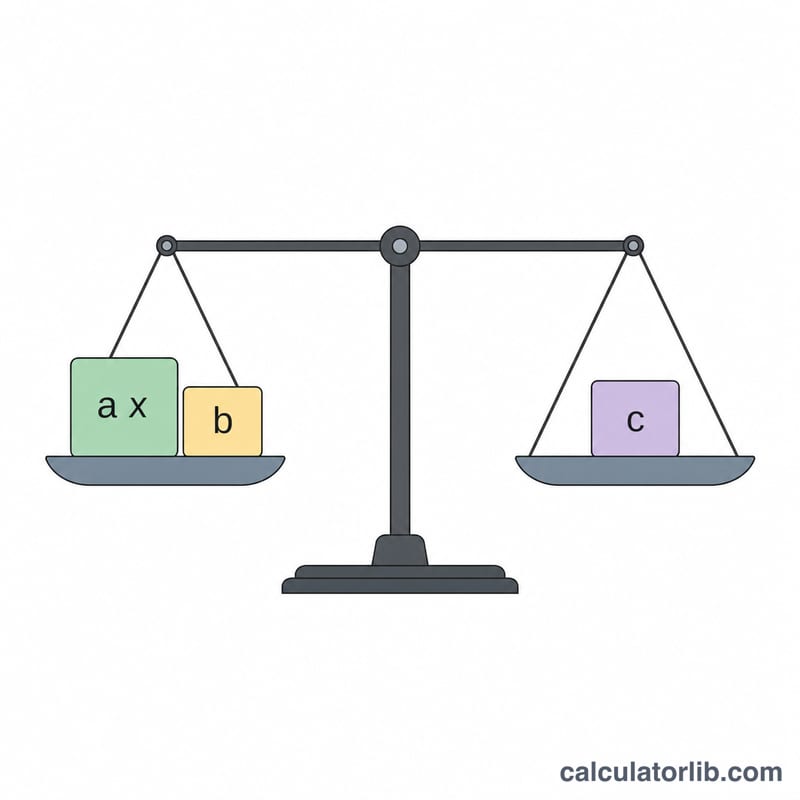
A two-step equation is a linear equation that takes the form \(ax + b = c\), where a, b, and c are known numbers and x is the unknown you want to find. It is called "two-step" because solving it requires exactly two inverse operations: undoing the addition (or subtraction) and then undoing the multiplication (or division).
How to Use This Calculator
Enter the coefficient a (the number multiplying x), the constant b (added on the left side), and c (the value on the right side). The calculator returns the value of x along with the two solving steps so you can follow the algebra and check your own homework.
The Formula Explained
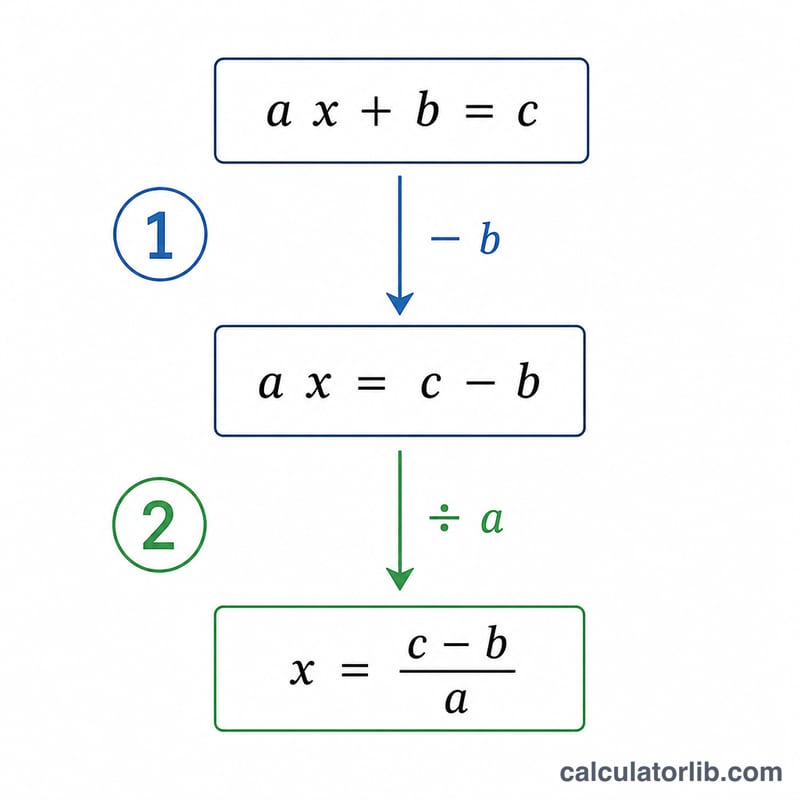
Start with \(ax + b = c\). First subtract b from both sides to isolate the term with x: \(ax = c - b\). Then divide both sides by a to get x alone: $$x = \frac{\text{Right side } c - \text{Constant } b}{\text{Coefficient } a}$$ The coefficient a must not be zero, otherwise there is no single solution and the equation is not genuinely two-step.
Worked Example
Solve \(2x + 3 = 11\). Step 1: subtract 3 from both sides → \(2x = 8\). Step 2: divide by 2 → \(x = 4\). You can verify: $$2(4) + 3 = 8 + 3 = 11$$ ✓
FAQ
What if a is zero? If \(a = 0\) the equation becomes \(b = c\), which has either infinitely many solutions or none, so there is no unique x. This calculator returns 0 in that case.
Can a, b, or c be negative or decimals? Yes. The calculator accepts any real numbers, including negatives and decimals, and the formula works the same way.
How do I check my answer? Substitute the solution back into \(ax + b\) and confirm it equals c.