
What Is the Rule of 72 for Inflation?
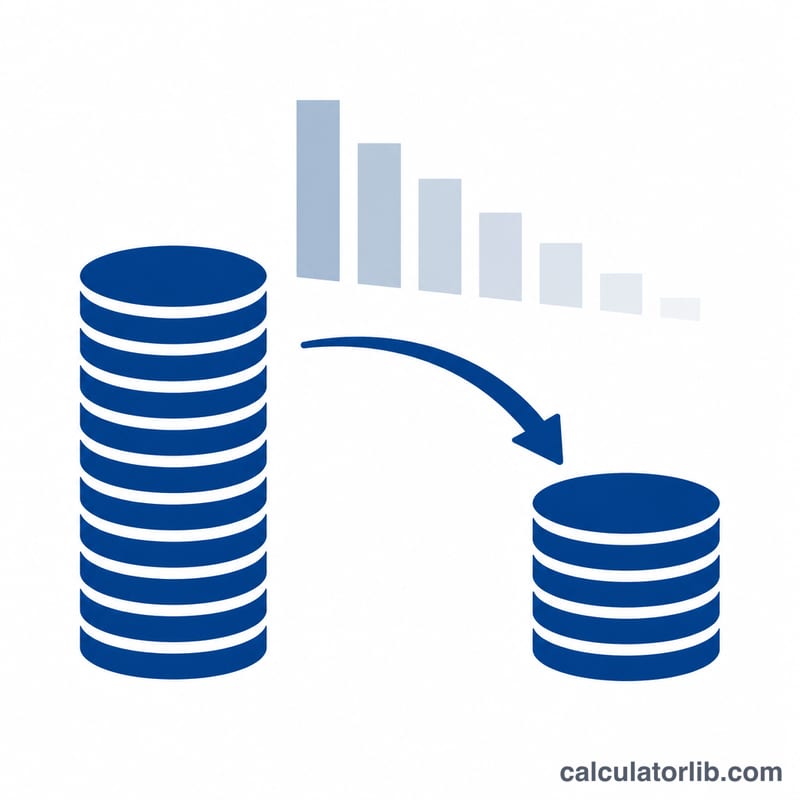
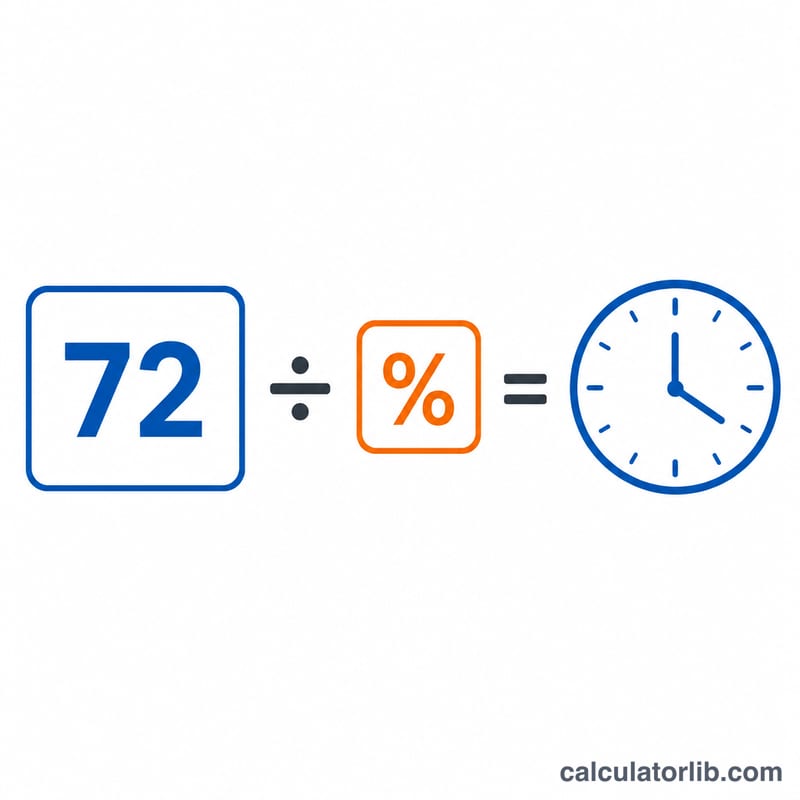
The Rule of 72 is a quick mental-math shortcut for estimating how long it takes a quantity to double — or, in the case of inflation, how long it takes the purchasing power of your money to be cut in half. Simply divide 72 by the annual inflation rate (as a percent) and you get the approximate number of years until your money buys only half of what it does today.
How to Use This Calculator
Enter the expected average annual inflation rate as a percentage (for example, enter 3 for 3%). The calculator instantly divides 72 by that rate to show how many years it takes for your money's real value to halve, plus the equivalent in months.
The Formula Explained
The formula is $$\text{Years} = \frac{72}{r}$$ where r is the inflation rate in percent. It works because of the mathematics of exponential decay: the natural log of 2 is about \(0.693\), and when multiplied by 100 and adjusted for typical rates, 72 becomes a convenient, easily divisible approximation that is accurate for rates roughly between 2% and 10%.
Worked Example
Suppose inflation runs at a steady 4% per year. Dividing 72 by 4 gives 18. That means in about 18 years, money sitting under your mattress would buy only half of what it can today. At 6% inflation, it would take just $$\frac{72}{6} = 12$$ years.
FAQ
Is the Rule of 72 exact? No — it is an approximation. The precise answer uses logarithms, but the Rule of 72 is remarkably close for moderate inflation rates.
Does this account for wage growth or interest? No. It measures the erosion of idle cash. If your savings earn interest above inflation, your purchasing power may not fall at all.
Why 72 and not 70? 72 has many divisors (2, 3, 4, 6, 8, 9, 12), making mental math easy, and it is accurate near commonly observed inflation rates.